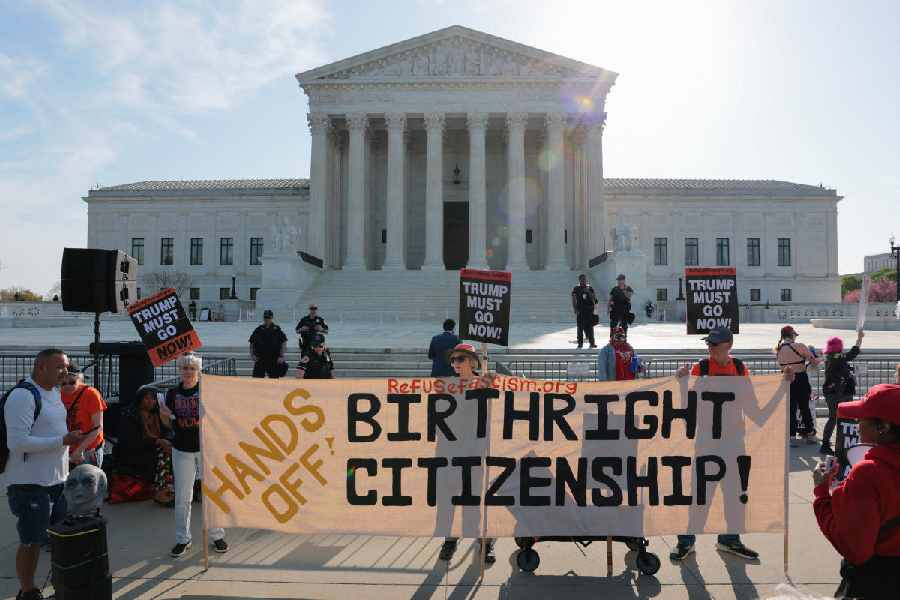
The US Supreme Court is set on Wednesday to consider the legality of President Donald Trump's directive to restrict birth right citizenship in the United States, a contentious plan tied to his efforts to curb immigration that would upend the long-held understanding of a key constitutional provision.
The justices will hear arguments in his administration's appeal of a lower court's decision that blocked his executive order directing US agencies not to recognize the citizenship of children born in the United States if neither parent is an American citizen or legal permanent resident, also called a "green card" holder.
Trump plans to attend the arguments, according to his official schedule. It is believed that he would become the first sitting president to attend arguments before the Supreme Court. He has repeatedly criticized certain members of the court since it struck down on February 20 the sweeping global tariffs he imposed last year under a law meant for national emergencies, going so far as to say he was "sickened" by two justices he appointed during his first term - Neil Gorsuch and Amy Coney Barrett - and called them "an embarrassment to their families."
Trump's directive issued last year violated citizenship language in the US Constitution's 14th Amendment as well as a federal law codifying birth right citizenship rights, the lower court found, acting in a class-action lawsuit by parents and children whose citizenship is threatened by the directive.
Limiting who qualifies for citizenship at birth is a top priority for the Republican president, who issued the order last year on his first day back in office as part of a suite of policies to crack down on legal and illegal immigration. Critics have accused him of racial and religious discrimination in his approach to immigration.
The 14th Amendment has long been interpreted as guaranteeing citizenship for babies born in the United States, with only narrow exceptions such as the children of foreign diplomats or members of an enemy occupying force.
The provision at issue, known as the Citizenship Clause, states: "All persons born or naturalized in the United States, and subject to the jurisdiction thereof, are citizens of the United States and of the state wherein they reside."
The administration has asserted that the phrase "subject to the jurisdiction thereof" means that being born in the United States is not enough for citizenship, and excludes the babies of immigrants who are in the country illegally or whose presence is lawful but temporary, such as university students or those on work visas.
Citizenship is granted only to the children of those whose "primary allegiance" is to the United States, including citizens and permanent residents, the administration has argued. Such allegiance is established through "lawful domicile," which lawyers for the administration define as "lawful, permanent residence within a nation, with intent to remain."
'Birth tourism'
The administration has said that granting citizenship to virtually anyone born on US soil has created incentives for illegal immigration and led to "birth tourism," by which foreigners travel to the United States to give birth and secure citizenship for their children.
An eventual ruling by the Supreme Court endorsing the administration's view could affect the legal status of as many as 250,000 babies born each year, according to some estimates, and require the families of millions more to prove the citizenship status of their newborns.
The 14th Amendment was ratified in 1868 in the aftermath of the Civil War of 1861-1865 that ended slavery in the United States, and overturned a notorious 1857 Supreme Court decision that had declared that people of African descent could never be US citizens. Concord, New Hampshire-based US District Judge Joseph Laplante last July let the challenge to Trump's order by these plaintiffs proceed as a class, allowing the policy to be blocked nationwide.
The challengers have said the Supreme Court already settled the question of birth right citizenship in an 1898 case called United States v. Wong Kim Ark, which recognized that the 14th Amendment grants citizenship by birth on US soil, including to the children of foreign nationals.
The administration contends that the 1898 precedent supports Trump's order because, according to the court's ruling in that case, at the time of his birth, Wong Kim Ark's parents had permanent domicile and residence in the United States.
The Supreme Court is expected to rule by the end of June. The court last year gave Trump an initial victory in the birthright citizenship context in a ruling restricting the power of federal judges to curb presidential policies nationwide. Though arising from early-stage judicial rulings declaring Trump's directive unconstitutional, the court's ruling did not resolve its legality. The court, which has a 6-3 conservative majority, has backed Trump on other major immigration-related policies since he returned to the presidency. It let Trump expand mass deportation measures on an interim basis while legal challenges play out, such as ending humanitarian protections for migrants or allowing them to be deported to countries where they have no ties.