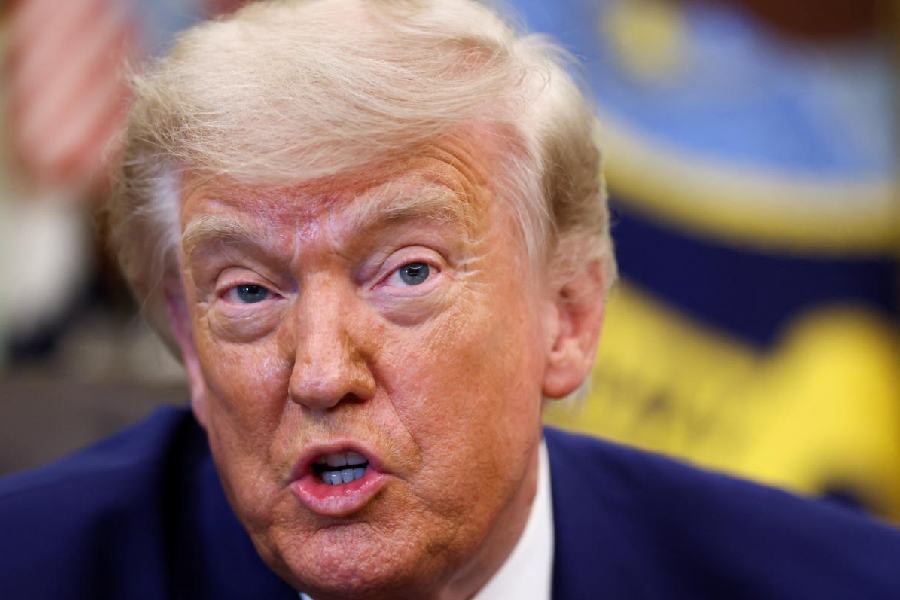
At least 83 times during his campaign to return to power, President Donald Trump pledged to negotiate an end to the war between Russia and Ukraine within 24 hours, even before taking office.
After nearly a year of painful on-again, off-again negotiations, Trump would come to acknowledge a hard reality. As he put it on Sunday after meeting with the Ukrainian President, Volodymyr Zelensky, at Mar-a-Lago: “This is not a one-day process deal. This is very complicated stuff.”
The New York Times spent the year chronicling the hidden story of the negotiations; the ambition, the tenacity, the ideological and personal infighting; the cruelty and the inconsistency that Trump’s campaign pledge wrought; the decisions that Trump and his aides would make, and not make, and their reverberations on the front lines.
Here are six takeaways:
Secret letter
Leaders in West Asia and in Europe heard Trump’s campaign promise and offered to facilitate negotiations with the Russian President, Vladimir V. Putin. Trump was eager to move fast, but his advisers feared a replay of f
our years before: Revelations that some Trump aides had contacts with the Russians during the transition had become part of the Russia investigation that shadowed much of his first term.
To avoid such an outcome, Trump’s pick for national security adviser, Michael Waltz, reached out to Biden aides and asked for a secret letter from the President granting Trump and his team permission to begin talks during the transition.
But Biden refused, telling aides that Trump might make a deal with Russia at Ukraine’s expense, and he did not want to endorse that.
Back channel
Trump appointed his longtime friend Steve Witkoff as Middle East envoy. When Witkoff visited Riyadh to discuss the war in Gaza, the Saudi crown prince offered to introduce him to Kirill Dmitriev, the head of Russia’s sovereign wealth fund, as a secret go-between to begin talks with the Russians.
Trump had already selected Keith Kellogg, one of his longest-serving advisers, as special envoy for Ukraine and Russia. Kellogg was a vocal Putin critic and supporter of Ukraine, and his appointment stirred backlash from Trump advisers who believed his approach would perpetuate the conflict.
As negotiations intensified after the inauguration, Kellogg was increasingly sidelined and Witkoff took centre stage.
Munitions withheld
During the transition, J.D. Vance, the Vice-President, had seeded the Pentagon with like-minded officials who believed that Ukraine was a sinking ship, that after nearly four years of war America could no longer afford to support it. They wanted to redirect support to what they saw as a higher priority — confronting China.
At their urging, Pete Hegseth, Trump’s defence secretary, made a series of unannounced decisions to hold back critical munitions, including 155-millimeter shells, that the Ukrainians needed to defend their lines. “The fewer shells we have, the more casualties we have,” a Ukrainian front-line commander said. “There is a direct correlation.”
Ability overestimated
Trump believed he had an understanding of Putin, that their personal rapport would help him persuade the Russian to cut a deal to end the war. Yet even as the Pentagon withheld munitions and Zelensky made concessions, Putin stiff-armed Trump’s peace proposals and accelerated Russian bombing campaigns on Ukrainian
cities.
Trump grew increasingly frustrated with Putin, lashing out on Truth Social and asking aides, “Do we sanction their banks, or do we sanction their energy infrastructure?” But for months, he did neither.
Secret aid
Many US military and CIA officers remained supporters of Ukraine, and when Trump held off on imposing sanctions, they searched for other ways to choke off the Russian war economy.
Trump had allowed these officers to continue providing intelligence to the Ukrainians for drone strikes on crucial components of the Russian defence industrial base,
including oil refineries. Early efforts had been disorganised, with little impact. But after a CIA expert identified the refineries’ Achilles’ heel — a coupler that, if destroyed, would keep a refinery offline for weeks — the drone
campaign would take off. According to one US intelligence estimate, the energy
strikes would cost the Russian economy as much as $75 million a day.
The CIA would eventually assist with Ukrainian drone strikes on Russian “shadow fleet” vessels in the Black Sea and the Mediterranean.
Ukrainian ‘beauty’
The two Presidents’ relationship seemed to hit a nadir in a blowup in the Oval Office on February 28. Six months later, they had what turned out to be a far-warmer meeting.
Trump would remark to aides that when he owned the Miss Universe pageant, the Ukrainian contestants were often the most beautiful. In August, gathered in the Oval Office with Zelensky, Trump blurted out, “Ukrainian women are beautiful.” Zelensky replied, “I know, I married one.”
Trump then said that an old friend, the Las Vegas mogul Phil Ruffin, had married a former Miss Ukraine, Oleksandra Nikolayenko. He called Ruffin, who put his wife on the phone. Trump did the same for Zelensky.
“You could feel the room change,” said one official who was there, adding, “It humanised Zelensky with Trump.”
New York Times News Service