 |
 |
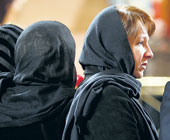
| Tatiana, Yeltsin’s daughter, at the cathedral and (below) his body in the coffin. (AP) |
Moscow, April 24 (AP): Thousands of sombre and teary-eyed mourners shuffled past the open coffin of former President Boris Yeltsin today, lighting candles and crossing themselves to the sound of Orthodox prayers.
Former US Presidents George H. W. Bush and Bill Clinton were to attend tomorrow’s funeral service that culminates with Yeltsin’s burial at the landmark Novodivechy Cemetery. Another prominent foe of communism, Polish Nobel Laureate Lech Walesa, was also scheduled to attend.
Other nations, however, were sending middle-tier diplomats and retired politicians — a reflection both of the funeral’s quick timing but also perhaps of Yeltsin’s uncertain legacy as unsteady democrat, communist scourge and incomplete reformer.
Yeltsin, the first President of post-Soviet Russia who served as one of the pallbearers of the Soviet state, died of heart failure yesterday. He was 76.
Russians queued under overcast skies to pass through metal detectors and the towering metal doors of the Christ the Saviour Cathedral on the banks of the Moscow River. The gold-domed edifice is a replica of the original, which was blown up by the Soviet authorities in 1931 just a few months after Yeltsin’s birth, and rebuilt during his presidency.
Inside, white-robed Orthodox priests chanted prayers and swung censers. Yeltsin’s widow, Naina, and his two daughters sat dressed in black alongside the casket, which was draped in the Russian tricolour in the centre of the cathedral’s nave. An honour guard stood nearby.
Officials estimated that around 4,000 people had paid their respects by early evening.
“I followed Yeltsin as soon as he appeared, I followed him everywhere.... He was the first honest and decent President,” said Taisiya Shlyonova, a 75-year-old pensioner. The mourners were mostly middle-aged or older.
“There are good and bad things about him, but he will remain in history for his one great achievement: he buried communism,” Alexander Bolshakov, a 44-year-old teacher, said as he waited to enter the cathedral.
The Soviet Union was an atheist state, so it seemed fitting Russia’s first post-Soviet president was accorded religious rites.
Though he made appearances at church services, Yeltsin was not regarded as an overtly pious man, but the Russian Orthodox Church was grateful for his support.
“By his strength, he helped the restoration of the proper role of the Russian Orthodox Church in the life of the country and its people,” church spokesman Metropolitan Kirill said in a statement.
Yeltsin’s burial will also break with Soviet traditions. Unlike most of the leaders of the USSR, he will not be interred in the cold formality of the burial ground at the Kremlin walls; instead, his grave will be a plot at Novodevichy Cemetery, a leafy and comforting expanse next to Moscow’s most famous monastery.
It is largely a burial site for dreamers and artists, rather than politicians, including writers Anton Chekhov and Mikhail Bulgakov and composer Sergei Prokofiev. It is also the resting place of Soviet leader Nikita Khrushchev — a maverick with simple tastes and often crude manners, like Yeltsin.