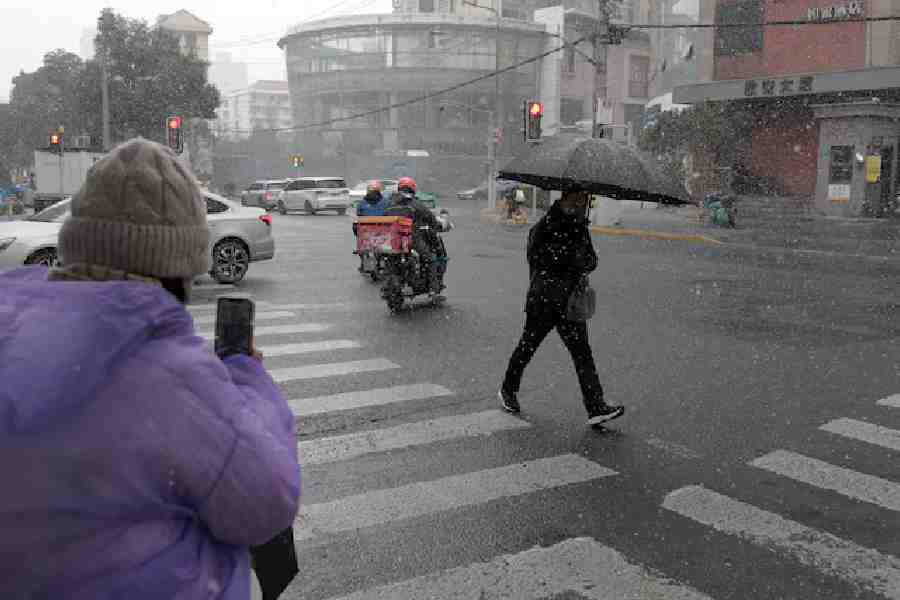
Russia's Far East was buried under metres of snow by its heaviest snowfall in 60 years on Tuesday as a winter blast swept across Asia, dusting Shanghai white and grounding flights in Japan's northwest.
The cold snap disrupted transport across the region, closing roads in China, stranding air travellers in Japan and leaving parts of Russia’s Far East paralysed.
Scientists said the weather was related to waves of cool air coming in from the Arctic, which was simultaneously affecting Eastern Russia and Asia, and a second, affecting Eastern Europe.
"You've got these two simultaneous bursts of cool air coming down from the Arctic due to a waviness in the jet stream," said climate scientist Theodore Keeping, referring to air currents in the upper atmosphere which define weather patterns.
"The Arctic polar vortex, which is this massive cold air which circulates the Arctic is relatively weak right now, and what that means it drives the jet stream less intensely, and that leads to waves of cool air coming down from the Arctic," said Keeping, an extreme weather researcher for World Weather Attribution at London's Imperial College Centre for Environmental Policy.
VAST SNOWDRIFTS IN RUSSIA'S FAR EAST
In Russia’s Far Eastern Kamchatka Peninsula, vast snowdrifts several metres high blocked building entrances and buried cars, after more than 2 metres (6.5 feet) of snow fell in some areas in the first half of January, following 3.7 metres in December, according to weather monitoring stations.
Some vehicles were almost completely submerged, four-wheel drives struggling for traction or immobilised entirely, as residents dug narrow paths through the snow to reach apartment entrances. In the port city of Petropavlovsk-Kamchatsky, locals were filmed walking atop snowbanks beside traffic lights, with some jumping from the drifts for fun.
"It's like a sand dune," resident and blogger Polina Tuichieva said of the mammoth snow in Petropavlovsk-Kamchatsky, 6,800 km (4,200 miles) east of Moscow.
RARE SNOW IN SHANGHAI
The same system swept south into China, where a wave of low temperatures brought rare snowfall to the financial hub of Shanghai as authorities warned the frigid weather could last for at least three days. The east coast city last experienced heavy snowfall in January 2018.
"It was the first time I have seen such heavy snowfall in Shanghai," 23-year-old student Li Meng said.
The wintry scenes marked a sharp reversal from just a week earlier, when Shanghai basked in unusually high temperatures of 20 degrees Celsius (68 degrees Fahrenheit), prompting some osmanthus trees to bloom, local media reported.
"The weather seems rather strange this year," 30-year-old Shanghai resident Yu Xin said. "Last week, it was still over 20 degrees Celsius, but this week it dropped below zero and started snowing. In general, the temperature fluctuations have been quite significant, so some people might feel a bit uncomfortable."
Chinese state media said sharp temperature drops also hit provinces south of the Yangtze and Huai rivers, including Jiangxi and Guizhou. In Guizhou, temperatures are expected to fall by 10 to 14 degrees Celsius, Zhejiang News reported.
As icy conditions spread, authorities shut sections of major roads across 12 provinces — including Shanxi, Inner Mongolia and Heilongjiang — due to snowfall and icy roads, state broadcaster CCTV said.
TRAVEL WARNING IN JAPAN
In Japan, strong winds and heavy snowfall disrupted travel along its northwestern coast, grounding dozens of flights and hitting popular ski regions at the height of winter.
The Japan Meteorological Agency warned that heavy snow would hit northern and western regions between January 21 and 25, urging people to avoid non-essential travel.
ANA Holdings cancelled 56 flights affecting around 3,900 passengers, while Japan Airlines scrapped 37 flights affecting 2,213 travellers. Nearly all of ANA’s cancellations were concentrated at New Chitose Airport near Sapporo in Hokkaido.