China on Monday reaffirmed its territorial claims over the Shaksgam Valley in the backdrop of India's objections, stressing that the Chinese infrastructure projects in the area are "beyond reproach".
India last Friday criticised China's infrastructure development projects in the Shaksgam Valley, saying it reserves the right to take necessary measures to safeguard its interests as it is an Indian territory.
Pakistan illegally ceded 5,180 sq km of Indian territory in the Shaksgam Valley to China in 1963 from areas illegally occupied by it.
“Shaksgam Valley is Indian territory. We have never recognised the so-called China-Pakistan 'boundary agreement' signed in 1963. We have consistently maintained that the agreement is illegal and invalid,” External Affairs Ministry spokesperson Randhir Jaiswal said.
“We also do not recognise the so-called China-Pakistan Economic Corridor, which passes through Indian territory that is under forcible and illegal occupation of Pakistan,” he said.
Reacting to Jaiswal's comments, Chinese Foreign Ministry spokesperson Mao Ning told a media briefing here that "first of all, the territory you mentioned is part of China’s territory".
"China’s infrastructure activities in its own territory are beyond reproach,” she said while responding to a question on India’s criticism.
Mao said China and Pakistan have signed a border agreement and determined the border between the two countries since the 1960s.
These are the rights of Pakistan and China as sovereign states, she said. On India's criticism of the CPEC, Mao repeated Beijing's narrative that it is an economic initiative aimed at local economic and social development and improving people’s livelihoods.
“Such agreement and CPEC will not affect China's position on the Kashmir issue and China’s position remains unchanged in this regard,” Mao said.
According to the sources, around 75 kilometres of the road — believed to be approximately 10 metres wide — has already been completed, with construction continuing at pace.
A report published by The Print claimed that the Chinese People’s Liberation Army (PLA) had earlier constructed a 36-kilometre stretch of the road. “Satellite images show that this new road is linked to two Chinese military posts outside Shaksgam Valley. One of the posts is thought to be the headquarters of the PLA unit operating in the area,” the report said.
China’s official stand on the Kashmir issue, as often reiterated by Beijing, is that “Jammu and Kashmir dispute is left over from history, and should be properly and peacefully resolved in accordance with the UN Charter, relevant UN Security Council resolutions and bilateral agreements”.
In his response to a question on China's infrastructure development in the Shaksgam Valley, Jaiswal said, “The entire Union Territories of Jammu and Kashmir and Ladakh are an integral and inalienable part of India. This has been clearly conveyed to Pakistani and Chinese authorities several times."
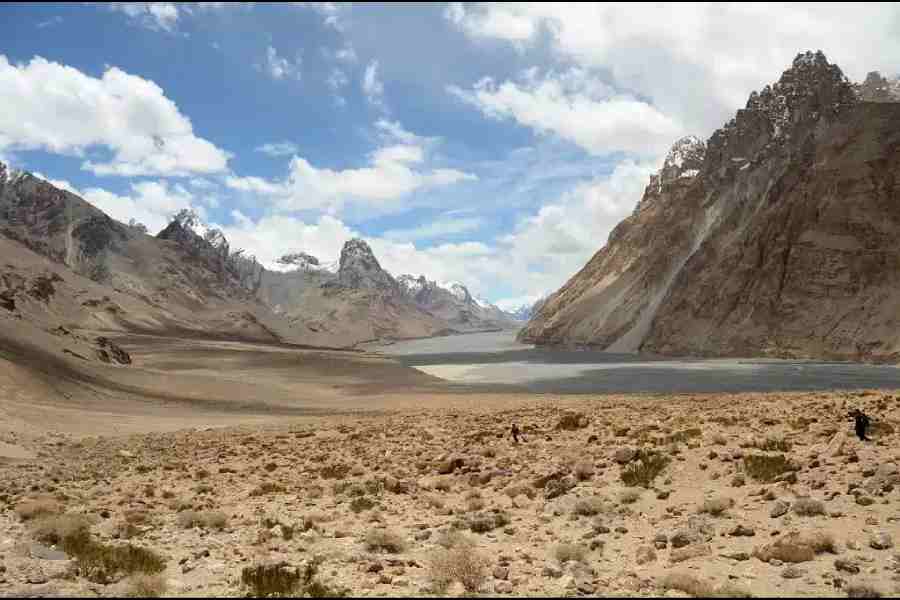
Shaksgam Valley spans around 5,400 sq km and borders China’s Xinjiang province to the north and Pakistan-occupied Kashmir to the south and west. It was ceded by Pakistan to China under a 1963 border agreement, a transfer India does not recognise, maintaining that the valley is part of the erstwhile state of Jammu and Kashmir.