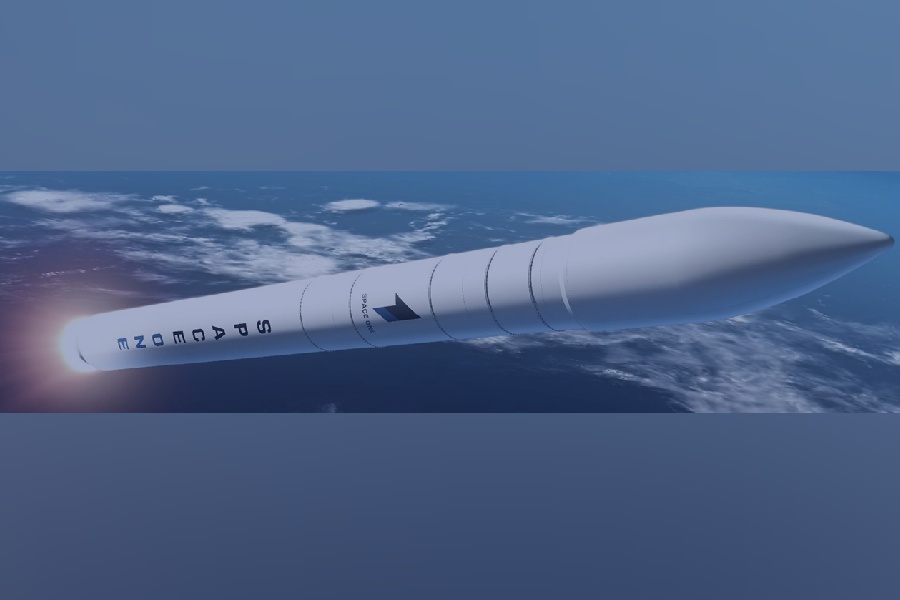
Japan's Space One said its Kairos small rocket self-destructed 69 seconds after lift-off on Thursday, failing to achieve the country's first entirely commercial satellite launch for the third attempt in a row.
Three months after another state-run rocket launch failure, the unsuccessful flight dealt a fresh blow to Japan's efforts to establish domestic launch options and reduce its reliance on American rockets amid rising space-security needs to counter China.
Kairos, the 18-metre (59 ft) solid-propellant rocket, carried five experimental satellites, including from Tokyo-based ArkEdge Space and the Taiwan Space Agency. It ended the flight automatically at an altitude of 29 km (18 miles) above the Pacific.

"No significant abnormalities were found in the flight or onboard equipment" before the self-destruction, Space One's Vice President Nobuhiro Sekino told a press conference, suggesting that the rocket's autonomous flight termination system went wrong.
Live footage showed Kairos flying on a wobbly trajectory within two minutes after blasting off from the company's private launch pad at the tip of the Kii peninsula in western Japan.
Space One, the joint venture backed by optical electronics maker Canon, aerospace giant IHI, builder Shimizu and other Japanese firms, previously failed at two Kairos launches in 2024.
Falling short of targets
Japan has a dearth of homemade launch vehicles despite expanding defence needs and business opportunities for domestic satellite makers.
The country successfully launched only three rockets in 2025, far short of its annual launch cadence target of 30 in the early 2030s.
In December, the failed sixth flight of the state-funded H3 rocket, built by Mitsubishi Heavy Industries, further disrupted the pipeline.
Satellite firms have already tended to tap reliable and affordable US options such as Elon Musk's industry-leading SpaceX for ride-sharing, or small rocket pioneer Rocket Lab for launches from New Zealand.
To ease the bottleneck, the government has granted million-dollar subsidies to Space One and other nascent rocketeers at home.
The defence ministry has signed hefty contracts with startups, including Space One, towards putting dozens of national security satellites in space. But no Japanese company has achieved a satellite launch with a commercially-built rocket.
Also doubling down on rockets in Japan are carmakers, partly to repurpose their combustion engine industry amid electrification.
Last year, Toyota invested in Interstellar Technologies, the first Japanese company that reached outer space in 2019, while Honda conducted a surprise reusable rocket experiment.
Outside the US-China space race, commercial rockets are still in the early stage of development. Startups from Germany, Australia and South Korea test-fired rockets of similar sizes to Kairos last year, but none made it to space.
"Building a launch track record quickly is crucial to competing with global small rocket rivals," said Kota Umeda, research fellow at the Institute of Geoeconomics in Tokyo. "Capturing SpaceX's market will be tough, but Japan already has no shortage of customers seeking to launch small satellites."