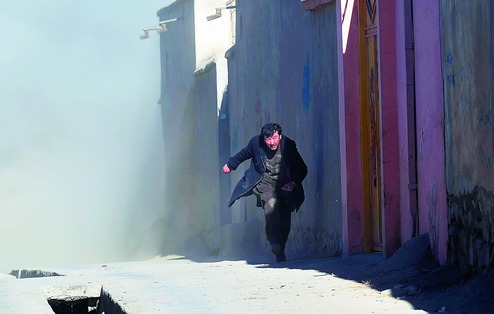

Kabul: Suicide bombers stormed a Shia cultural centre and news agency in the Afghan capital on Thursday, killing more than 40 people and wounding scores, many of them students attending a conference.
Islamic State said in an online statement that it was responsible for the attack, the latest in a series the movement has claimed on Shia targets in Kabul.
Waheed Majrooh, a spokesman for the ministry of public health, said 41 people, including four women and two children, had been killed and 84 wounded, most suffering from burns.
The attack occurred during a morning panel discussion on the anniversary of the Soviet invasion of Sunni-majority Afghanistan at the Tabian Social and Cultural Centre, witnesses said.
The floors of the centre, at the basement level, were covered in blood as wailing survivors and relatives picked through the debris, while windows of the news agency, on the second floor, were all shattered.
"We were shocked and didn't feel the explosion at first but we saw smoke coming up from below," said Ali Reza Ahmadi, a journalist at the agency who was sitting in his office above the centre when the attack took place.
"Survivors were coming out. I saw one boy with cuts to his feet and others with burns all over their faces," he said. "About 10 minutes after the first explosion, there was another one outside on the street and then another one."
Deputy health minister Feda Mohammad Paikan said 35 bodies had been brought into the nearby Istiqlal hospital. Television pictures showed many of the injured suffered serious burns.
The bloodshed followed an attack on a private television station in Kabul last month, which was also claimed by the local affiliate of Islamic State.
Taliban spokesman Zabihullah Mujahid issued a statement on Twitter denying involvement in the attack, which a spokesman for President Ashraf Ghani's office called an "unpardonable" crime against humanity.
Over the past two years, Islamic State in Khorasan, as the local group is known, has claimed a growing number of attacks on Shia targets in Afghanistan, where sectarian attacks were previously rare.
The movement, which first appeared in eastern Afghanistan in 2015, has extended its reach steadily although many security officials question its ability to conduct complex attacks and believe it has help from criminals or other militant groups.
Prior to Thursday's attack, there had been at least 12 attacks on Shi'ite targets since the start of 2016, in which almost 700 people were killed or wounded, according to United Nations figures. Before that, there had only been one major attack, in 2011.
The attacks have increased pressure on Ghani's western-backed government to improve security. Much of the centre of Kabul is already a fortified zone of concrete blast walls and checkpoints, following repeated attacks on the diplomatic quarter. Reuters