India is willing to rebuild ties with Bangladesh with a “forward-looking approach”, Indian high commissioner Pranay Verma conveyed to Prime Minister Tarique Rahman on Monday.
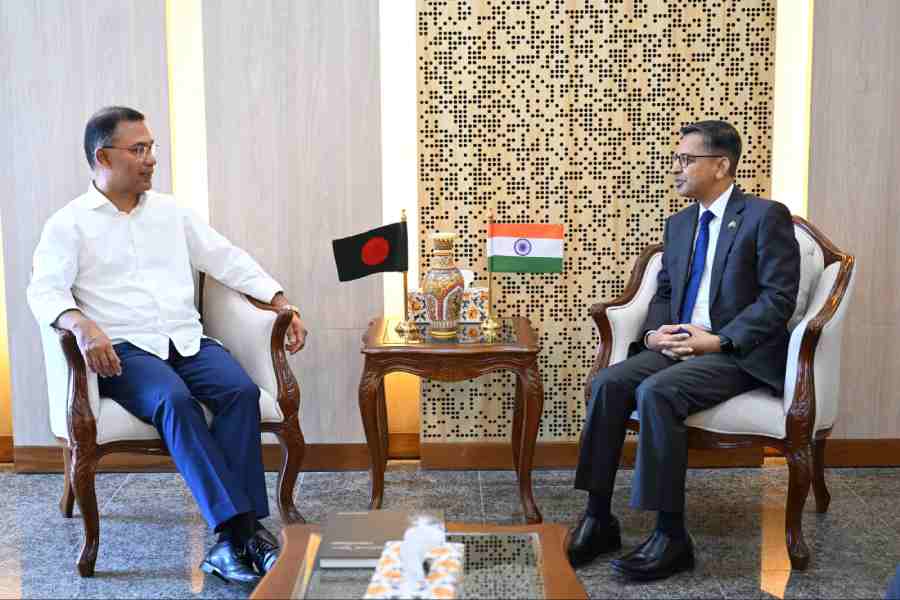
The state-run BSS news agency, quoting a premier’s office spokesman, said Verma paid a courtesy call on Rahman at his Cabinet division office in Bangladesh Secretariat here.
During the meeting, Verma and Rahman "discussed bilateral engagement with a focus on people-centric cooperation in multiple domains aligned with the national development priorities of the two countries," the Indian High Commission said in an X post.
Earlier, Rahman has emphasised Dhaka’s intent to strengthen ties with New Delhi, stating Bangladesh accords "high importance" to its relationship with India.
The high commissioner also conveyed "India’s intent to work together with the Government and people of Bangladesh by adopting a positive, constructive and forward-looking approach and based on mutual interest and mutual benefit."
Officials familiar with the meeting said the envoy told Rahman that India and Bangladesh should transform their geographical proximity into new opportunities through strengthened economy, connectivity and enhanced cultural and people-to-people exchanges.
Bangladesh’s foreign minister Khalilur Rahman, the premier’s foreign affairs adviser Humayun Kabir, and Indian deputy high commissioner to Bangladesh Pawan Badhe were among those present at the meeting.
The high commissioner’s call came a day ahead of Kahlilur Rahman’s planned New Delhi visit, when he is likely to meet his Indian counterpart S. Jaishankar, national security adviser Ajit Doval, commerce minister Piyush Goyal and petroleum and natural gas minister Hardeep Singh Puri.
India has shown its willingness to rebuild ties with Dhaka since the February 12 elections brought Rahman’s BNP to power.
On April 2, Bangladesh's high commissioner to India, Riaz Hamidullah, met Army Chief General Upendra Dwivedi in New Delhi and discussed enhancing defence cooperation between New Delhi and Dhaka.
"Pleased to meet General Upendra Dwivedi, Chief of Army Staff (Indian Army), at South Block and reflected on Bangladesh-India ties, including defence collaboration," Hmidullah wrote on X.
New Delhi-Dhaka relations had come under strain during the tenure of the interim government in Dhaka led by Muhammad Yunus.
But ties have shown signs of improvement following the election of Bangladesh Nationalist Party leader Tarique Rahman as prime minister, with both sides making efforts to reset engagement.
During Yunus’s government, a rise in anti-India rhetoric and strained diplomatic interactions were visible. The Yunus government repeatedly summoned the Indian high commissioner indicating diplomatic strains.
Yunus targeted India for hosting former prime minister and Awami League leader Sheikh Hasina, demanding her extradition and insisting she “keep quiet” while in India and to avoid instigating instability in Bangladesh.
Under the previous government, the Pakistan Army had tried to gain a foothold in Bangladesh, with several top officials from Islamabad visiting Dhaka.
Yunus projected attacks on Hindu minorities as clashes based on personal or political rivalries. Under his administration, reports of atrocities against Hindus and other minorities increased, which Yunus initially dismissed as “exaggerated” or politically motivated.
PM Modi had raised strong concerns regarding the safety of minorities and advised Yunus to avoid shrill rhetoric that was vitiating the environment.
External affairs minister Jaishankar countered Yunus’s “landlocked” comments by highlighting India’s own vast coastline and the Northeast’s role as a connectivity hub.
India ended the transhipment of Bangladeshi exports through Indian territory and temporarily closed visa application centres in several cities due to security concerns.
Under Rahman, who has a Bangladesh First policy, New Delhi and Dhaka have restarted working together, as the two countries share common security goals, especially when it comes to the BBIN (Bangladesh, Bhutan, India, Nepal) region and the Indian Ocean.
India and Bangladesh have also been looking at common maritime and energy security goals, with Dhaka participating in the ongoing IOS SAGAR exercise that was flagged off from the Naval Dockyard in Mumbai on April 2.
Earlier, on February 18, Lok Sabha Speaker Om Birla had attended the swearing-in ceremony of Bangladesh's new Prime Minister Tarique Rahman in Dhaka and conveyed a personal invitation from Prime Minister Narendra Modi to visit India at the earliest convenience.
Birla extended warm congratulations to Tarique Rahman and reiterated that India stands ready to support Bangladesh's efforts to build a democratic, progressive, and inclusive nation. He also reaffirmed India's commitment to strengthening the enduring partnership between the two neighbouring countries.