India and the European Union are expected to announce progress on an ambitious free trade agreement, finalise a strategic defence pact and outline a mobility framework at summit-level talks scheduled for Tuesday.
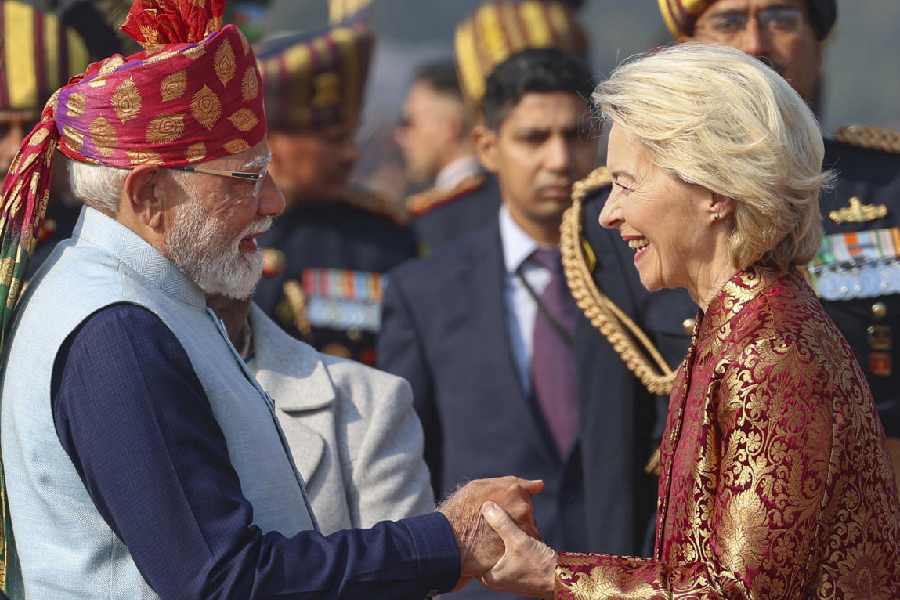
PM Modi will host European Commission President Ursula von der Leyen and European Council President Antonio Costa at the meeting, which is expected to produce a broader roadmap for cooperation amid global geopolitical uncertainty triggered by shifts in Washington’s trade and security policies.
Costa and von der Leyen were the chief guests at India’s 77th Republic Day celebrations at Kartavya Path on Sunday.
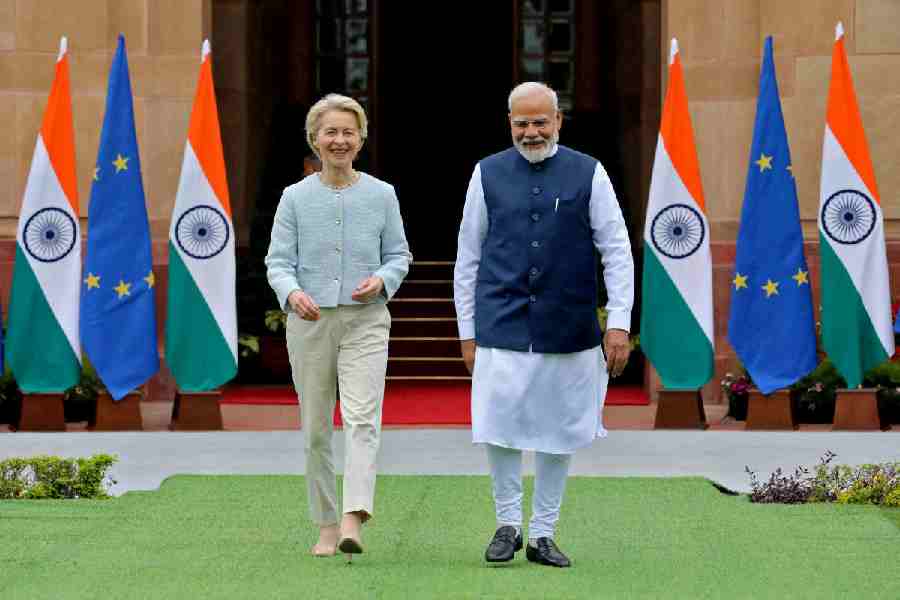
“A successful India makes the world more stable, prosperous and secure. And we all benefit,” von der Leyen said on Monday.
The European Commission President said last week that India and the EU were on the cusp of a “historic trade agreement” that could create a combined market of nearly two billion people, accounting for almost a quarter of global GDP.
Negotiations for the India-EU free trade agreement were first launched in 2007 but were suspended in 2013 due to differences over the scope and ambition of the deal. Talks were formally relaunched in June 2022.
Officials on both sides have said the proposed FTA is expected to significantly deepen bilateral engagement across sectors, including trade, technology, clean energy and supply chains.
The summit is also expected to reaffirm strategic alignment between New Delhi and Brussels as both sides seek to navigate evolving global economic and security challenges.
The broad focus of the summit will be on trade, defence and security, climate change, critical technologies and strengthening the rules-based global order.
Besides firming up the free trade agreement, the two sides are set to unveil a defence framework pact and a strategic agenda at the summit.
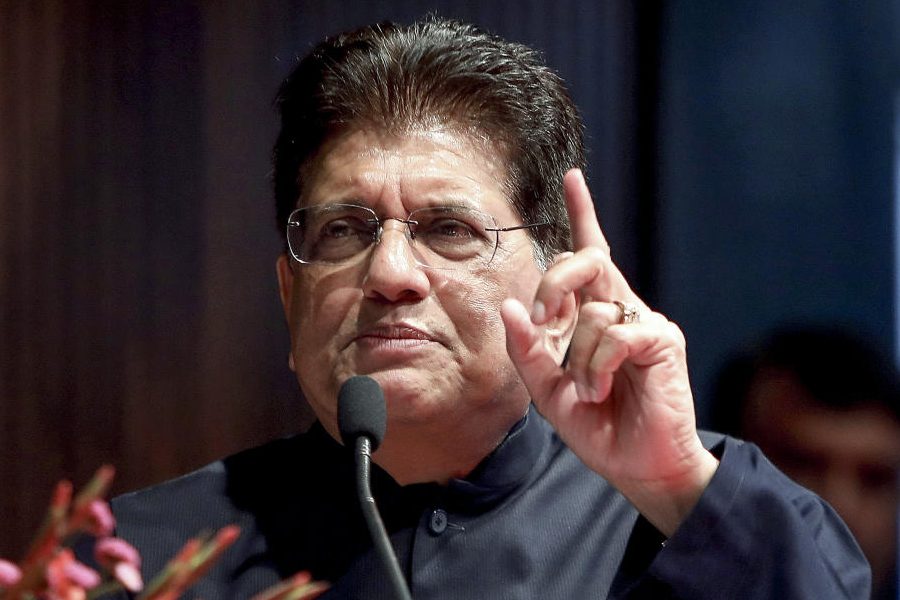
India and the European Union have been strategic partners since 2004.
The proposed Security and Defence Partnership (SDP) will facilitate deeper defence and security cooperation between the two sides, officials said.
The SDP will bring interoperability in the defence domain and will open up avenues for Indian firms to participate in the EU's SAFE (Security Action for Europe) programme.
The SAFE is the EU's Euro 150 billion financial instrument designed to provide financial support to member states to speed up defence readiness.
At the summit, India and the EU are also set to launch the negotiations for a Security of Information Agreement (SOIA).
The SOIA is expected to boost industrial defence cooperation between the two sides.
The memorandum of understanding on facilitating the mobility of Indian workers to Europe is expected to be another key outcome of the summit.
It will provide a framework for advancing mobility initiatives by EU member states with India, the officials said.
France, Germany and Italy are among the European nations that have migration and mobility partnerships with India.
The two sides are also expected to ink a number of agreements to provide for deeper cooperation in several other sectors.
They are also likely to deliberate on the pressing global challenges, including the Russia-Ukraine war.
While the two sides don't see eye-to-eye on everything, they do share a core set of interests which include having a stable international order, European officials said last week.
The summit will also be an opportunity to discuss with India "Russia's war of aggression against Ukraine", they said.
President Costa will reiterate the message that this war represents an existential threat for Europe and poses a direct challenge to the rules-based international order and that it has clear consequences also in the Indo-Pacific, the officials noted.
The ties between India and the EU have been on an upswing over the last few years.
The EU, as a bloc, is India's largest trading partner in goods. For the financial year 2024-25, India's total trade in goods with the EU was worth about USD 136 billion, with exports around USD 76 billion and imports at USD 60 billion.