The Federal Communications Commission said on Friday it had approved SpaceX’s request to deploy another 7,500 second-generation Starlink satellites, significantly expanding the company’s global broadband footprint.
The approval allows Elon Musk’s SpaceX to operate a total of 15,000 Gen2 Starlink satellites worldwide. The FCC also cleared upgrades to the satellites, operation across five frequency bands, and waived earlier limits that restricted overlapping coverage and capacity.
The agency said the additional satellites would enable direct-to-cell connectivity outside the United States and supplement U.S. coverage, supporting next-generation mobile services and internet speeds of up to 1 gigabit per second.
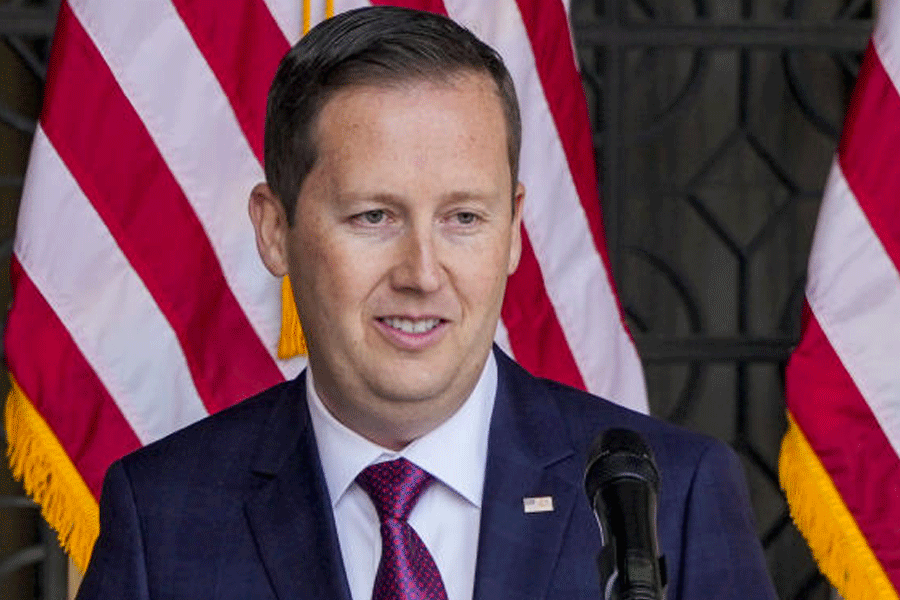
“This FCC authorization is a game-changer for enabling next-generation services,” FCC Chair Brendan Carr said. “By authorizing 15,000 new and advanced satellites, the FCC has given SpaceX the green light to deliver unprecedented satellite broadband capabilities, strengthen competition, and help ensure that no community is left behind.”
SpaceX has sought approval for nearly 30,000 satellites, but the FCC said it was deferring authorisation for the remaining 14,988, including those proposed for operations above 600 km.
The FCC said SpaceX must launch 50% of the maximum number of authorized Gen2 satellites, place them in assigned orbits, and operate them no later than December 1, 2028, and SpaceX must launch the remaining satellites by December 2031. It must complete deployment of the 7,500 first-generation satellites by late November 2027.
Last week, Starlink said it would begin a reconfiguration of its satellite constellation by lowering all of its satellites orbiting at around 550 km (342 miles) to 480 km over the course of 2026, a move to increase space safety. Starlink said in December that one of its satellites experienced an anomaly in space, creating a "small" amount of debris and cutting off communications with the spacecraft at 418 km in altitude, a rare kinetic accident in orbit for the satellite internet giant.
SpaceX has become the world's largest satellite operator through Starlink, a network of about 9,400 satellites beaming broadband internet to consumers, governments and enterprise customers.
The predecessor of FCC chief Carr, Jessica Rosenworcel, urged in 2024 more competition to SpaceX's internet satellite constellation Starlink, noting at the time that Starlink controlled nearly two-thirds of all active satellites.