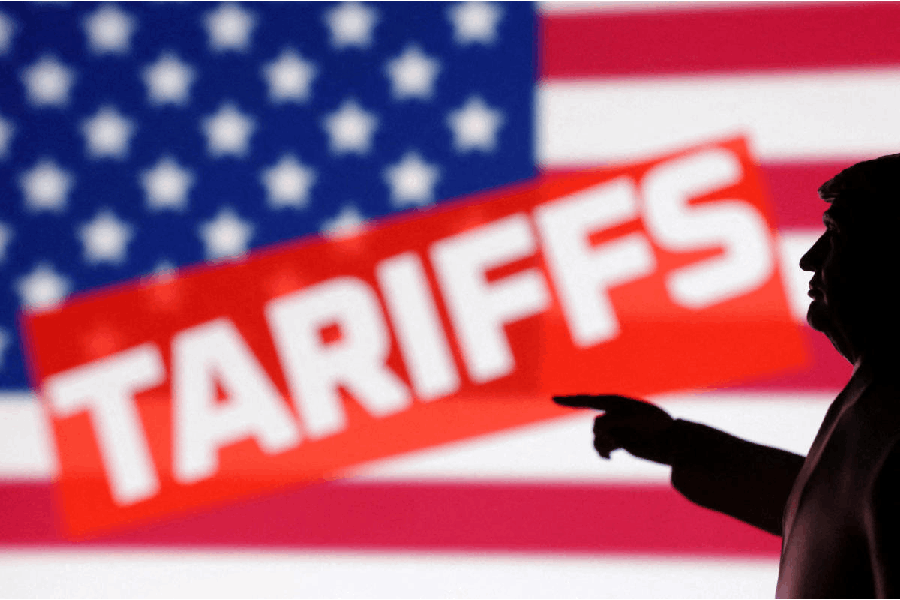
US President Donald Trump said on Wednesday that imports from countries supplying Iran with military weapons will face immediate 50% tariffs with no exemptions, threatening the move just hours after agreeing to a two-week ceasefire with Tehran.
After more than five weeks of strikes against Iran's missile launchers, military sites and weapons industry, Trump reverted to tariffs as leverage, using a social media post to warn China and Russia against restocking Tehran's arsenals.
Beijing and Moscow have denied supplying any weapons recently, although allegations against Russia have persisted.
But the US Supreme Court stripped Trump of his fastest and broadest tariff authority, the International Emergency Economic Powers Act, in February, ruling that his broadest global tariffs imposed under the 1977 law were illegal.
"A Country supplying Military Weapons to Iran will be immediately tariffed, on any and all goods sold to the United States of America, 50%, effective immediately, There will be no exclusions or exemptions! President DJT," Trump wrote on the Truth Social site, without naming any countries.
China and Russia have helped Iran build military capacity to counter US and Israeli pressure, including by supplying missiles and air-defense systems. That support appeared capped during the US-Israeli strikes on Iran.
'A China-related threat,' Lipsky says
Reuters reported in February, prior to the first US and Israeli strikes on Iran, that Tehran was considering a purchase of supersonic anti-ship cruise missiles from China.
Reuters reported in March that China's top semiconductor maker, SMIC, had sent chipmaking tools to Iran's military, according to two senior Trump administration officials.
"This is a China-related threat, the way I read it. And China will read it that way," said Josh Lipsky, vice president and chair of international economics at the Atlantic Council.
Although drone and missile parts routinely flow from Chinese entities to Iran, evading US sanctions, Lipsky said Trump was unlikely to follow through with new tariffs in the near term because that would derail his planned trip to Beijing to meet with Chinese President Xi Jinping.
China's defense ministry spokesperson Zhang Xiaogang on Thursday denied reports of Chinese firms providing Iran with chip equipment and satellite imagery.
"China has always been open and above board on the Iran issue, maintaining an objective and impartial stance, and has consistently worked to promote peace talks while never engaging in any activities that could fan the flames or add fuel to the fire," Zhang said in a statement.
"The international community can clearly see who is saying one thing and doing another, and who is creating war and conflict everywhere."
On Tuesday, US Trade Representative Jamieson Greer said Trump wanted to preserve stability in US-China ties, safeguarding US access to Chinese rare-earth minerals while maintaining prior tariff levels and avoiding a "massive confrontation" with Xi.
Alternative tariff tools
Of Trump's still available trade tools, an active "Section 301" unfair trade practices action against Chinese goods from his first term would be the most likely vehicle for adding new tariffs quickly, Lipsky said.
A more limited tool would be Section 232 of the Cold War-era Trade Expansion Act of 1962, aimed at protecting strategic domestic industries on national security grounds, but it would limit duties to specific sectors.
Trump's tariffs on Chinese goods over nearly eight years already have cut US imports from China sharply, from a peak of $538.5 billion in 2018 to $308.4 billion in 2025, with further declines in January and February.
Russia has been another source of arms technology for Iran, but US imports of Russian goods also have shriveled since the invasion of Ukraine in 2022 and financial sanctions imposed on Moscow as a result of that move.
US imports from Russia, one of the only countries not subject to Trump's now-cancelled "reciprocal" tariffs, jumped 26.1% to $3.8 billion in 2025. These imports are dominated by palladium used in automotive catalytic converters, fertilizers and their ingredients, and enriched uranium for nuclear reactors.
The Commerce Department is moving to impose punitive tariffs on Russian palladium after an anti-dumping investigation.