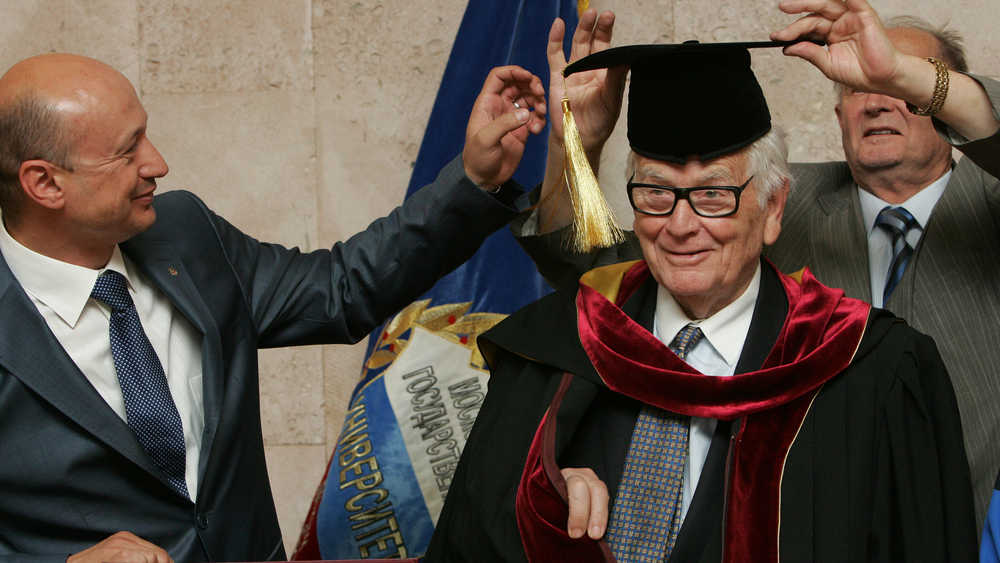
Pierre Cardin, the visionary designer and licensing pioneer who invented the business of fashion as it is conducted today, has died.
He was 98.
His death was confirmed on Tuesday by the French Academy of Fine Arts. He died at the American Hospital in Neuilly-sur-Seine, just outside Paris, his family said, according to Agence France-Presse.
“Fashion is not enough,” Cardin once told Eugenia Sheppard, the American newspaper columnist. “I don’t want to be just a designer.”
He never was just that. He clothed the famous — artists, political luminaries, tastemakers and members of the haute bourgeoisie — but he was also a merchant to the masses with an international brand, his name affixed to an outpouring of products, none too exalted or too humble to escape his avid eye. There were bubble dresses and bath towels, aviator jumpsuits and automobiles, fragrances and ashtrays, even pickle jars.
Planting his flag on the Rue du Faubourg Saint-Honoré in Paris, he proceeded to turn the country’s fashion establishment on its head, reproducing fashions for mass, ready-to-wear consumption and dealing a blow to the elitism that had governed the Parisian couture.
“He had this wonderful embrace of technology and was in love with the notion of progress,” said Andrew Bolton, the head curator at the Costume Institute of the Metropolitan Museum of Art in New York.
In 1958, Cardin put models in helmets matched with tiny skirts and coloured stockings. He dressed men, and women, in spacesuits. “The dresses I prefer,” he said at the time, “are those I invent for a life that does not yet exist.”
His designs were influenced by geometric shapes, often rendered in man-made fabrics like silver foil, paper and brightly coloured vinyl. The materials would shape the dominant aesthetic of the early 1960s.
“His ability to sculpt fabric with an architectural sensibility was his real signature,” he added. Cardin drew inspiration from everywhere, be it the pagodas he visited in China, Op Art painting or automotive design.
“I’m always inspired by something outside, not by the body itself,” he told The New York Times in 1985.
Clothing, he said, was meant “to give the body its shape, the way a glass gives shape to the water poured into it”.
Yet his men’s ready-to-wear designs, introduced in 1960, were decidedly more faithful to the body’s outlines. Built on narrow shoulders, high armholes and a fitted waist, they were streamlined and somewhat severe, dispensing in some cases with traditional collars in favour of the simple banded Nehru, a namesake adaptation of the style worn by the Indian Prime Minister.
Those suits were slow to catch on in the US — until the Beatles appeared in knockoff versions on the Ed Sullivan television show in 1966. Nehru-mania ensued.
Cardin had laid the foundations for a global empire by the late 1950s. At a time when France was fashion’s uncontested epicentre, he was bringing his designs to Moscow, Tokyo and Beijing, doing more to erode global boundaries than any designer of the day.
New York Times News Service