 |
| ... I spoke about Swami Vivekananda and his concept of ‘Daridranarayan’. Also Mahatma Gandhi’s concept of trusteeship, which is a huge concept in social responsibility. And later on, Mother Teresa, and her saying, ‘love is all that you can give and you can take’Swati Gautam |
A Xaverian from Calcutta recently represented Asia at the Eighth World Union of Jesuit Alumni Congress in South America. The global congress is held every four years and moves from continent to continent. The last one was held in Africa in 2009. This year, it was South America’s turn and Medellin, the second-largest city in Colombia after capital Bogota, was the venue for the five-day event that started on August 14. The theme this year was “Jesuit education and social responsibility: how can we serve?”
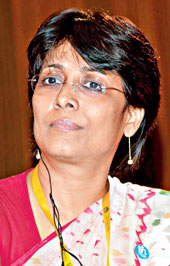
Calcutta-based entrepreneur Swati Gautam was nominated by the Jesuit Alumni Associations of India (JAAI) to deliver one of the seven keynote addresses. The first speaker was the Father General of the Society of Jesus, Adolfo Nicolas SJ. That apart, North America sent motivational speaker Chris Lowney, Europe sent entrepreneur Gunter Pauli from Belgium, Africa sent a Jesuit priest from the Central Africa Province and host continent South America was represented by economist José Antonio Ocampo and Carlos Raul Yepes, the president of Colombia’s largest bank.
“From Asia they, therefore, wished to have a lady speaker. They also wished very clearly to have a non-Christian, for the non-Christian point of view,” said Gautam, who is just back home after a month-long trip that took her to the depths of the Amazon and beyond. The St. Xavier’s College alumnus of the 1990 batch and later faculty member in mass communication and marketing communication spoke to Metro about getting selected, preparing her speech and the “mind-altering experience” in Colombia.
“To be nominated, one had to be well-versed not just with the Jesuit movement but also with one’s Jesuit surroundings. One could be a very committed Xaverian but not be aware so much of the Jesuit inputs. I’ve always had an interest in spirituality and religions and was thus very aware of the Jesuit movement,” said Gautam.
Next came the tall task of writing her speech. “My topic was ‘how to help the most needy’. It was as simple as this. It gave me a chance to really speak about Indian culture and all that it encompasses,” she said. In her hour-long address, Gautam spoke about how “living in harmony and giving and taking” had been a part of Indian culture for very long. “Our villages were very self-sustaining, through history. That model could only function if there was social responsibility, where the seniors of the village would take care of the needy and the needy would in turn do their bit.”
According to Gautam’s research, this “give and take” continued till the colonial period, “when the British broke up our economy, to facilitate the integration of the village to the city and enable them to take away more raw materials”.
“Then I spoke about Swami Vivekananda and his concept of ‘Daridranarayan’. Also Mahatma Gandhi’s concept of trusteeship, which is a huge concept in social responsibility. And ,later on, Mother Teresa, and her saying, ‘love is all that you can give and you can take’. All of this I set against the basic Hindu Vedant philosophy of non-dualism. One of our Brahma vakyas is aham brahmasmi or ‘I am divine’. So, if I am divine and everything too is divine, where is my problem in being of service to the other? It makes service a very simple task.
“Then arises the question, how do we identify the really needy. While preparing my speech, I drew heavily from the Bhagwad Gita. It says, you do not identify the needy by judging someone as ‘worthy’ or ‘unworthy’. I also consulted the Jataka tales for their simple but profound messages.”
All this was fine, but as Gautam pointed out, “a lot of things in my address were not seemingly in consonance with Christian values. And the audience comprised people from many countries, predominantly Catholic, if not by definition, then definitely by practice. A large number of people were very conservative priests from Latin America, Rome and elsewhere”.
But Gautam needn’t have worried. “When I was speaking, there was a lot of hushed silence, and I truly wondered what was happening, whether I was letting everything down! But the outpouring of acknowledgement later and the hundreds of namastes — and the many, many keen questions in the interactive session — that came towards me and all the other 15 Indian delegates showed me that there is a set of people in this world today who are genuinely interested and willing to explore human values and religion in spirit and not just in letter. It was pretty much a mind-altering experience,” she smiled.