 |
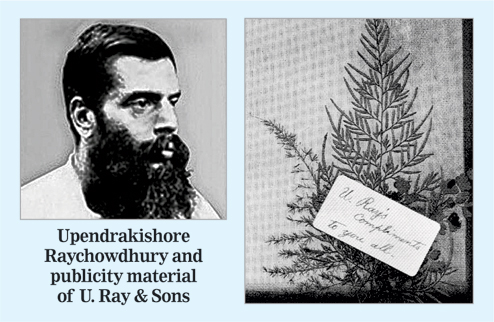
Half-tone was invented in 1873, and between 1897-1912, Upendrakishore Raychowdhury (born on May 10, 1863), who was an internationally recognised pioneer in the field of photographic reproduction on a mass scale and is credited with inventing one of the key components of the half-tone process, had contributed nine research-oriented articles to The Penrose Annual.
According to experts, three of these are of significance — The Theory of Half-tone Dot (1898), The 60 degree Cross-line Screen (1905-06) and Multiple Stops (1911-1912). Upendrakishore had patented the automatic screen adjustment indicator which printers had the option to buy along with Penrose equipment, as it made processing an automatic operation rather than one dependent on human intervention.
Upendrakishore is remembered for his contribution to children’s literature. He had written classics like Sekaler Katha, Tuntunir Boi and Chheleder Ramayan and used to edit Sandesh, the popular magazine for children. His experiments and attainments in the field of process work, that is mass reproduction of photographs, and his academic papers on this subject are eclipsed by his enormous success as a writer. Upendrakishore’s Penrose essays — all nine of them — have been brought together for the first time in a single slim volume titled Essays on Half-Tone Photography, Upendrakishore Raychowdhury, by Jadavpur University. What makes the volume valuable is that it is a facsimile of the essays as they appeared in Penrose’s Pictorial Annual, a London-based periodical on the graphic arts.
The volume includes a translation of an article by Siddhartha Ghosh, a historian of science, sports, crime and science fiction. It is titled Graphic Technology and Upendrakishore. In his own lifetime, a printing expert from abroad had commented that Upendrakishore’s contribution was far more original than that of his counterparts in Europe and America, “which is all the more surprising when we consider how far he is from hub-centres of process work”.
In the Editor’s Note William Gamble had written: “My readers will miss this year an article from the classical pen of Mr U. Ray, B.A., on the principles of the half-tone process, which he has so deeply investigated. From correspondence I have had with Mr Ray, I know that up to the last moment he had intended to prepare an article, but a painful illness, necessitating his complete cessation from work and retirement to a health resort, compelled him to abandon the idea, and he was only able to instruct his staff to send us some of the blocks produced by his method. I fortunately have his permission, however, to make some notes concerning his methods, from documents he has sent my firm in regards to his patents. Mr Ray is evidently possessed of a mathematical quality of mind and he has reasoned out for himself the problems of half-tone work in a remarkably successful manner.”