 |
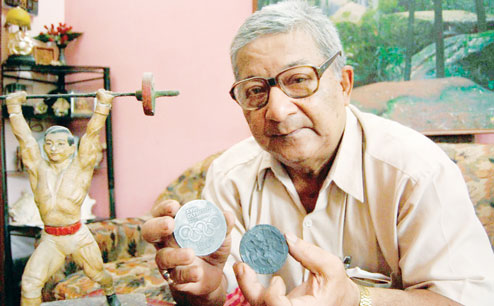
| Laxmi Kanta Das with his Olympic participation medals and (below) outside the Tokyo Olympic stadium. Pictures by Gopal Senapati |
When the Indian hockey team regained the Olympic gold in Tokyo, 1964, a picture of the on-field celebrations came out in the newspapers — of a young Indian whirring a broken umbrella over his head. That was Laxmi Kanta Das, a 26-year-old weightlifter from Shibpur, Howrah. “The moment the final whistle blew, wrestler Maruti Mane and I leapt on to the field. I must have broken the umbrella in my hand while running around,” Das grins.
Sweet was the taste of revenge. In Rome, four years ago, India had lost to Pakistan in the final. “Claudius fought valiantly, yet we couldn’t equalise that one goal.” Later when the Indians were trudging back to the Games village, they were overtaken by jubilant Pakistanis, who shouted slogans on seeing the Indians. “They really had rubbed salt into our wounds.”
Thankfully, Das did not lose his head and lunge at them. He had just lifted 130kg in clean and jerk, 95kg in snatch and 90kg in military press. Flinging a few men would have come easy for the weightlifter who came 12th. Today at 74, the 11-time national champion walks slowly, often with support. Yet the squat, stocky figure can be made out to be a powerhouse.
 |
Bengal ruled in weightlifting in those days. “We would win six-seven of the eight events at the Nationals,” he smiles. But there was little support for the amateurs before international events. “Even if a coach was provided, we had to attend the training camp with our own money.”
Only the hockey players were treated like princes, followed by the footballers. It was with three footballers from Bengal — P.K. Banerjee, Chuni Goswami and Arun Ghosh — that he had joined the Rome-bound contingent. “Officials treated the rest of us like dirt, ridiculing us for our rural backgrounds.”
He remembers how the chartered flight had to wait for the queen of Patiala who was stuck at the immigration counter. “She was carrying so many ornaments that the government ordered an inventory. It was suspected that the native state royals sold their jewels abroad.” They used to take part in events like shooting and took family along.
The Games village was an overwhelming experience for the Howrah boy. “So many players and such glittering shops all around! Omega watches were selling at a discount. The four of us went over. On the way, a man was shadow-boxing alone on the road. PK loved to speak to people. He went up and asked: ‘You must be a boxer?’ ‘Yes. My name is Cassius Clay,’ he replied. We later saw him in the ring, dancing like a butterfly, stinging like a bee. He became famous at that Olympic.”
 |
 |
| Milkha Singh and Mohammad Ali, whom Das met at the Rome Olympics, where they shot into fame |
He remembers seeing Wilma Rudolph, a former polio patient, set the track ablaze with three golds. Then there was the Ethiopian Abebe Bikila, winning the marathon barefooted. But one experience that broke his heart was seeing Milkha Singh run. “Our seats were behind the starting line. So seeing him finish from the distance, we erupted in joy, certain he had won something,” he shakes his head, recounting how the bronze medal slipped away despite Singh breaking the Olympic record.
There was a big stir when Sophia Loren came. Das didn’t care. “With electricity still to reach Shibpur, where would we see films? But our manager David Abraham (Cheulkar), who used to act in Hindi films, followed her around leaving me to fend for myself.” The weighing machines were all marked in Roman. Unaware of how much he was putting on, the man, who cooked for himself at home to avoid spicy food, got tempted by the delectable spread at the Games village.
With four days to go, when he cornered David to check his weight, the reading was 61.5, a kg and half more than the upper limit in his category. Even after surviving for days on fruit juice, Das found himself to be 400g overweight on D-Day morning. “Skipping breakfast and lunch, I locked myself into the steam room and jogged. By evening, when the weights were checked, I was okay, but the food packet I had kept in the warm-up room was gone.” So off he went to lift on nothing but tap water. “Wish I did not have to struggle with my bodyweight. I could have competed better.”
He remembers the Tokyo Olympics for the colourful inauguration and the Emperor. “Emperor Hirohito declared the Games open and left word that he would be back as audience only if Japan was certain to win. And it happened in my event. When (Yoshinobu) Miyake won, he came to our warm-up room to congratulate him. The Japanese are not supposed to look at the face of the Emperor, as he is said to be a descendant of the Sun. Everyone was bowing.”
This Olympic, Das has watched India’s Soniya Chanu in action. “I liked her style.” Coaching at his own club since he quit in 1969, Das is happy that the government invests so much in Olympic training but is sad that so few are coming into sports from Bengal. “Youngsters go to gyms to look good, not to compete in sports. The few who come, do so to secure a job and quit sports as soon as they do.”
Next door to Das’s one-storeyed home is Mallikbagan math, the venue of weightlifting and body-building leagues over the years. Construction materials lie piled on one side of it. “Some landshark must have grabbed it,” he sighs.