 |
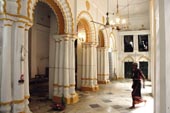
| The thakurdalan of the Dattas near Raja Subodh Mullick Square. Picture by Bishwarup Dutta |
A few years ago, I had met Jenny Balfour-Paul, an authority and writer on indigo, at a seminar on textiles, and subsequently, she had sent me the photocopy of an illuminated letter written in 1850, perhaps on its first month, by a British adventurer to his mother.
It contained an account of his stay in Calcutta which he dubbed “The City of Pale Faces”. He stayed in Wellesley Street and visited north Calcutta, where, apart from the punkhapullers, men carrying corpses tied to bamboo, and women with pitchers balanced against their midriff, he came upon a brick-and-mortar structure, that must have been a novelty for him. He left a visual record of all this.
Calcutta historian Debasish Basu identified the structure as the thakurdalan of Akrur Datta’s family close to Raja Subodh Mullick Square. He also added in the same breath that it had been demolished recently. I had visited this thakurdalan in 1983 but had no photograph of it. Sure enough, a block of flats had come up on that spot at 18/4 Akrur Datta Lane.
It was only recently that I discovered by chance that not only is the thakurdalan intact but Durga puja is still held there annually. I met Raka Datta at a book launch she organised, and putting two and two together, I figured out that her in-laws were the Dattas of Wellington Square.
The Dattas were a typical up and coming family of that age. Akrur Datta, the pater familias, was born in 1720 in Sonatikri village near Mogra railway station in Hooghly district. He came to Calcutta in 1740 and started a joint venture with Pritiram Marh, the father-in-law of Rani Rashmoni, and became enormously rich.
Later, he became a contractor for the supply of sloops to ferry the East India Company’s goods from ships. He constructed a house at 1 Rajen Datta Lane, where his family lived.
Rajinder Narain Datta, Akrur’s great grandson, was an illustrious member of the family. He went to Drummond’s Dhurrumtolla Academy and Hindu College, and in spite of celebrating Durga puja, was against orthodoxy. He had mastered English, Greek, Latin, Italian, French and Hebrew for the privilege of reading early Christian texts.
Considered the “father of homoeopathy in India” he had treated the Maharaja of Jaipur, Raja Radhakanta Deb, Jyotirindranath and Satyendranath Tagore and Ramakrishna when he had throat cancer.
Like Ramdulal Dey (Sircar) of Chhatubabu Latubabu fame, Rajinder and his uncle Kalidas started a flourishing shipping trade with the Americans and like Akrur, were banians.
Rajinder was close to Charles Eliot Norton, an American who began his career in the Indian trade and later became a Harvard university academic.
Norton felt the Wellington Square house was “ill-situated, large and inelegant on the outside. Within, the rooms which are generally very small, are built around an open square court; about the second storey runs a veranda with which the upper chambers communicate. All looks uncared for…”
But for Durga puja “the open (courtyard) was covered with a fine carpet and hung with lights which gave it the brilliancy of a ballroom.” Norton was among the European and Americans invited to the Durga puja at the Datta home in which 200 people lived.
The family founded Savitri Library in 1879. Its collection has been donated to Bangiya Sahitya Parishad.
I met the present generation of the Dattas at their 1 Raja Subodh Mullick Square house, a multi-storeyed building, where their stables and library was once located.
Sanat Kumar Datta, separated from Akrur by seven generations, said the family once owned properties in Clive Street, Canning Street and on Strand Road, where the Jessop’s dry dock was situated.
Once this used to be a 200-strong family. Now only two branches of the Dattas live there. His son Samit took me to the thakurdalan behind the flats. This is debuttar property belonging to the deities. After the front half of the structure was handed over to the developer, the funds it generated were used to repair it.
It was in bad shape, and about eight years ago, the first of the double row of five elegant lime-and-surki arches had to be knocked down and replaced with cement ones. The roof too was repaired. The crescent-shaped staircase is paved with marble now.
On the right of the thakurdalan is the residence of the priest, and the rooms on the left have occupants against whom an eviction suit has been filed. The images of Kali, Gopal, Chandi and Rajrajeshwar are worshipped daily. Chandeliers swathed in cloth hang from the ceiling.
When I visited the thakurdalan in 1983, I was told that when the puja began in the late 18th century, Bengal lived in constant fear of invasions by Arakense and Maratha marauders. So there was a hideout under the thakurdalan. The tunnel opened on to Wellington Square, from where one could escape in a sloop.
The creek, after which the nearby “row” was named, used to flow close by. The creek dried up long ago. Now the hideout is blocked.
The thakurdalan once used to be visible from the road itself. Now it is screened by the block of flats.