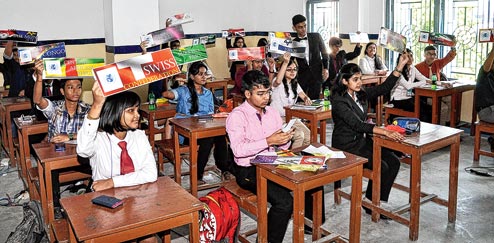

Debate, diplomacy and deliberation filled up each hour as students of seven schools came together to take part in the first edition of the United Nations simulation at Sri Aurobindo Institute of Education (SAIE) from October 31 to November 2.
Over 120 participants from The Salt Lake School, Salt Lake Point School, South Point High School, Calcutta Boys High School, Techno Model School, Adamas International and the Heritage School were distributed across the three UN committees that were simulated at the SAIE Model United Nations.
A Model United Nations (MUN) simulates the working of the United Nations, with participants discussing global issues such as poverty, disease, famine, war and terrorism by representing a country's government and its policies. The participants have to follow the interests that the government of the country they are representing have shown and work according to its foreign policy, keeping in mind the relationship the particular government has with respective nations.
At the event, the General Assembly Disarmament and International Security Committee, named Disec, discussed “measures to prevent acquisition of weapons of mass destruction by violent non-state actors”. So terrorism was a focal point of debate. The representatives of Gambia, Belize and Argentina accused the Saudi Arabian and Iranian governments of sponsoring terrorism and spreading violence across Central Asia as well as Africa. This caused the governments of Iran and Saudi Arabia to seek a formal apology from the representatives of Belize, Gambia and Argentina, claiming that they had “hurt the sovereignty of their respective governments”.

The General Assembly Special Political and Decolonisation Committee, named Specpol, held a debate on the Comprehensive Review of Special Political Mission. The agenda item was created by the United Nations in 2013 and a debate is held annually where member states exchange views on the challenges that special political missions face and their contribution to international peace and security in a deteriorating global strategic environment of civil wars and violent conflicts leading to humanitarian crises.
Specpol also discussed the United Nations Review and Work Agency for Palestine Refugees in the near East which was created in December 1949 as a relief and human development agency to supports Palestinian refugees, and their descendants, who fled or were expelled from their homes during the 1948 Palestine war and the 1967 Six Day war. While it was originally intended to provide relief, UNRWA now offers education, healthcare, and social services. In the absence of a solution to the Palestine refugee problem, the General Assembly keeps renewing the agency’s mandate.
In Specpol, the representatives of the Iranian and Israeli government got into a heated argument about the different aspects of the Relief Works Agency. The delegate of Iran argued that the people of Palestine who were being helped by the agency were being disrupted by Israeli forces whereas the Israeli delegate claimed that the agency was failing since the Palestinian government had refused to come to the negotiating table.
The third committee that was simulated at the event was the United Nations News Service. It showcased the role of news agencies in the UN like Al-Jazeera, Reuters and Amnesty International, and also worked as the news bureau of the MUN.
After three days of heated debates, the best delegation trophy went to Calcutta Boys High School which also took home the prizes for the best delegates in both Disec and Specpol committees, representing Russia and Iran respectively. In the UN News Service section, Indrajit Sur and Soham Chakraborty of Salt Lake School were adjudged the best photographer and best reporter respectively. “I like doing street photography which presents a wide variety of subjects. Here we had to click only portraits. The others in the fray had better cameras. So the victory was a pleasant surprise,” said the Class XI boy from Baguiati who made good use of his Canon 1300D.
“I was glad to work with a very enthusiastic set of reporters and photographers. MUN helps increase your opportunities after school ends and college starts,” said Chandrima Biswas, an alumna of the host school who headed the photography section of the news service.

“The objective of SAIEMUN was to encourage the growth and development of talent and intellect in terms of public speaking and debating skills,” said Upamanyu Chatterjee, a Class XII science student of SAIE and BJ block resident who acted as the secretary-general of SAIEMUN 2017.
“We’re living in an era of globalisation and the best thing that any educational institute can provide to their students is exposure. We believe that a Model UN is the best platform that a school can give pupils for them to refine their diplomatic and debating skills. These skills will help them face the world,” said Debleena Bhattacharya, the host school principal.
Starting last year, the school held a series workshops inviting well-known names in the field to groom the students. "The concept of MUNs was alien not just to the children, but also to us," said Nandita Chandra, the school's vice-principal who played a key role in starting MUN at the school and acted as the vice-president and head of the executive committee at the event.
“The concept of MUN is spreading like wildfire. I was amazed at how these young students, some of whom are barely in Class VI and VII, were able to represent the governments of countries so well,” said Sourav Mishra, a fourth year electrical engineering student at Jadavpur University who was the chairperson of Specpol.
Rrivu Banerjee, a post-graduate English student from Jadavpur University, who acted as the chairperson of Disec and the head of UN News Service, had chaired the school’s intra-MUN event too last year. “The quality of delegates has improved greatly and even though it is a beginners’ MUN, the level of debate was high,” he said.