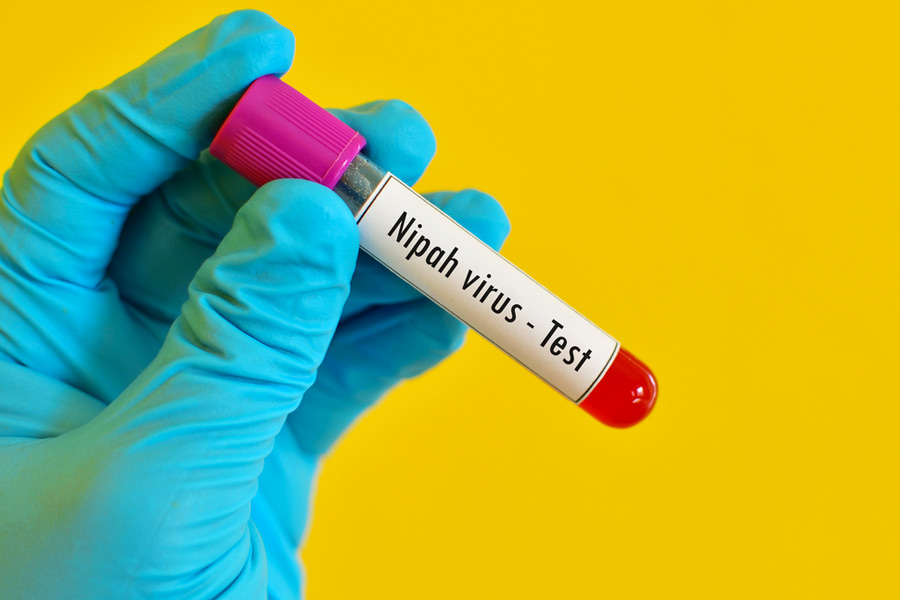
The National Institute of Virology in Pune has confirmed two Nipah virus cases in Bengal, with the state health department identifying around 90 people who had been in close contact with the two patients, both of them nurses, government sources said on Tuesday.
All the 90 are under observation, and their samples have been sent for testing.
A health official said efforts were on to trace more people who may have come in contact with the two nurses.
One of the two nurses has slipped into a coma, and the other is critical, a state official said. They are being treated at the private hospital in Barasat, North 24-Parganas, where they are employed.
Chief secretary Nandini Chakravorty had announced two suspected Nipah virus cases at a news conference on Monday evening. Health secretary Narayan Swaroop Nigam had said the samples of the two nurses had been sent to NIV Pune for confirmation.
“NIV Pune has confirmed that the Nipah virus has been found in the samples of the two nurses,” a government official said on Tuesday.
“We have also identified about 90 people who came in contact with the two nurses. These include their family members and nurses who provided them care.
“Those who were in very close contact with the two nurses and are in the high-risk category have been kept in quarantine. We are calling them twice every day to check on their health.
“Till now, none of them has shown any symptoms of the virus infection.”
Doctors said the symptoms of a Nipah infection include high fever, headache, myalgia (muscle pain), vomiting and sore throat, followed by dizziness, drowsiness, altered consciousness and neurological signs. The virus can cause meningoencephalitis.
It was discussed whether the infected nurses could be shifted to the Infectious Diseases and Beliaghata General Hospital, commonly known as Beleghata ID Hospital. But the idea was dropped, given the two patients' condition and the distance between the two hospitals.
“We felt it would be imprudent to shift them, given their condition. A treatment protocol has been sent to the Barasat hospital, and health department experts are monitoring the treatment,” the government official said.
The health department has begun surveillance in several districts to identify possible cases of Nipah infection, an official said.
It has also prepared a quarantine protocol that will be distributed among hospitals.
Health department sources said the protocol clarifies what should be considered "close contact" with a suspected or confirmed Nipah patient, and who should be considered "high risk" and who "low risk".
"Close contacts" include those admitted to the same hospital ward, or those who shared a room with a suspected or confirmed Nipah patient, or those with direct contact with such a suspected or confirmed patient during their illness, including their transport.
The protocol suggests a 21-day quarantine for anyone exposed to a person suspected or confirmed to be infected with the virus.
Officials at several hospitals said they had continued with their isolation facilities since the Covid outbreak as one or two Covid patients did still get admitted from time to time and have to be kept in isolation.
"We have three rooms to isolate patients, one of which has ITU facilities. We can use them to isolate patients exhibiting symptoms of the Nipah virus," an official at a private hospital in Calcutta said.
Doctors and public health experts said the Nipah virus is primarily zoonotic — transmitted from animals to humans — but human-to-human transmission is possible from prolonged contact with an infected person. Healthcare workers are therefore at greater risk of getting infected, doctors said.
The transmissibility of the virus is not as high as that of the Covid virus but the fatality rate is very high, the doctors said.
The World Health Organisation says "the case fatality rate is estimated at 40% to 75%" for Nipah.
It also says that "fruit bats of the Pteropodidae family are the natural host of the Nipah virus" and the virus can also be transmitted through contaminated food.
Doctors said it was advisable not to consume raw date palm sap. "There is a possibility of the sap being contaminated with the saliva and urine of bats, which is why it is better to avoid it," an infectious disease specialist said.
One of the infected nurses had taken ill and returned home to East Burdwan on December 31. Suffering from high fever and respiratory problems, the nurse went to a local health centre.
While being treated at home, the nurse fell unconscious on January 4, and was taken by family members to Burdwan Medical College and Hospital. The patient was shifted to the Barasat hospital on January 6 after the illness worsened, health department sources said.
The second nurse was admitted to the Barasat hospital on January 4.