The US has accelerated a visible military buildup across West Asia as President Donald Trump weighs options for potential airstrikes on Iran, even as diplomats prepare for fresh talks in Geneva.
President Donald Trump has ordered a force build-up and directed military planners to prepare options for a potential air campaign.
Sources told CNN that strikes could be launched as early as this weekend.
Here is an overview of US preparations in the region as Tehran fortifies its nuclear facilities following US strikes in June 2025.
The aircraft carrier USS Gerald Ford, which has completed a deployment in Venezuela, is now heading towards Israel’s coast.
It was spotted arriving in the Mediterranean on Friday.
Another aircraft carrier, the USS Abraham Lincoln strike group, arrived in the Arabian Sea last month. Last week, the European Space Agency picked up images of the carrier 679 km south of Iran’s coastline.
A network of warships and accompanying aircraft, including F/A-18E Super Hornets and F-35C stealth fighters, are deployed with the carrier groups.
US naval assets have been tracked in the Red Sea, the Persian Gulf, the northern Arabian Sea and the Strait of Hormuz.
At least 18 advanced combat aircraft designed to evade radar and conduct precision strikes, the F-35 Lightning II jets, have been positioned at Muwaffaq Salti Air Base in Jordan. Satellite imagery, reported by the CNN, has also identified several E/A-18G Growlers used in electronic warfare operations.
At least seven US air bases in the region have been mobilised and repositioned closer to Iran since mid-January.
Trump has remained ambiguous about whether or when he will order a strike, saying negotiations might conclude in about 10 to 15 days, reported The Washington Post.
The US President has warned Iran of ‘bad things’ if the latter does not agree to a deal to cease a nuclear program as both sides meet in Geneva on Tuesday.
One of Trump’s earliest declarations of hostility was a Truth Social post on January 28. ‘A massive Armada is heading to Iran. It is moving quickly, with great power, enthusiasm, and purpose…,’ Trump wrote.
The US may have a military advantage, but Iran has not taken a back seat in fortifying its nuclear sites.
After sustaining heavy damage to its nuclear programme in attacks last year, Tehran has focused on repairing missile facilities.
Satellite images of Imam Ali Missile Base in Khorramabad reveal that three out of the 12 structures destroyed by Israel have been rebuilt and another three are under construction.
Intensive repairs have been going on in another two military bases.
At the Taleghan 2’ nuclear facility, satellite images showed a concrete sarcophagus surrounding the site.
In a post on X, Institute for Science and International Security (ISIS) president David Albright warned that the facility may soon be revamped into an unrecognisable bunker, providing protection from aerial strikes.
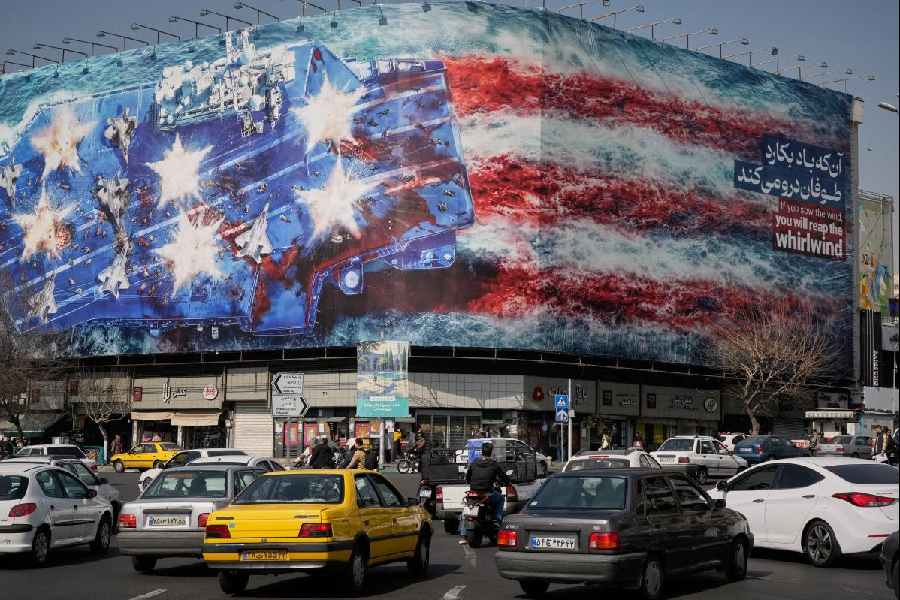
Iran, fearing regime change, has intensified its crackdown on dissent, continuing a wave of arrests across multiple cities.
A strike or a breakdown in talks, would have wide-ranging regional consequences beyond Tehran and Washington.
John Hopkins University professor Vali Nasr told CNN, ‘The Iranian tactic is trying to convince the United States that war is going to be costly.’