Asansol-based trekker Raju Chakraborty will never forget the unpredictability of the mountain.
He’d merely sat down to tighten his bootlaces after hours of steep climbing towards the Kanakata Pass in the Kumaon Himalaya. The rock “beneath me was apparently stable”, but it began lurching without warning and then sliding downward. For a brief moment, the expedition’s most experienced climber stood “inches away” from a fatal fall.
Such incidents usually do not happen in the mountains during organised trekking expeditions. However, this single moment captures the very nature of the recently completed Mount Durgakot-Kanakata Pass expedition. For five climbers, the feat is defined less by summits and more by uncertainty and survival in this lesser-known hilly corner.
Unlike well-known climbing routes dotted with signboards, campsites or backed by rescue gear, the uniqueness of this expedition was its misty-covered terrain where navigation solely depends on experience.
The climb to Mount Durgakot itself was unusual. At 5,791 metres, it’s not one of the tallest peaks in the Himalayas. Rather, Durgakot’s significance lies in its relative obscurity. While trekkers flock to popular routes in Uttarakhand, Durgakot remains largely untouched, because it is hidden behind steep ridges and almost inaccessible valleys.
The team set up Camp-2 at 5,106 metres on an exposed ledge where space was so limited that even pitching tents became a problem. Chakraborty said: “It’s almost like risk management. In fact, our kitchen tent hung above a sheer drop.”
The climbers recounted how the load carriers were forced to descend immediately after unloading equipment. “We were left with a narrow weather window. It was a moment to make the decision — either reach the summit and descend safely the next day. Or else? Risk being trapped,” said the team leader.
The crux — mountaineering literature may celebrate summits, but experienced climbers know that it’s only a part of the story.
Ascending Durgakot requires technical skills.
Near 5,338 metres, the team used jumar ascenders (also known as hand ascenders) and ice axes to negotiate the frozen section of a steep ice wall before pushing through deep snow towards the summit.
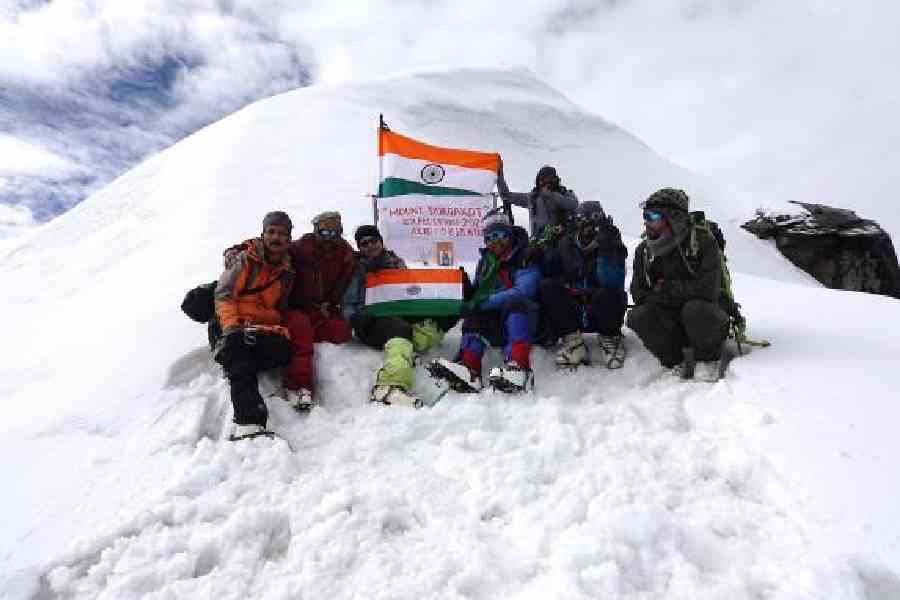
“On June 17, we pushed forward into a hostile wall of rain and blinding white-out to establish Camp-1, moving aggressively to outrun the weather,” said Balram Singh, a Delhi climber. They reached the top on June 19, 2025. The upper trail rewarded them with views of the celebrated peaks — Nanda Devi, Nanda Kot, Trishul, Maiktoli and Panwali Dwar.
For one team member, Calcutta’s Runa Dey, 49, the summit carried added significance. The Hatibagan resident and a schoolteacher became the first recorded female climber to summit Mount Durgakot. “It was a moment of pure elation,” she said.