Joga Bonito — play beautifully — was the creed of Brazilian masters from the 1950s through the ’70s, a philosophy as much as a style.
Today, it is an epitaph.
The language of the modern game belongs to the tacticians: pressing, counter-pressing, rest defence, transitions.
Jurgen Klinsmann, who served on Fifa’s technical study group at Qatar 2022, put it with the weary resignation of a man watching an old neighbourhood being demolished. “Too complicated,” he said. “So many words. The game I played is no longer that simple.”
He was not wrong. And the 2026 World Cup, now past its group stage and into the knockout rounds, has done nothing to contradict him.
There are ghosts worth invoking here.
The 1970 Brazil side, flamboyant and technically flawless in equal measure, remains the gold standard of what football can be at its most exhilarating.
Diego Maradona weaving past five England defenders at the Azteca in 1986 — on that unforgiving, treacherous turf — and burying the goal of the century is a memory that refuses to age.
The moments of brilliance from the past were advocates of the argument that one man, on his day, could be worth more than any system.
Lionel Messi still makes that argument. But he makes it within a system, and that distinction matters.
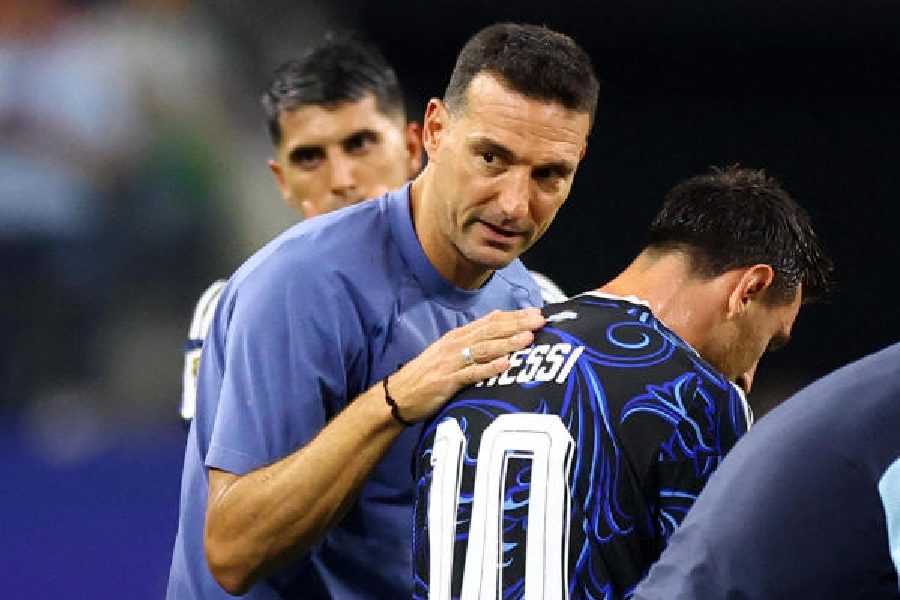
For all the tactical complexity swirling around this tournament, Lionel Scaloni’s Argentina are, paradoxically, its simplest team. In possession, they settle into a 4-3-3; defending, they shift cleanly to a 4-4-2. There is nothing complex about it, it’s just a system they have built the entire edifice around.
Messi’s record-breaking 17th World Cup goal against Austria illustrated the precision of the design.
Facundo Medina delivered a low cross from the left. Thiago Almada, reading the moment exactly, selflessly let it run — knowing who was arriving behind him. Messi held his nerve, waited for the Austrian goalkeeper to commit to his left, then crashed a left-footer into the near post. Economy of touch. Maximum damage.
What makes it possible is that his teammates run the kilometres, he does not. Against Austria, Messi covered 7.52km. Rodrigo De Paul, his partner at Inter Miami as well as in the national team, covered 10.52km.
The teammates create the space; Messi, stationed in that half-light just outside the opposition’s penalty box, exploits it. You get a Messi once in a lifetime. Scaloni has understood that, and organised everything else accordingly.
Carlo Ancelotti does not have the luxury of generational genius to organise around, but he arrives at this World Cup with something invaluable: clarity. Five Champions League titles give a man an instinct for what actually works in a tournament.
His 4-3-1-2 has brought order to a Brazil side that has spent years lurching between chaotic attacking formations and collective hand-wringing.
Vinicius Junior now has genuine freedom on the left flank. Lucas Paqueta, chastened by the Morocco nightmare, has settled into a more disciplined role, linking with his old academy ally.
Up front, Matheus Cunha operates as a false nine with the intelligence and movement the role demands — he could prove as decisive in this tournament as Julian Alvarez was for Argentina in Qatar.
Brazil’s midfield, meanwhile, has been given a clear directive: control the tempo, do not merely feed attackers.
The test arrives on Monday. Brazil face Japan in the Round of 32, and it is a fixture that frames the tournament’s central argument — the Ancelotti system against the Moriyasu system. Neither side is playing for beauty. Both are playing to win.
Japan’s best goal of the group stage, against Sweden, was a masterclass in coached movement. Three passes from the right flank, a lethal assist from Ritsu Doan to unlock the Swedish defence, and Daizen Maeda finishing first-time with his right foot.
Coach Hajime Moriyasu watched from the touchline with barely concealed delight: it had happened exactly as rehearsed.
Didier Deschamps does not need to be subtle. When you have Kylian Mbappe running at full tilt, and Jules Kounde surging from right back into the opposition half at a comparable pace, subtlety is for lesser teams.
France play a 4-2-3-1 that is less a formation than a statement of intent: direct, vertical, terrifyingly quick in transition.
Against Norway, with Ousmane Dembele cutting inside from a wider position and Mbappe conducting the chaos, they were close to unplayable — Dembele’s hat-trick merely the statistical proof.
Numbers tell part of the story.
A total of 215 goals were scored across the 72 group-stage matches of this expanded, 48-team tournament — an average of 2.99 per game, and one of the highest rates in World Cup history over a sustained phase.
The entire 2022 edition produced 172 goals across 64 matches; this group stage surpassed that figure before the knockout round had even begun.
The last time the World Cup approached three goals per game over a comparable stretch was 1958.
The expanded format accounts for some of it — more matches, including several mismatches, Germany’s 7-1 demolition of Curacao among them.
But the deeper reason is tactical: quick transitions compress the time between a turnover and a shot on goal, and the gaps left behind by high defensive lines are ruthlessly exploited by the Mbappes and Vinicius Juniors of the world.
The group stage brought festival football — upsets, goal gluts, the collective joy of 48 nations taking their turns on the stage.
The serious business begins now, and the shape of it is already clear.
Coaches will lean on their systems. Pressing and counter-pressing will determine which teams advance and which go home.
The beautiful game, in any classical sense, will be a rarity — a flash of Messi in his danger zone, a Mbappe run that leaves defenders stranded, perhaps a moment of invention from Spain’s extraordinary teenager Lamine Yamal.
But do not expect the unexpected. This World Cup will be won by a team, not a player. The tacticians have seen to that.