
A sepia picture of the Fever Hospital, now known as the Calcutta Medical College and Hospital, or a panoramic view of Chowringhee Road from the past century would have been lost to most Calcuttans had it not been for smartphones and two universities.
In an effort to make an academic collaboration more practical, the English department of Jadavpur University and the University of Liverpool have added a segment on Calcutta heritage to an augmented reality app (Layar, available on iOS and Android) as an extension of their "Envisioning the Indian City" UGC-UKIERI Thematic Partnership. The British Library in England has chipped in with its priceless archival images to make the app an effective guide for tourists and scholars in the city.
Calcutta's map with a cluster of old photographs as pointers to heritage sites is what meets the eye once you download the free app on your phone and search for Timescape Kolkata. Click on a picture and you get to see its high-resolution version and read a bit of its history. You find that the roads leading up to the Fever Hospital are nearly empty, a far cry from the clogged ones now. You are told it was built on a plot donated by the philanthropic millionaire, Mutty Lal Seal.
Some distance away lies Dhurrumtollah or the now Lenin Sarani with an 1851-52 picture of an empty stretch taking us back in time. We can also see a different Eden Gardens with a lake and a temple in the backdrop. All pictures come with a snippet and there are around 100 of them.
The app can be used on the move. If you point your phone's camera towards a heritage site, the app will recognise it, drawing on recorded geo-coordinates. The image on your mobile screen will then be augmented by a corresponding 19th century photograph.
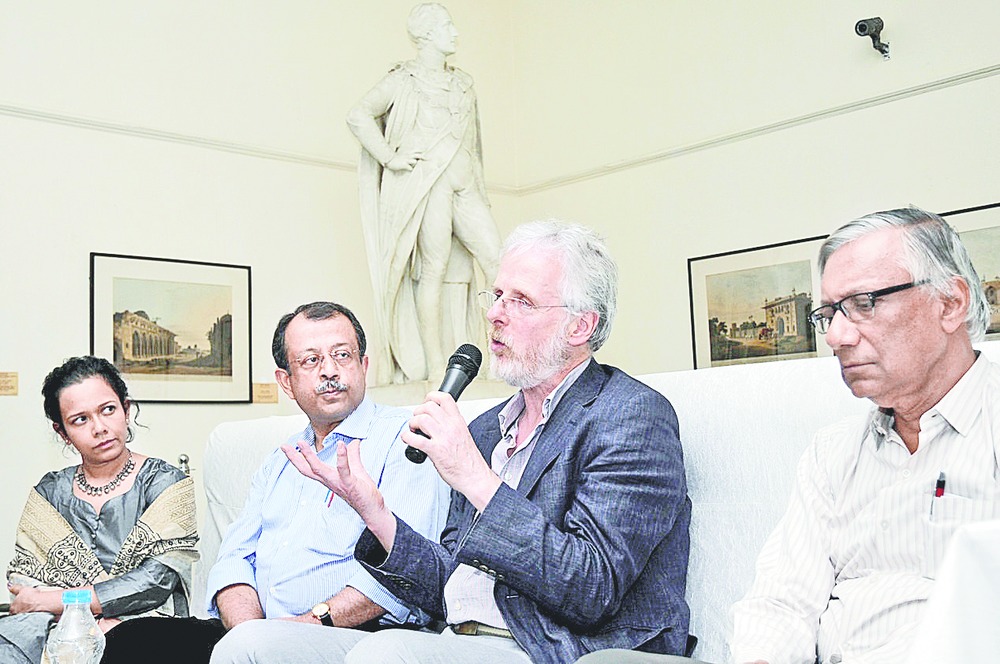
Calcutta is the first Indian city to be covered by the app. Timescape Kolkata was launched at the portrait gallery of Victoria Memorial on Saturday in the presence of academicians Supriya Chaudhuri and Sukanta Chaudhuri of JU, Nandini Das, project lead from the University of Liverpool, John Falconer of the British Library and Jayanta Sengupta of Victoria Memorial Hall.
The first step towards getting transported in time is downloading the Layar App on one's phone. Search for Timescape Kolkata on the menu and once the city's map is loaded, the nearby points of interest will automatically be displayed and help users compare the past with the present. One can also go to www.time-scape.org for more information.
"This app is an evocative historical tool. At the British Library we have a huge archive of maps, drawings and photos of Calcutta - most of which are not available to the people of the city. So, this is a small offering from us to the people of Calcutta," said Falconer, lead curator of visual arts at the British Library.
Academicians from both universities felt the app offered huge future possibilities. "One can keep adding layers of history (visual and factual). It can be used to map other Indian cities, too, helping both the tourism and education sector," said Sukanta Chaudhuri.
Funded completely by the University of Liverpool, it was a six-month project for Martin Winchester (of Liverpool) and Sujaan Mukherjee and Kawshik Kirtania (of JU), during which they completed the picture research, got the geo-coordinates in place and completed other technical requirements. "We now have plans to add paintings, music and narrations to the Calcutta layer. We can also cover other buildings and sites that are not colonial," added Supriya Chaudhuri, the head of the project from JU.