 |
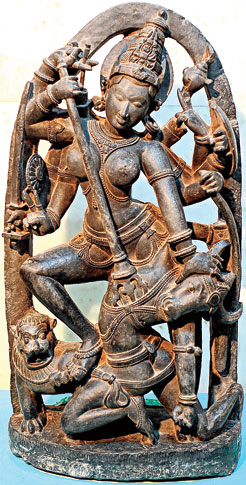
| Mahisasuramardini, one of the exhibits. Picture by Pradip Sanyal |
The Indian Museum is shut down for restoration, but in keeping with the festive season, as the cliché goes, it has put up an exhibition of diverse images of the goddess preserved in its art, archaeology and anthropology sections.
These range in date from the Harappan period down to the late 19th century. Apart from the images, the display of a collection of weaponry associated with the goddess in her martial aspect and objects meant for her worship makes this exhibition titled Durga Durgatinasini (September 23 to October 4) even more fascinating although the lighting is all wrong in the Ashutosh Birth Centenary Hall, where it is being held, the heat inside beyond human endurance, and the skimpy and inadequate captions full of literals.
The exhibition begins with the tiny Harappan terracotta mother goddess dating back to 2500 BC. Characterised by heavy breasts and a squat torso, she is the prototype of all future goddesses, however elegant like the prostate figure of the woman who has just given birth, titled Sadyojata of 11th century Gaur. She is reminiscent of the familiar figure of Maya, who sees a white elephant in her dream. It would have helped viewers if the caption explained that this carved figure was once thought to have given birth to Krishna. Thereafter, the baby was mistaken for Ganesh. Now the child is said to be Shiva, and she the Divine Mother.
Another image that may puzzle lay viewers is the chalchitra (late 19th century or early 20th century Midnapore) of a war-like Durga on various mounts. In one frame she is depicted as Varahi, the sow-faced consort of Varaha —Vishnu in the avatar of the cosmic boar. But the numerous exquisite metal and stone images of the goddess collected from all over the country more than make up for these shortcomings.
A small terracotta figure clearly envisages the many-armed goddess who has anything between two and 18 hands, as in the beautiful Pahari watercolour of 18th century depicting the triumphant lady to whom her supplicants make deep obeisance. In one metal Mahisasuramardini, the vehicle resembles a unicorn or a lion of Chinese origin, the type still seen in Durga images of old families such as Sobhabazar. She is in many forms — Kali (seated and with two tusk-like protruding teeth), Parvati, Mahisasuramardini, Sarvamangala, Devi Mundeswari — at times with her consort Shiva.
Durga is again present in various delightful Kalighat pats (the lion is a pussy cat fondling the trunk of a beheaded demon in the form of an elephant) and as Annapurna. There is an interesting array of weapons from damascened shields and swords, vajra and tridents to arrows, a machete-like dao and a mace with the head of a tusker. The objects used for her worship include a conch shell carved with a Durga image, a kamandulu, incense stick burners, vessels, plates and bells. More than anything even the most popular pandals can offer.