 |
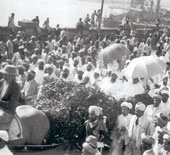
| The 51st Syedna and his son travel by the Hooghly in 1935 and (below) three Dawoodi Bohra women |
 |
People who belong to small communities are always in fear of their religious and cultural identities being erased through assimilation, persecution or by some other means. The Jewish community of Calcutta was known for its orthodoxy, Westernisation notwithstanding. The same holds for the Parsis, whose numbers have dwindled alarmingly, and the Dawoodi Bohras, about whose existence few of the mainstream communities are even aware of.
Perhaps one of the ways of resisting oblivion and obliteration is creating an archive of one’s community. And this is what communications consultant Mudar Patherya has been doing — creating a visual archive of the Dawoodi Bohra community to which he belongs. During their heyday in Calcutta there were 10,000 of them. Now there are only 4,000.
Patherya has a collection of 4,500 digitised photographs now, many of them belonging to his extended family, but all relating to the Dawoodi Bohra community in Calcutta, the men easily identifiable by their beards and snow-white caps and sherwanis. Mostly in the hardware and clothiers line of trade, Dawoodi Bohras came to Calcutta from Surat in mid-19th century. Once quite liberal in their outlook, the women were never in purdah, and stood out on account of their dress — ghaghra and odhni draped over their heads. The more Anglicised ladies were clearly more at home with English than their vernacular Gujarati.
Now, however, there is a noticeable sartorial change. The women wear a modified form of the burqa or rida that covers the head but not the face. These changes are documented in the photographs that Patherya has collected over the years.
Patherya, who began his career as a cricket writer at the ripe old age of 18, ascribes his endeavour to preserve the past to this game itself.
“Cricket has a deep sense of history,” says the 46-year-old man with a library of 1,600 cricket books and a tiny cricket museum as well. A glib talker, he says his first “infection point” was 1992, when his father, who was an “outstanding” calligraphist in Urdu, English and Gujarati, became paralysed. It was then that he began collecting the letters his father had written, including one dating back to 1948, in which he expressed his sense of wonder on finding himself in a metropolis like Calcutta, having been a Surat resident. Some of his letters were structured like plays, and there were his diaries as well. He thus collected 300 to 450 letters.
But before that, in 1985, Patherya had bought an M5 National video camera that later helped him gain access to the personal collections of photographs and films of other people in his community. Mudar was interested in the visits of the pontiffs, the 51st Syedna and his son the 52nd Syedna in 1921, 1935, 1953, 1961 and 1964. One route open to him was getting in touch with old families. His mother’s family was the first to reach Calcutta by bullock cart in 1843, for which their surname is Bengaliwalla.
Patherya points out the sartorial elegance of his ancestors, particularly the men with their flowing beards and headdress, “which were an elemental part of their dress”.
From 1979-80, Bohras gained a “new visual identity”. “Anything prior to that is of interest,” he says. The 1400th year of the Hijri calendar (1980) was “occasion for the community to introspect”. That was when the “need for a distinctive sartorial identity” was felt. This is when beards made a comeback and ridas made an appearance.
To gather “anecdotal evidence” on the Syedna’s visits he called up people who had witnessed them, now spread all over the world. He got the photographs he could lay his hands on scanned and returned the original as well as their digitised versions to their owners. Yet “convincing people to give away their memories was difficult”. Patherya continues this process.
He went back to the people whose videos he had shot and got them transferred into DVD. A Prinsep Street resident had eight cans of films with nitrates coming off, dating on the Syedna’s 1961 visit. Patherya encountered a man, who had photographed the Syedna in 1971, 1976 and 1988, and now lives in Chennai.
A random pick of photographs proves interesting. One of 1927 vintage shows a sensitive-looking man with a beard and turban. The photos reveal little of the interiors save the ubiquitous carpets, a must in all Bohra homes. A group of women pose together, one in a sleeveless blouse, another in a magyar-sleeve blouse. A coconut wards off evil. A group of men and women are in fancy dress.
Most interesting is the series on the visits of the two Syednas. The 51st Syedna had visited Calcutta to open the Brabourne Road mosque. In a 1935 shot, the 51st Syedna and his son travel by the Hooghly in a flower-bedecked carriage, gold and silver umbrellas covering their heads, respectively. They are followed by a crowd of men wearing Arab headdresses, hollow in the middle in the case of people from Surat.
Now the 52nd Syedna is 94 years old. These images will remain engraved in Dawoodi memories.