 |
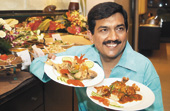
| Sanjeev Kapoor displays a few dishes from the new menu at Grain of Salt. Picture by Pabitra Das |
From slow-fried king prawns to burnt garlic fried rice, Biryani Gul-e-Gulzar to Barrah Gosht, mushroom vol-au-vents to asparagus-stuffed grilled fish. Grain of Salt, one of the country’s largest fine-dining restaurants serving Indian and world cuisine, has turned two with a brand new eclectic spread of Continental, Indian and, for the first time, a full-fledged Oriental menu.
“These are days of super-specialities. We had set out with the idea of not being a clone of other speciality Chinese eateries. But since there is a defined demand for Oriental food, we have decided to fine-tune our menu and offer a more elaborate bill of fare with stress on Chinese provinces closer to our taste,” said master chef Sanjeev Kapoor, inaugurating the weeklong anniversary celebrations.
While clientele feedback — “Calcuttans are extremely passionate with opinions” — has essentially driven the menu revamp, it’s the “element of surprise” the chef and his team are banking on to keep the covers warm. “For instance, if everyone else is adding dhania to dal, you add mint. A simple twist and a hint of imagination can go a long way,” stressed Kapoor.
Grain of Salt director Nitin Kohli agreed heeding audience response during the first two years has been crucial to the eatery’s success. “Unlike in other industries, where the learning curve would stop after two to three years, in the hospitality trade, you never cease to learn. Each item on the new menu has been painstakingly researched and customised, and we have tried to keep ingredients and flavours as authentic as possible,” he said.
Kapoor felt while tastes are well defined Calcutta is still “extremely receptive” to change. Hence the plum and honey chillies and the bell-pepper in the mutton kebabs. Or the all-new Sangdong (pot-roasted) chicken and lamb stirred in wine sauce. For vegetarians, there is the stir-fried spinach & chilli-garlic or Buddha’s Delight — a mix of bamboo shoot, mushroom, bean curd, broccoli and sprouts with ginger vinegar.
In world cuisine, a core strength area for Grain of Salt, the options have just got expansive as well. So, one can pick Lamb Piccata Pizzaiola (flattened lamb steak with tomato and olives), gratinated prawn Florentine (prawn served on a bed of spinach and pasta) or three-mushroom olive strudel (a mixture of three mushrooms, encased in puff pastry shell, served with tomato dip).
Kitchen king
If you are using your microwave only for heating and defrosting, you are missing out on a world of healthy cooking. That was the handy advice from master chef Sanjeev Kapoor, introducing his new book Microwave Cooking Made Easy at Crossword bookstore on Wednesday morning.
The book, published by Popular Prakashan and priced at Rs 250, is the fifth from Kapoor. It packs in all you might need to get started. Basics like equipment for the microwave and principles behind microwave cooking are covered, moving on to 82 detailed recipes of soups, starters and snacks, vegetables, chicken, seafood, egg, accompaniments like chutneys and sauces, breads and rice, desserts and beverages.
Silencing those who thought Indian food couldn’t be cooked in a microwave, Sanjeev Kapoor has included recipes of Indian specialities like Tangdi Kebab, Murgh Makhmali Kebab, Keema Tikka Kebab, Mirchi Ka Salan, Paneer Makhani, Kalakand, Gajar Halwa and Zafrani Pulao. “You can also make your favourite fish in the microwave. Just heat oil on a dish, place the fish pieces on it and watch it get shallow-fried,” explained the ever-smiling chef, (fielding questions from eager housewives).
Dispelling myths about the use of aluminium foil while cooking and defrosting, Kapoor advised the audience to stick to the time span specified in his recipes and explained the significance of marination and soaking in microwave cooking. Most importantly, he said, in the microwave, the food is cooked in its own juices and is full of natural aroma, colour and texture.
Here is how to make the most of your microwave:
• To roast papads, brush them lightly with oil on both sides and cook for about 30 seconds on high
• If you have forgotten to soak pulses, lentils or beans overnight, cover them with water in a large bowl and heat on high for about 10 minutes to bring to a boil. Allow them to boil for two more minutes and then let them stand for an hour. The pulses will cook faster this way
• To warm chapatis, sprinkle a little water on them and heat on high
• Turning is a must especially during thawing
• When cooking paneer, add the paneer last to prevent it from becoming tough