 |
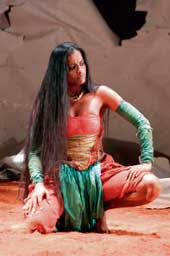
| Tritiyo Sutra rehearses for Raktakarabi. Picture by Sanat Kumar Sinha |
Close to his death anniversary, Rabindra Utsav will address the multifaceted genius of Rabindranath Tagore. What aims to be an annual event on the lines of the Shakespeare Festival in England, it has been conceptualised by Happenings and is backed by the state department of information and cultural affairs, and Airtel.
Rabindra Utsav this year revolves around a ?rediscovery of Tagore?s plays?, featuring three stage luminaries from beyond Bengal. Habib Tanvir?s Naya Theatre (Bhopal) will present Raj-Rakt, while the K.N. Panikkar-led Sopanam (Thiruvananthapuram) will present Raja and H. Kanhailal?s Kalakshetra (Imphal) will enact Dakghar. Representing the Calcutta stage will be director Suman Mukhopadhyay and Tritiyo Sutra?s Raktakarabi.
The plays will be interspersed with interactive sessions involving directors. ?We want to project Bengal to the world and also see how people outside Bengal react to Tagore,? said Shibani Iyengar of Happenings. ?Being a multilingual event it can also travel to other states,? said Ajai Puri, CEO, Airtel, Calcutta. Already, Prithvi Theatre has booked all four productions for its anniversary celebrations in November, where they will be presented as Tagore Festival from Bengal. The plays may also feature in the Rangshankara Festival of Bangalore and the Dehradun Tagore Festival.
Habib Tanvir told Metro from Bhopal that the festival was ?most welcome? as it would ?spread the message of Tagore? and cause a ?revival of his plays?. Raj-Rakt would be for Tanvir a second attempt at presenting Tagore?s Visarjan. His first, in collaboration with Rangakarmee in January, had left him dissatisfied. ?Sambhu Mitra had gone on record saying that there was something wrong with his presentation of Bisarjan and that he had failed, which is why no amount of persuasion could force him to continue after the first four shows. I failed because there remained a basic conflict between naturalistic, locale-based elements and those that are abstract and spiritual. So I have decided to go back and try again. I might fail but at least this time with a different title and different language (Chhattisgarhi-Hindi mix), and the audience will be free to draw their own conclusions,? said Tanvir.
K.N. Panikkar?s Raja in Malayalam will use the ?folk-ritualistic art form of Theyyam?. To represent the enigmatic king, a ?stage device shaped like a moving shell (almost like the hay-figure in Theyyam burnt at the end of the ritual)? will be used. ?The chronological sequences have been built to probe the essence, the formless content. The layers woven by parable have to be broken into to reach out to the inner energy,? explained the director.
Kanhailal?s plays, rarely seen in Calcutta, are known for their innovative intercultural and multilingual approach. The Manipuri Dakghar will be ?a symbolic presentation of man-in-life distinguished by his perception, emotion and intelligence? seeking to trace the turbulent journey of Amal?s soul beyond barriers, through four movements ? Amal in Primordiality, Amal in Exile, Amal in Hope and Amal in Dream. But the director warns that the production is a movement away from the ?demands of urban theatre? and ?has been designed for the rural environment?.
Suman Mukhopadhyay on the other hand has ?recontextualised Raktakarabi in a contemporary setting without making it a modern costume play?.
All the plays will be staged at Rabindra Sadan from 6.30 pm, August 3-6. Face to Face with directors, moderated by Samik Bandyopadhyay, will be held from 11 am-1 pm, August 4-7, at Bangla Akademi. Tickets are available from August 28 at Rabindra Sadan and Airtel Relationship Centres on Park Street and at City Centre, Salt Lake.
Sebanti Sarkar