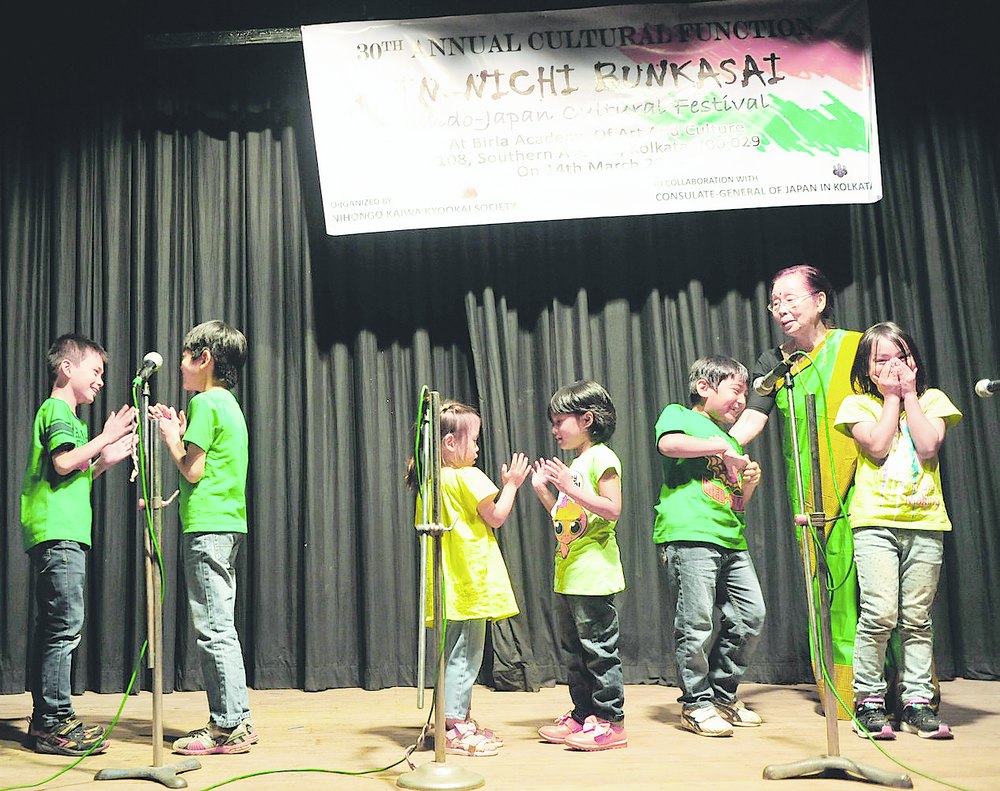

Students and teachers of the Japanese language and members of the expatriate Japanese community gathered at Birla Academy recently to host the 30th edition of In Nichi Bunkasai, an Indo-Japan cultural festival organised by Nihongo Kaiwa Kyookai Society.
"The society was founded in 1984 under the guidance of Kazuko Nigam for students to pursue Japanese studies even after their course ended. Such a platform promotes people-to-people exchange between countries," said consul-general Kazumi Endo. Speaking on the sidelines of the event, he expressed surprise at the uninterrupted run the annual programme has enjoyed despite the tiny Japanese population in the city.
"There are less than 100 Japanese here, the lowest by far among all the consulate-serving areas in India. In Delhi, there are about 5,000 from Japan. Bangalore, Mumbai and Chennai have 1,000 each. It is regrettable that Japanese businesses are not coming to Calcutta."
The two anchors of the event, Pratistha Chanda and Anunita Banerjee, spoke of the long history between the two countries, starting with the monk Bodhisena's visit to Japan in 752 AD for the eye-opening ceremony of the Great Buddha of Nara. They also mentioned Rabindranath Tagore's friendship with Okakura Tenshin, the art expert. "And of course, we are both rice-eating nations," summed up Anunita, dressed in a kimono.
The president of the society Jayanta Saha remembered 2011, when a tsunami had devastated Japan a day before the programme was scheduled. "But the then consul-general, Mitsuo Gawaguchi, insisted that the show must go on and even sang Chalte Chalte with us."
Members sang the hit song Sekai Ni Hitotsu Dake by the J-pop boy band, SMAP, prompting the consul-general's wife Misako Endo to sing along. They also sang Dhitang dhitang bole translated into Japanese. "We translate a popular song to sing in Japanese every year," said secretary Sanjoy Ganguly, the only male voice in the chorus.
Little students of Japanese Supplemental School also presented a song, drawing a huge applause. This was followed by a multi-lingual skit, with chief patron Kazuko Nigam in the role of a teacher trying to teach the language to students from various provinces. A play was also staged titled Tora Ga Kita (Here Comes the Tiger), inspired by an episode in Saratchandra Chattopadhyay's Srikanta.
Language of expressions

It was a celebration of expressions, both verbal and silent. Students of Kolkata Anubhav, many of whom have impaired hearing, presented beautiful acts of mime at a seminar-cum-workshop organised in collaboration with the ministry of culture at Rotary Sadan. Performers from MUK Academy, Mouna Mukhur and the puppetry group, DANA, joined in for a series of acts in mime, dance and puppetry.
Krishna Dutt, the secretary of Kolkata Anubhav, along with daughter Bijoya, its cultural secretary, presented a fusion of mime and dance, titled The Burning Soul. They narrated a story of a young girl who is burnt alive by her in-laws. "What better way to raise a voice than through art?" said Bijoya, an Odissi dancer.
The guests included Rosemarie E. Hille, deputy consul-general of Germany in Calcutta, Miratun Nahar, social activist and writer, and Sudip Srimal, the director of Nehru Children's Museum.
"Kolkata Anubhav deserves a special mention for taking the initiative to unlock the potential of children through mine. Art in all forms is a beautiful medium to show that disability is not inability," Hille said.
Bangla Children's Day
Bangladesh celebrates March 17 as Children's Day in memory of the father of their nation, Sheikh Mujibur Rahman. The Bangladesh deputy high commission in Calcutta organised a sit-and-draw competition for children on the occasion. The event also marked the 95th birth anniversary of Rahman.
"This day is always special for us. I wanted my family to participate too. So I brought my six-month-old son here and took colour impressions of his fingers and toes on paper. It was very sweet of the children to come out in this hot weather and participate in our event," said Zokey Ahad, the deputy high commissioner.
The children were given two topics to draw on - 'Amar Sonar Bangla' and 'Bangabandhu Sheikh Mujibur Rahman'. "We organise such programmes every year. Our father of the nation was very fond of children. A day spent with children is a day well-spent," said Md. Mofakkharul Iqbal, the first secretary (press) at the deputy high commission for Bangladesh.

Tagore soiree
Rabindrasangeet artistes Kaustav Goswami, Sispiya Banerjee, Debadrito Chatterjee and others performed at a soiree titled Rupak Rabi at Baitanik, a music school on Elgin Road, recently. Music director Debojyoti Mishra, who was the chief guest, spoke about the importance of original compositions and encouraged budding artistes to take risks. "The programme focused on various symbols and motifs in Tagore's compositions," said Sourish Ghosh, one of the organisers.
Plex perplex
A man was stopped after his bag was examined at the entrance of a multiplex. His bag contained a packet of condoms. It was seized. The man was appalled. He had come to the show alone, and had no intention of picking up anyone, he said, and even if he did, how would it be possible to use the contents of a packet of condom in the auditorium? In any case, carrying condoms was always better than not carrying them. Was there any law against carrying a packet of condoms into a theatre, he asked.
No one knew. But the man would not be allowed the condoms, they wouldn't get past the security. Weapons of some kind. He relented. "You keep them," he told the securitymen. "And I wish you find great joy."
(Contributed by Sudeshna Banerjee, Samabrita Sen, Showli Chakraborty and Chandrima S. Bhattacharya)