 |
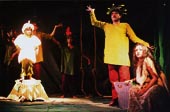
| Swapnasandhani stages Bhalo Rakshaser Galpo |
Bengali theatre?s struggle to establish an alternative base in south Calcutta continues with groups like Swapnasandhani and Sandarbha persevering in presenting weekly shows on specific evenings at Sujata Sadan. Both groups, in fact, have promised not to stage their new productions anywhere else. In towns like Imphal and in several other countries of the world, residents of the immediate neighbourhood support such ventures by attending diligently ? an audience phenomenon known as community theatre. Will the Hazra Road-Bhowanipore-Manoharpukur paras rally round Sujata Sadan? Only time can tell.
Swapnasandhani?s latest, Bhalo Rakshaser Galpa, is dramatised by Ujjwal Chattopadhyay from Jaya Mitra?s story for children. Unlike most children?s theatre in Bengali, which functions as mouthpieces for adult dramatists and directors, this play sees the world mainly from a kid?s-eye view.
When an acquisitive ogre attempts to grab everything valuable on earth, tempting a poor kingdom with fake gold and imprisoning a river personified as a girl, the local princess comes to the rescue, aided by Bhalo Rakshas, an old woman and hordes of plants and animals. Not only does this convey the right message but it is not the usual sermonisation foisted on children by grown-ups.
Embodiments of the life force, young people instinctively empathise with all life forms and nature. Moreover, potentially politicised indoctrination is thankfully avoided, preventing the Sabchai Daitya from turning into a capitalistic demon or a parody of President Bush.
Fittingly, the play also breaks some fairytale stereotypes. The rakshas is good instead of bad, a young boy instead of a big-built man. The old enchantress is not someone to be frightened of, but a friend. Indeed, the fair sex overwhelmingly populates the ?good side? ? Ma Prithibi, river, princess, enchantress, even the Rani (certainly sharper than her husband). The exploiters and silly folk are men ? the Daitya and his cronies, the idiotic Raja and his fawning minister.
The most appealing performers are the children with Riddhi Sen (Bhalo Rakshas) the darling of the audience for his presence and far-reaching voice. The toddlers who play the ants steal the show whenever they wander across the stage.
Among the adults, Koushik Sen does a neat double role as Daitya. Shankar Ghosh and Saswati Guhathakurta make a memorable middle-class Raja and Rani worried about their economic condition, and Krishanu Nag portrays a feckless minister trapped between their conflicting demands.
Koushik Sen directs a warm, colourful, feel-good show, recommended viewing in a genre that (in Bengali) produces much of quantity but not always high in quality. Schools should invite this production to their auditoriums.