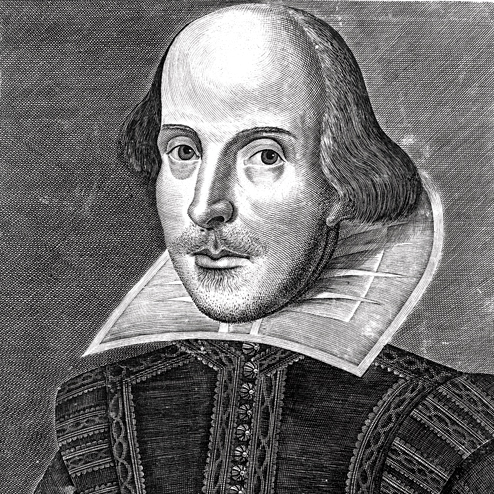

The story of Shakespeare's life is almost as racy as the plots he penned over four hundred years back.
At age 18, when he was a young man barely three years out of school, Shakespeare had an affair with Anne Hathaway, a woman eight years his senior whose father was a fairly well- to-do farmer and a resident of a village about a mile away from Shakespeare’s own birthplace in the small town of Stratford-on-Avon. The result of the liaison was a pregnancy, and a marriage was hastily arranged.
To get around the rule for three banns or notices to be put up before a marriage, a special license was acquired from the Bishop of Worcester. Two friends of the bride’s father put up a bond promising to pay the church the then substantial sum of £40 if the wedding were to prove unlawful.
However, nothing untoward seems to have occurred, and six months after the wedding, in May 1583 was born to Shakespeare and his wife a daughter. The couple went on to have two more children in 1585 when the twins Hamnet and Judith were born. Of these three, Shakespeare’s son Hamnet died when he was only eleven. There may be a touching reference to this loss in one of Shakespeare’s plays — King John — in which there is a dialogue on the death of a young boy — Prince: “I lov’d him, and will weep/ My date of life out for his sweet life’s loss.”
There has been much speculation about Shakespeare’s relationship with his wife, fuelled largely by the fact that in his will he left her only his “second best bed”.
Of course, Shakespeare seems to have been greatly knowledgeable about love, for he imagined into existence not only immortal lovers like Romeo and Juliet, Antony and Cleopatra, Portia and Bassanio, Rosalind and Orlando, Olivia and Orsino, but also penned some of the greatest love poetry that has ever been written. These poems were his sonnets — all 154 of them — which were dedicated to a man identified only by his initials as Mr. W. H.
The first 126 of the sonnets are brilliant examples of a powerful homoerotic love, while the rest are addressed to a mysterious “Dark Lady” with whom the poet seems to have fallen in passionate but hopeless love. “My love,” writes Shakespeare in one of these, “is as a fever, longing still/For that which longer nurseth the disease.”
In his professional life, Shakespeare appears to have had a good sense of money. The financial fortunes of his father, a glover by profession and a trader in fine leather goods, seems to have declined over time. But Shakespeare’s personal fortunes flourished, and by the time he retired he was a fairly prosperous owner of both land and some properties. Part of the money no doubt came from his selling of the scripts of his plays to the theatre managers of the day, but part also came from the shares he owned in the acting company that he belonged to and from his stake in the Globe theatre house in which many of his plays were staged. Before his death, he succeeded in ascending to the status of a gentleman, buying for himself and his family a coveted court-of-arms.
A great many detail about other aspects of Shakespeare’s life have been lost in the mists of time. We do not know, for instance, exactly when Shakespeare began his scintillating life as a dramatist. As a matter of fact, there is an unaccounted for period of around seven years from 1585 known as the “dark years” in Shakespeare’s life.
Early in the 18th century, one Nicholas Rowe circulated the story that Shakespeare had been caught and punished for poaching deer from the estate of Sir Thomas Lucy, a Stratford nobleman. People came to believe too that Shakespeare had taken revenge by writing an insulting ballad about this nobleman.
None of these stories are accepted as true today, but it is certain that by 1592 Shakespeare had become a playwright popular enough to excite the jealousy of one of his contemporaries, the playwright Robert Greene who was riled enough to denounce Shakespeare as a “Shake-scene” and an “upstart Crow, beautified with our feathers.”
Nevertheless, Shakespeare did have his friends and admirers, his friend and contemporary Ben Jonson being not the least of them. Queen Elizabeth and King James too were favourably disposed towards him, and he seems to have been close to several aristocrats, the Earl of Southampton in particular.
As a man of the theatre, Shakespeare seems to have had some experience as an actor. Around 1593, he may have acted as the King in George Peele’s play King Edward I, for one character in this play in referring to the King, declares: “Shake thy spears in honour of his name.”
But legend also has it that even at the height of his fame as a dramatist, Shakespeare performed in the role of the Ghost of Hamlet’s father.
Acting, however, was not regarded as a respectable profession in Shakespeare’s day. Being clubbed together with acrobats, musicians and clowns as “masterless” men without any fixed employment, they were regarded as no better than vagabonds and were subject to prosecution under contemporary vagrancy laws.
To save themselves from being arrested and deported, the men in the acting trade passed themselves off as the servants or employees of prominent noblemen — in Shakespeare’s case, the Lord Chamberlain. Later, with the ascension of King James to the throne of England and his preference for Shakespeare and his fellow players, the “Lord Chamberlain’s Men” renamed themselves the “King's Men”.
Stage talk
Plays in Shakespeare’s days had to be performed outside the limits of the city of London, for the Puritans who governed the city were against theatrical performances on moral grounds.
The first Elizabethan playhouse which was called The Theatre was thus built beyond the city limits, as was the Globe playhouse in which Shakespeare’s plays were staged. The Globe was a roughly cylindrical structure of three storeys with a thatched roof and erected on the other side of the river Thames. Seats for the audience ran in galleries on each storey for almost two-thirds of the inner circle, leaving space for a stage to be built extending into the centre of the circle. Those who could not afford the price for seats in the galleries watched the performances standing on the ground in front and around the stage and so they were called the “groundlings”. Behind the stage were the tiring (short for “attiring”) or dressing rooms and spaces for the musicians. There were one or more trapdoors set into the stage for actors to magically appear or to descend into Hell. Above the thatched roof there was a tower from which flags were raised and trumpets were sounded to announce to the people on the other side of the Thames that a performance would be staged on that particular day. And though the Globe theatre itself was fairly small in size, it seems that several thousand people would fill it to capacity. Acoustics however did not seem to have been a problem, partly because the stage extended well into the audience’s circle, and partly because the wood and lath and plaster out of which the theatre was built helped to amplify the sound.
In the absence of artificial lighting, performances would be held during the daylight hours with props like candles or lanterns carried by the actors indicating a night time setting. Also, since the use of scenery was unknown, dialogues in the plays suggested places or settings. And because there were no curtains, Shakespeare in his tragedies like Hamlet made sure that at the ending there would be survivors enough left to carry off all “dead bodies” lying on the stage. Music and sound effects were however commonly employed, and in fact it was the firing of an off-stage canon that set the thatch of the Globe on the roof on fire and burnt it down on 29 June, 1613.
Shakespeare seems to have retired from the stage in or around 1612. Aged around 48 at this time, he spent the last four years of his life in Stratford.
In January 1616, his lawyer drafted his final will and testament and on March 25, he rewrote it to save the inheritance of his daughter Judith from her rascally husband.
He died a few weeks later on 23 April, the same day on which he had been born. And he was buried on April 25 which had been the day he had been christened 52 years back.
CONTEST CALL
1. In 1954, Kishore Sahu directed a Hindi version of Hamlet in which he played the Prince of Denmark. Name the popular actress who starred as Ophelia in this film.
2. Who was the first to translate Shakespeare's The Tempest into Bengali?
3. Rabindranath Tagore wrote an essay comparing Kalidas’s Sakuntala with which of Shakespeare's heroines?
4. What is a ‘Bowdlerized’ version of a Shakespeare play?
5. Why are actors superstitious about speaking out aloud the name of the play Macbeth?
6. In Bratya Basu’s play Hemlat Prince of Garanhata, what is the name of the character corresponding to Hamlet’s uncle, King Claudius?
7. How old was Shakespeare when he died?
8. Name the famous Bengali poet who wrote the poem Ophelia.
9. In Act 2 Scene I in Julius Caesar, Cassius tells Brutus ‘The clock has stricken three.’ What’s wrong about this?
10. Which Shakespeare character did Sir Laurence Olivier first play in film?
Send your response to saltlake@abpmail.com or The Telegraph Salt Lake, 6 Prafulla Sarkar Street, Calcutta 700001 by end-April. The first three correct entries will receive prizes.
The author is former head of the department of English at
Rabindra Bharati University and secretary general,
The Shakespeare Society of Eastern India