Ninety-nine point six two per cent.
A Muslim-majority booth in Garbeta Assembly constituency on Thursday recorded one of the highest turnouts in Indian electoral history.
By 5pm, the polling personnel at Booth No. 238 in Uttarbill-Majhpara village, West Midnapore, were virtually through their day’s work.
Some 533 of the 536 voters — a scarcely believable 99.44 per cent — had already cast their votes.
Given that another had voted through a postal ballot, the overall polling at the booth was 99.62 per cent.
“Two voters could not vote because they are ill and bedridden,” an election official in the district said.
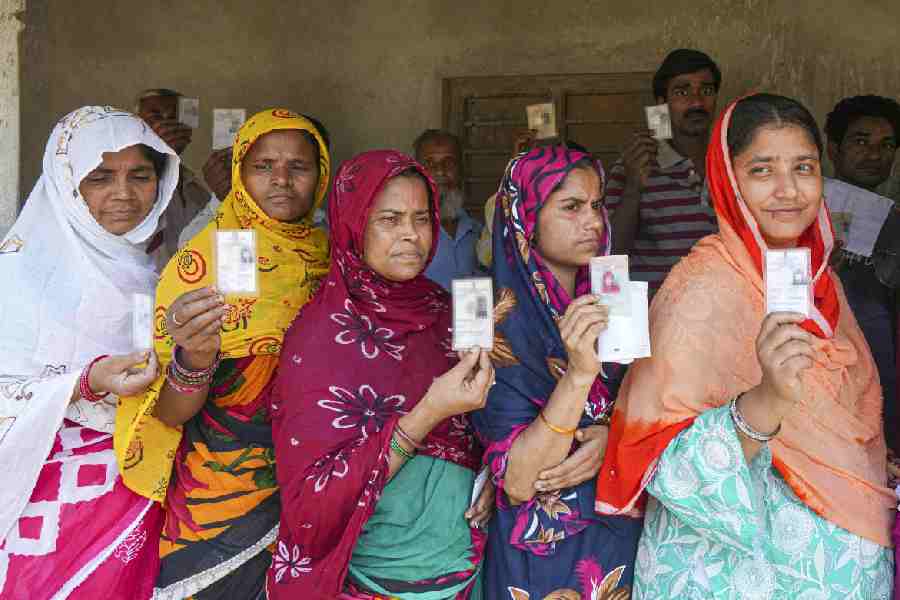
Booth 238 — which has 121 Hindu and 415 Muslim voters — bears testimony to the alacrity with which voters in minority-dominated pockets cast their vote during the first phase of this post-SIR Bengal election.
While Booth 238 stole the limelight, others did not lag. By 9pm, the 152 first-phase constituencies had witnessed an overall turnout of 92.35 per cent — a record for any single election phase in Bengal. Some people were still expected to vote after 6pm.
The Election Commission claimed the measures taken to ensure free and fair polls had encouraged people to come out and vote, but political
observers said the SIR scare too had to be taken into account.
Some underlined that the turnout figures would have risen also because of the deletion of a large number of absentee, shifted, duplicate and dead voters.
An election official in West Midnapore attributed the high polling partly to the fear among many, in the context of the SIR, that those who fail to vote might have their names removed from future electoral rolls.
“Polling personnel spoke to voters at the Garbeta booth and learnt this was the result of fear following the SIR,” he said.
“Many migrant workers returned to their village, spending thousands out of their own pockets, only to vote.”
By the time polling had opened at 7am, the majority of the voters of Booth 238 had queued up before the Uttarbill Majhpara Shishu Shiksha Kendra, the polling station. By 1pm, some 518 voters — 96.64 per cent — had voted.
“I have never before in my 15 years of handling elections seen such a huge turnout,” an official monitoring the election in Garbeta said.
“To avoid any controversy, we cross-checked repeatedly with the polling officers
to ensure everything was in order.”
Several voters confirmed that panic over the possible deletion of those who did not vote had prompted many to cast their votes early.
“Those who work outside the district had returned home two days before just to vote,” said Ashajull Pathan, 47, a voter registered with Booth 238.
Constituencies like Raghunathganj, Bhagabangola and Lalgola in Murshidabad, where over 80 per cent of the voters are Muslims, saw turnouts above 95 per cent.
According to a 5pm report, the turnouts in these constituencies stood at 95.64, 95.07 and 95.31 per cent.
At Booth 72 in Madhya Garibpur Primary School, in Domkal Assembly constituency of Murshidabad, the turnout was 98 per cent. A source said all the 723 voters of the booth were Muslim.
“Already, many names have been removed from the electoral rolls, and if further deletions happen because of voters abstaining from voting, it would be another blow to us,” Abul Basar, 45, a farmer registered with Booth 72, said. “So, (nearly) all the voters voted this time.”
Political scientist Biswanath Chakraborty said: “The minorities were particularly concerned about the large number of deletions during the adjudication
process. That is why the turnouts are much higher in these areas.”
He added: “Another reason is that the voters, irrespective of religion, wanted to check whether their names had been correctly included in the electoral rolls.”
Migrant ‘photo proof’
Many migrant workers, particularly Muslims, who had returned home to vote clicked selfies outside the polling booths after voting, holding up their ink-marked fingers.
“I clicked a photo outside the booth and saved it on my phone,” said Mobarak Sheikh, from Olitola village in Mothabari Assembly constituency, Malda, who works in Mumbai.
“I did it to prove that I am an Indian voter and that I cast my vote today, in case anyone questions my citizenship at my workplace,” he said.
Ramzan Ali, from Hariharpara in Murshidabad, who earns a living as a hawker in Odisha, asked a friend to capture him on camera after he had voted.
“We are often labelled Bangladeshis — this is proof that I am an Indian and have cast my vote. The ink mark will fade, so I wanted to have a snapshot taken outside the booth to counter such allegations in future,” Ali said.
Additional reporting by Alamgir Hossain from Murshidabad and Soumya De Sarkar from Malda