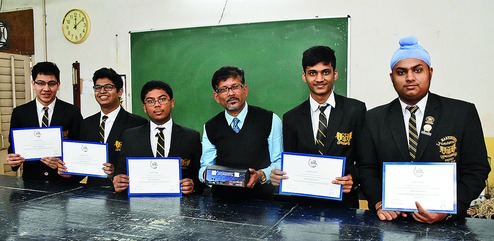

Calcutta: A schoolboy team named after a Greek god found inspiration in a simple screensaver of a mountain to create a physics experiment that has wowed scientists at CERN, the Swiss research hub that nailed the elusive Higgs Boson.
Team Hephaestus from La Martiniere for Boys won a Raspberry Pi-based cosmic ray detector from CERN as the prize for making it to a shortlist of 30 in a global competition featuring 180 teams from 43 countries.
Chirag Ashis Sarkar, Kshitij Gupta, Aditya Berlia, Yash Vardhan Didwania and Harsh Deep Singh had got together after their Class XI exams to brainstorm for the CERN outreach programme called Beamline for Schools when an idea emerged from an unexpected source.
"One day, we were in a cafe when Aditya stopped at a screensaver of a mountain on his laptop. This was the genesis of our experiment," Kshitij recounted.
The boys had till then been grappling with the challenge of devising an original experiment that could be run at CERN using its beamline. It also had to have some practical applications, Chirag said.
Since scientists at CERN were focused on identifying the properties of anti-matter, Team Hephaestus thought they should study the behaviour of gravity in matter and anti-matter. "Why not send a proton beam to a sample material from the mountain and watch the characteristic X-rays that would emerge? From that, we hoped to identify the ores of the sample," Harsh said.
The team, coached by teachers Debasis Roy and Subrata Roy, wanted to use oil as a sample, but learnt that they could not use any organic substance. Hans Peter Beck from CERN, who had been advising them over email, gave a new direction to the experiment.
Since most experiments in geo-physics are expensive, tedious and often unreliable, the La Martiniere boys decided to try finding a way to identify ores by sending high-energy electrons. The idea clicked, although they didn't win the top two prizes that would have assured them of a trip to CERN.
"The quality and creativity of the proposals is inspiring. It shows the remarkable talent and commitment of the new generation of potential scientists," said Charlotte Warakaulle, director for international relations at CERN.
For Team Hephaestus, assembling the Cosmic Pi they won is the next project. "We are very excited to have got the detector and T-shirts and certificates from CERN. This has whetted my appetite to study particle physics," Kshitij said.