 |
 |
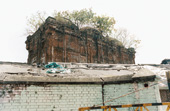
| Basri Shah mosque as it was and (below) now with its domes covered with cement. Picture by Sanat Kumar Sinha |
The best way of conserving a heritage structure is getting the people of the neighbourhood in which it is located to take care of it. But, on the other hand, local people may not be best equipped to “restore” a dilapidated structure falling to pieces as a consequence of years of neglect. Not that government agencies or undertakings such as the Archaeological Survey of India, the Life Insurance Corporation of India, which is one of the wealthiest landlords anywhere, or the Calcutta Municipal Corporation always do a satisfactory job of restoration but they can be pulled up for their lapses, if the public so wishes.
The Muslims who live in the industrial belt of Cossipore have taken it upon themselves to repair and reuse the Basri Shah mosque at 8 Sett Pukur Road, built in all probability between late 18th century and early 19th century, and considered the oldest extant mosque in the city.
Constructed seemingly at an elevation higher than that of the buildings and hutments of the workers’ colony encircling it, not only does this rectangular structure dominate the area but it is also visible from the new bridge connecting Chitpur with Barrackpore Trunk Road across the Cossipore railway yard. With parasitic vegetation growing from its three domes like hair standing on end, it was a picturesque sight. A small colony with many Hindu residents has grown around its base, and a narrow brick strairway leads to this place of worship whose walls were once used to dry cowdung cakes. Actually, there used to be many rooms on the ground floor but these are not accessible any longer. It was blocked from inside and all the chunam or lime and surki or brick dust plaster had disappeared, exposing elaborate brickwork of great delicacy. The walls were ornamented with graceful stucco work seen in temples and stately homes of the same vintage. The same mason constructed them, after all. The construction of this mosque is attributed either to Zafar Ali Khan, the dewan of Siraj-ud-Doula, who moved to this area after the Battle of Plassey, or Nawab Reza Khan, but it is said to have come up in the early 19th century.
Now, scaffolding has been erected around it, and all the delicate brickwork is under layers of cement. A steep flight of stairs to the mosque has been constructed of late on the road itself, and its interiors lie exposed for the first time in many years. A man supervising the repairs said local people decided to repair the abandoned mosque and collected subscriptions. He was innocent of the use of lime plaster, but claimed that skilled masons have been hired now as the earlier work was unsatisfactory.
The interiors of the mosque are being repaired too. Its ceiling is covered with floral motifs and is encrusted with plaster creepers that enrich its starkness. There was no point arguing with him that cement does more harm than good to such an ancient structure. But since the Calcutta Municipal Corporation has used cement with impunity to repair the natmandir of Sobhabazar Rajbati, who can stop these well-intentioned people?
A few yards away is the mazar of Hajrat Hassan Basri Shah Rehamatullah Alai Chitpur Dargah, which may be centuries old but must have been made over in recent times. One of the mutawalis confirmed that the mosque had not been in use for decades and prayers will be held there once again.
Not very long ago, the civic authorities had declared their intent to renovate two of the city’s oldest temples at Boral and this mosque as well. Nothing came of it. And now locals have come to the rescue of this mosque.
Calcutta is only 300 plus years old, and relatively old structures such as this mosque are part of our common heritage transcending their religious identity.