 |
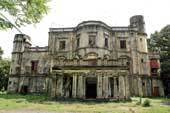
| The derelict Roxburgh Building in a restricted area of the Indian Botanic Garden, which may be restored soon. Picture by Sanat Kumar Sinha |
Roxburgh Building and the herbarium, that boasted one of the richest collections of plant specimens anywhere, and the library in front of it in a restricted area of the Indian Botanic Garden in Shibpur, which went to rack and ruin after they were abandoned in the 1970s, may be soon be restored to their former glory.
M. Sanjappa, the director of the Botanical Survey of India (BIS), has sought the help of experts from IIT Kharagpur. Earlier, in the mid-1990s, a grant of Rs 35 lakh was received to repair the 200-year-old structures, and the Central Public Works Department (CPWD), which is in charge of the upkeep of the 273-acre garden, had been routinely assigned the job.
“But I was not happy with CPWD’s work as conservation architects are necessary to execute the restoration project,” says Sanjappa. “I have plans to turn the building into a museum that will also house the herbarium, the way it was earlier.” Sanjappa had good reason to be apprehensive about CPWD’s intervention. The CPWD was responsible for the destruction of the Currency building in Dalhousie Square and more recently, of the Sailors Chapel in Hastings. But unless urgent measures are taken to restore both the heritage buildings they will fall to pieces.
The sprawling garden on the banks of the Hooghly opposite Metiabruz was founded by Colonel Robert Kyd in 1787, and William Roxburgh was its first salaried superintendent between 1793-1814. The building named after him was constructed around 1794, and although initially it served as Roxburgh’s residence, he subsequently constructed the herbarium and the library in the dilapidated house opposite it. Roxburgh was a pioneer in botanical studies in India and he had written Flora Indica, once the bible for botanists studying Indian flora.
A herbarium is a storehouse of dried plant specimens arranged scientifically and classified for the purpose of future study and research. Only 2.5 lakh species of flowering plants have been discovered so far. In India, 17,500 flowering plant species have been discovered.
The herbarium contained 2.5 million specimens collected from all over the world and different corners of India. The herbarium-cum-library adjacent to Roxburgh building came up in 1882. As the condition of the two buildings deteriorated all the valuable specimens and books were shifted between 1973 and 1975.
The original plans of the buildings are not available. After Independence, the British had perhaps carted out all the documents. The garden was renamed the Indian Botanic Garden in 1950, and up to 1963 it was under the administration of the state government. Subsequently, the Centre had taken it over. The papers may have been lost in the interregnum.