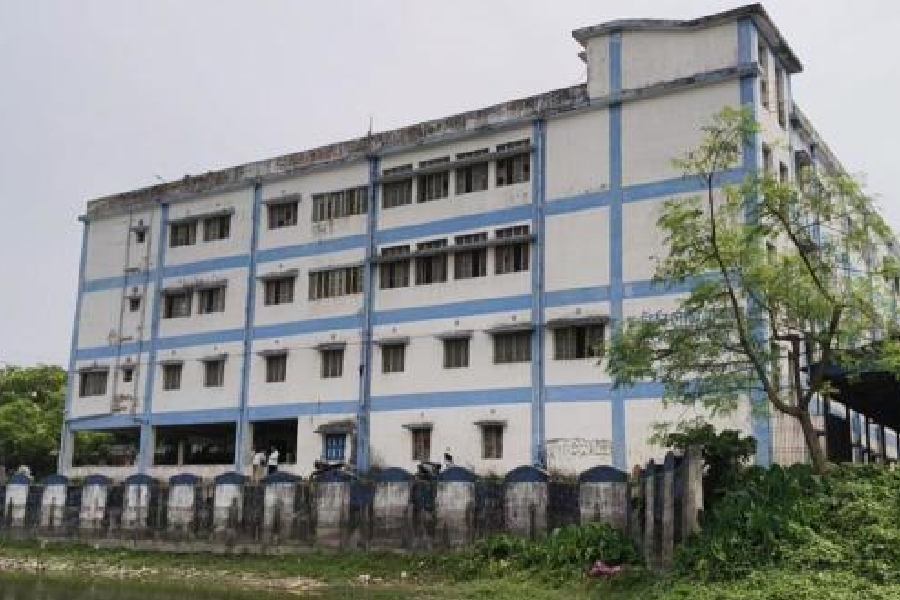
Ten-foot-high boundary walls ringed with barbed wire. Separate enclosures for men and women. Open spaces, LPG connections and medical dispensaries.
These are some of the specifications for the holding or detention centres for illegal immigrants, mostly Bangladeshis and Rohingyas, that the Union home ministry has circulated among the states.
“All the states and Union Territories have been asked to set up these centres, where illegal immigrants will be held until their deportation, with a 10-foot-high boundary ringed with barbed wire. Private buildings can be rented if government land is unavailable,” a home ministry official told The Telegraph.
“The states have been asked to provide separate enclosures for men and women, open spaces, LPG connections and medical dispensaries. Members of the same family must be housed together, not separated. The collection of inmates’ biometric data is mandatory.”
The guidelines stipulate a medical checkup when an inmate is put in a detention centre, the maintenance of inmates’ complete medical records, and provisions for adequate medical attendance.
Asked to estimate how many illegal Bangladeshis are staying in India, the official said it was impossible to give an exact number since they lived in “various parts of the country” and because such immigration had been “going on for several years”.
'Not feasible'
“The states must verify within 30 days the credentials of suspected illegal immigrants living within their boundaries. If the individual fails to produce Indian citizenship documents within this period, deportation proceedings should be initiated,” the official said.
“District magistrates have been designated as the competent authorities to verify citizenship claims and oversee the identification process.”
If the suspected illegal immigrants claim residency in a different Indian state from the one where they are under scanner, an upper limit of 90 days has been fixed to verify their antecedents, the official said.
“These deadlines are too tight to be feasible, particularly since the state police forces are already overburdened with their regular work,” the official said.
All the states have been asked to set up a special task force in each district to detect undocumented immigrants and submit a monthly status report on foreigners missing or overstaying their visas.
Harass concern
A former BSF director-general expressed a widespread concern, saying the governments must ensure that the detect-and-deport policy “does not lead to harassment of bona fide citizens of this country”.
“India has millions of bona fide citizens who do not have birth certificates or supporting documents. Most of them are poor and marginalised people,” the former BSF director-general told this newspaper.
“The states must ensure that the verification process is transparent. Genuine Indian citizens should not be harassed and detained in such holding centres.”
Scores of Bengali-speaking migrant labourers — mostly Muslims — last year alleged police harassment and torture in BJP-ruled states on suspicion of being Bangladeshis, with some summarily pushed across the border without a court order.
The former DGP cited the instance of Sunali Khatun, a Birbhum woman detained by Delhi police and pushed into Bangladesh last year on suspicion of being an illegal immigrant.
She and her young son were later brought back to India in December under orders from the Supreme Court, which declared her an Indian citizen, almost six months after she was pushed out.
Last week, the Centre told the Supreme Court that it had decided to bring back some others pushed into Bangladesh and then verify their claims of Indian citizenship.
The apex court is hearing the Centre’s appeal against a September 2025 Calcutta High Court order that set aside as “illegal” the government’s move of deporting Sunali and others to Bangladesh.
The former DG underscored that deportation was a thorny and long-drawn affair, often resulting in the violation of the detainees’ human rights.
“What if the purported country of origin (Bangladesh or Myanmar) refuses to officially accept those detained as its citizens?” he said.
“Those detainees would then be rendered stateless. What will the government do, then? These detainees will have no option; they will be stuck in the holding centres indefinitely.”