
Calcutta, June 18: A forum of civil society members and general electricity consumers has demanded the withdrawal of the latest hike in tariff, restructuring of the power regulator and making consumer participation in rate revision decisions mandatory, besides ending the CESC's monopoly.
The People's Movement Against Power Tariff Hike held a convention at the Yuva Kendra in Moulali yesterday, which was attended by several hundred people. The forum protested the "conspiracy of silence" of the state government and the Opposition on the private power utility's monopoly and the high tariff charged by it.
"The tariff hike in CESC-served areas has been steep over the past four years. What's worse, poor consumers are having to shoulder a heavier burden on account of the utility's policy," said former state power minister Sankar Sen, widely regarded as the pioneer in power sector reforms in Bengal, in a video message.
Sen had been sidelined by the Left Front after he took on the CESC in 1999 to stall the utility's efforts to charge consumers fuel surcharge with retrospective effect.
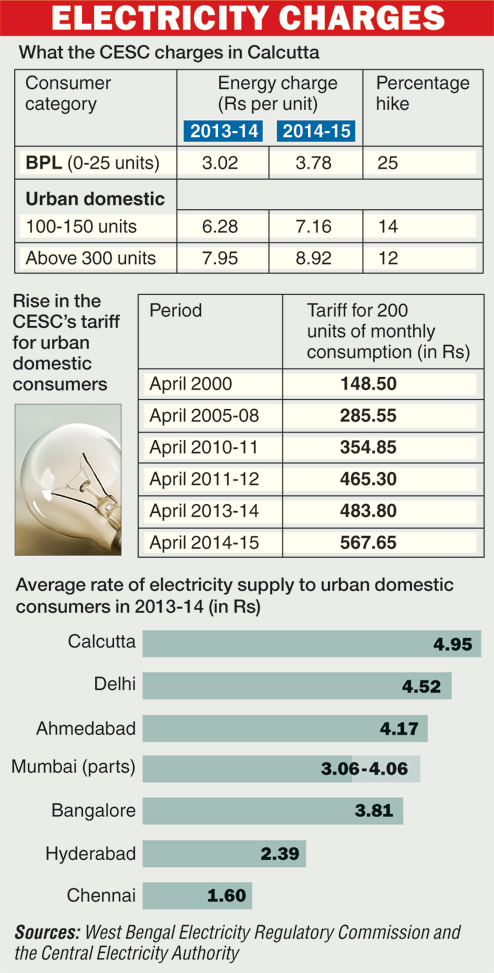
"Urban domestic consumers in Bengal are forced to shell out one of the highest power tariffs in the country for that key category. This must stop," said former West Bengal Renewable Development Agency director S.P. Gon Chaudhuri.
According to economist Ratan Khasnabis, the latest hike allows the CESC to charge Rs 6.97 per unit on an average from 2014-15, up from Rs 6.10 in 2013-14. He said the tariff for urban domestic consumers had risen in "leaps and bounds" since Trinamul came to power in May 2011. There are over 26 lakh such consumers in Calcutta, its adjoining pockets and Howrah.
"This movement must be intensified to bring about greater awareness among consumers," Khasnabis said.
CESC officials declined comment on the movement.
Responding to questions in the Assembly last week on the high tariff, power minister Manish Gupta had said the Mamata Banerjee government believed in lowering rates over time, but not by way of subsidies.
"For the sake of popularity in the short term, we cannot drastically lower tariff by heavily subsidising power, thereby increasing the burden on other sectors. That's how some of the other states with lower tariffs operate," Gupta had said, adding that the government had no say in the tariff charged by a private utility like the CESC.
Economist Prasenjit Bose, the organiser of the convention, was unwilling to buy Gupta's argument and advocated the need for competition among multiple utilities, like in other states.
"The government must ensure a stronger regulatory commission, which does not remain a rubber stamp of the utilities," he said.
According to him, the CESC has not been doing enough to increase its operational efficiency and is relying on increasing power tariff to maximise profits.