 |
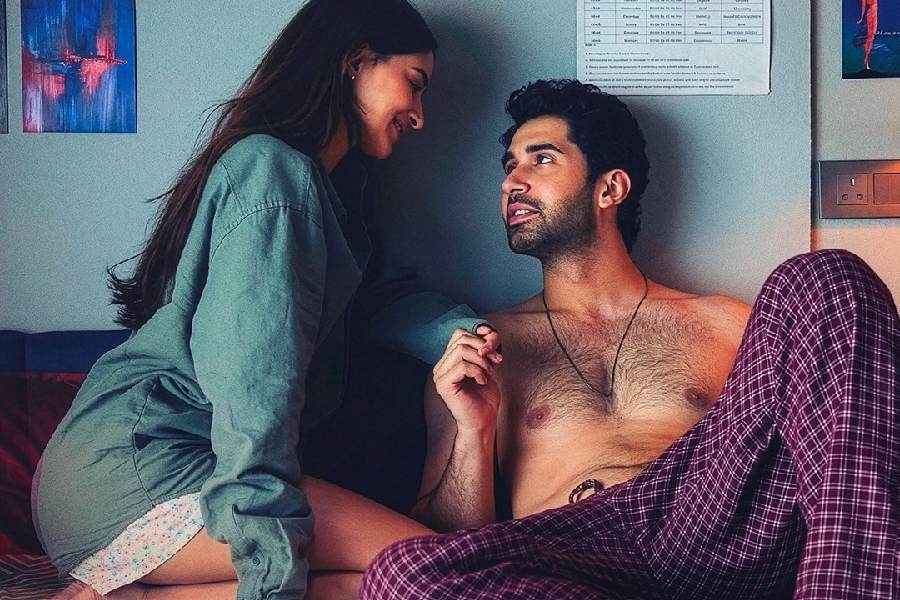
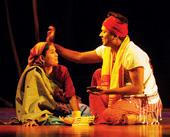
| A scene from Madhyabartini |
Peter Brook’s set designer Jean-Guy Lecat has been hired for a Tagore play to be staged in the city, which will see a spate of Tagore performances in the year leading to his 150th birth anniversary.
Lecat will be working on a production of Raktakarabi and young sarod artistes Amaan and Ayaan Ali will provide the score. But few of the other stage versions are based on Tagore’s plays.
Film director Gautam Haldar will direct the Purba Paschim production Raktakarabi to premiere on August 28. He tries to explain why Tagore the playwright is not so visible.
“We said nothing when Girish Karnad declared that Tagore’s contribution as a playwright was negligible, because we haven’t even begun to recognise the value of his work. What many writers have sought to express through entire plays Tagore does in a line of casual dialogue,” he says.
Is Tagore’s greatness going against him? Or is Tagore the story-teller more relevant than the playwright today? “Tagore was a genius trying to provoke a new idiom of play writing,” says Suman Mukhopadhyay. But he is following up his stage Raktakarabi and film Chaturanga, based on the Tagore novel, with a stage version of Ghare Baire.
“We will be using Ray’s film script but view the story from today’s perspective. Sandip’s craftiness, plus the feeling that the ‘parivartan’ he is clamouring for is not for the general good, are very relevant.” Ghare Baire, presented by Trityo Sutra, will premiere on August 30 at the Purba Paschim Tagore festival.
The poem Birpurush has just been launched as a play by Koushik Sen’s Swapnasandhani. Baharul Islam’s troupe Seagull from Assam will stage Tagore’s short story Madhyabartini on August 31. “Tagore’s plays have been done so often and by the best in the job,” he says. “Also, the trend just now is against well-made plays.”
Playwright Chandan Sen has dramatised a Tagore story to offer “more layers of meaning”. Thus are included historic figures like Keshab Chandra Sen, Vidyasagar and Rammohun Roy who opposed child marriage practices in his version of Tagore’s Tyag, to be presented by Ha-ja-ba-ra-la on July 4. Muktir Upay, to be presented by Sayak as Mukti Mukti on July 23, will be a “slapstick comedy that tries to document the times”.
Debashish Majumdar is penning a play on the Jallianwala Bagh massacre and Tagore. “The play does not present Tagore on stage but we see his secretary Prasanta Chandra Mahalanobis who knew of his letter rejecting the knighthood and how he was snubbed when he approached Deshbandhu Chittaranjan to launch a mass protest.”
Uma Jhunjhunwala’s Little Thespian presented two nuggets on love and sacrifice: the short stories Durasha was performed in Urdu-Hindi on June 14 and Shesher Ratri on June 16. They are part of an NSD-aided Katha Collage festival.
Gautam Haldar’s Naye Natua will present the poem Horikhela as a musical and Shib Mukhopadhyay’s Howrah group Natadha has come up with Mrinal Eka, a version of Strir Patra.
 |
| Fans of Brazil and Argentina in action at the World Cup 2010. (AFP) |
Brothers at war
They are loving brothers and arch rivals. Robin Boral, 76, with his head full of white hair, has been cheering out loud in the dead of night in his Southern Avenue residence for Brazil for decades. Ronen Boral, four years younger, does the same for Argentina. They have not missed a World Cup match in 50 years. And they have never agreed.
“Brazil was always my favourite. No other team could match up to their style of attacking soccer and elegant passes. Players like Nilton Santos, Eusebio and Didi were instrumental in powering the five-time world champions. Not to forget Pele,” says Robin.
Ronen is a Mohun Bagan fan, but otherwise fanatic about two time-world champions and 14—time Copa America winners – Argentina. “What sets Argentina apart is the quality of their centre forward players and their strong defence. The indomitable presence of Diego Maradona has only powered the team,” counters Ronen.
Their sister Rupu Boral recalls how her brothers go on arguing about the teams.
Football has changed. Robin recalls the Seventies when one could always see people huddled around the radio in roadside teashops. “Today’s World Cup is all about total football. There is not much of individual brilliance compared with earlier times,” says Ronen.
But the Brazil-Argentina divide has not. “It is quite well known that if there is any team which could beat Brazil, it is definitely Argentina,” says Ronen, smirking at his elder brother. And thus goes on a great Calcutta tradition of argumentation, started decades ago.
Of mice and mobiles
Rodents are known for their frightening destructive abilities.
It is a proven fact that they destroy more foodgrain than they can possibly consume. But whoever has heard of a rat stealing a mobile phone?
 |
This is apparently what happened recently at the crossing of College Street and Bowbazar. A small crowd had gathered at the Bowbazar crossing around one of those cement vats people put up on pavements all over the city to beautify their surroundings.
A man was frantically digging up the soil and had already created a largish hole in the middle. Was he one of those yogis who stick their heads into the ground ostrich fashion and apparently hold their breath, some say for hours? No such thing, said an onlooker.
The man had lost his mobile and his cool and he was convinced that one of the huge rodents that run around freely in his eatery had escaped with it. So he was digging up the rat hole to check if the thieving rodent had secreted his booty there. It is not known if the man found his mobile. One wonders how a rodent would use a mobile phone.
(Contributed by Sebanti Sarkar and Vishnu Varma)