
Calcutta: Riots in Maniktala; Muslim League's walk down Esplanade and the social segregation faced by refugees from East Bengal - it was a throwback to 1946 and the aftermath of the Partition for the audience at The Bengal Club on Monday.
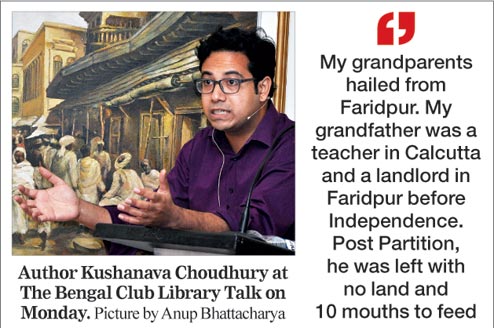
The Bengal Club Library Talk, with The Telegraph, author Kushanava Choudhury read out extracts from his debut book The Epic City: The World on the Streets of Calcutta.
Choudhury's talk focused on a particular chapter, Russian Dolls, that highlights the bloodshed in the run-up to Independence.
The author began with the Bengal famine in 1943 and went on to describe the texture of communal riots in various localities. Several members from the audience joined in to share personal anecdotes.
"I remember seeing the riots from my terrace. We would even eat and sleep there, to stay alert round the clock...," said octogenarian Atmaram Sarogi.
"I was seven and I remember the rioting in Howrah. I still live in that house," said Samir Dutta, 78.
Chaudhury observed how such accounts, if strung together, can give a picture of what happened in every locality during the riots. He, too, narrated some personal stories of the Partition.
"My grandparents hailed from Faridpur. My grandfather was a teacher in Calcutta and a landlord in Faridpur before Independence. Post Partition, he was left with no land and 10 mouths to feed ...," Choudhury said.
The conversation veered towards the life around refugee camps post-Partition, the squalor, abuse and social segregation faced by the residents there and to Ritwik Ghatak's films. "The day-to-day indignation faced by the refugees is unbelievable," added Chaudhury .
His talk also touched on the Cossipore killings, the Ghoti-Bangal strife and Calcutta of the present that looks more like a "sinking ship" abandoned by the present generation.
"It took me more than four years of research to write the book," he signed off.