 |
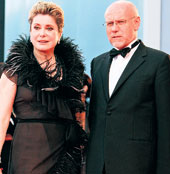
| (Right) Marco Müller, director of Venice Film Festival, with French actress Catherine Deneuve at the festival in 2006. (AFP) |
Marco Müller is the director of the Venice Film Festival since 2004. Born in 1953 in Rome, Müller, an India and China expert, created the mammoth Electric Shadows festival in Turin (1981), and directed the Pesaro (1982-89), Rotterdam (1989-2001) and Locarno (1991-2000) film festivals.
Subhro Saha caught up with him in Beijing recently, during the launch of the 70th edition of Colors, the magazine of Fabrica, Benetton’s communication research wing. Müller, who heads Fabrica’s cinema division, talks about Ray, Ghatak and Calcutta, familiar with all three. Excerpts:
Q: You have been in touch with Bengal cinema all through. Are there any directors in Bengal Fabrica Cinema would like to showcase?
A: I have been desperate to find new directors who would fit into the vision we have for Fabrica Cinema. For years I have been talking to both film schools in Bengal — the SRFTI and Chitrabani. Both Goutam (Ghose) and Buddhadeb (Dasgupta) — former chairmen of SRFTI — are my old friends. I have a special chemistry with Calcutta and Bengal and have been waiting for a chance to spend more time in Calcutta. Probably a special issue of the Colors magazine dedicated to Calcutta will be the strongest idea to connect with Bengal.
Q: While Ray has always been properly projected in the West, the same can’t be said of Ghatak. Can Fabrica do something to change this?
A: I was the first in Italy to organise a complete Satyajit Ray retrospective in 1984 as director of the Pesaro film festival and the following year, I did the first complete Ritwik Ghatak (still Ritwikda to Müeller) retrospective in Pesaro. That’s how I met Ritoban and Mrs Ghatak.
Ghatak is my favourite Indian film director and I think it’s a scandal for western culture that while everybody keeps celebrating Godard, nobody talks about the Godard from the other half of the world — Ritwik Ghatak. With Goutam I have been discussing the possibility of joining the efforts of the Benetton Group and a private group in Bengal for something big on Ghatak. With Buddhadeb I have been doing the same. I have always been very fascinated by these two strong personalities —Ray and his Tagorean interpretation of modernity and on the other side and the radical interpretation of modernity represented by Ghatak…
Q: What about Mrinal Sen?
A: Of course I was very fascinated by Mrinal too. He contributed to shaping our consciousness of how Bengal was changing.
Q: Do you feel Bengali cinema has fallen short of expectations in recent years?
A: One reason why Bengali cinema is not as diversified and exciting as it used to be probably lies with the fact that I only see two modes of production. Bigger budgets and hence an orientation which has to go more mainstream, and maybe too small budgets — too small to make it to even the national arena, which is so suffocatingly controlled by big Bollywood films.
Buddhadeb and Goutam are working towards fostering young talent. And there are many good short film directors.
Q: Where do you see Calcutta figuring on the national matrix in future?
A: Apart from the aesthetic relevance of Bengali cinema, there’s another important issue. You only have the complete cycle of production in three cities — Mumbai, Chennai and now in Calcutta. Also I have been discussing with my Bangladeshi friend and Nobel Peace Prize winner Muhammad Yunus and I’ve been stressing the fact that on two sides of the border, there should be, as in the past, only one cinema. The conditions are ideal for Calcutta to stay the pole of attraction.