 |
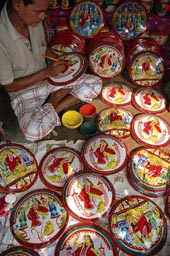
| An artist gives finishing touches to lakshmi patas in Kalighat on Friday. Picture by Sanjoy Chattopadhyaya |
From Kalighat patas to thriving theatre, there are so many things unique to our quixotic city that live on in some creative idiom or the other
through more than 300 years of its history, our city has been witness to the slow but inevitable death of many art forms. Some of them were folk imports from rural Bengal, and some surprisingly enough were city-grown, products of the first Western-style urban experience in this subcontinent. Though the Jeleparar Shong was certainly rural in origin, its culmination as a subaltern urban art form quite impressed even its European observers during the 19th century. Perhaps the Jeleparar Shong disappeared with the jeles themselves, the fishermen who lived on the fringes of the Sutanuti village, but its contribution to the Bangla language and its satirical poetic form became a heritage that continues to enrich our literature.
A similar experience was duplicated in our Kobir Lorai and its splendid Kobial tradition that created fine poets and social commentators like Bhola Moira and Anthony Firingee. Whether they disappeared because they became archaic or not is for the cultural historian to decide. Though the specific form itself may have died, their spirit continues to re-invent and thereby rejuvenate itself in other myriad living art forms. Where else would you identify the sources of the fine satirical tones and temper in the poetry of a Shakti Chattopadhyay?
It is interesting to observe how the art forms that found their home in Calcutta continually transmuted themselves with the demands of time and circumstance. Take the Kalighat pata. It began principally as painting of religious icons to be sold to pilgrims who came to the Kalighat Pitha. Gods and goddesses painted traditionally on the earthen shawra, soon found themselves rendered on paper. The urban experience saw recognisable living characters and stereotypes supplementing the gods and goddesses themselves as visual sources. Cartoon drawings that lampooned contemporary events and social aberrations took the Kalighat pata further away from its original traditional religious form and content to a much wider, more eclectic and secular expression. That was when the craft blossomed into a full-fledged art form.
The arrival of the lithograph and the rise of the printing press took the wind out of the sails of the Kalighat pata as a popular art form. But the re-discovery and adaptation of its figurative style by Nandalal Bose into a new language of painting has left an invincible impression of the Kalighat style on the contemporary Indian art idiom, influencing even artists as far removed from the Bengal tradition as Maqbool Fida Hussain.
Once again, a Calcutta art form had died, but its spirit continues to survive in myriad ways and means. This process of assimilation deeper into tradition and heritage is something that perhaps needs to be carefully studied by more serious scholars, but as an active participant in our city?s culture, I cannot avoid the intimate presence of our own art forms.
There are many other disappearing and disappeared art forms that have belonged to our quixotic city. Perhaps it is not right to bemoan their demise, but to expect and to watch keenly whether their experience reappears in other more interesting and timeless forms. Like the Jeleparar Shong or the Kobir Lorai in 19th century, there have been other performing arts that have faced the ravages of time and circumstance.
The street circus acrobats who performed on Sunday afternoons on the Maidan and on the pavements of the poorer districts of the city, are slowly thinning out. Animal rights notwithstanding, it is rare to find the bandar naachwala on the streets today. Despite political correctness, I for one, am sorry to see them disappearing, because I cannot help remembering the hours of joy that they contributed to my childhood.
Calcutta had always been proud of the fact that ours was the only Indian city where you could see a particular play on Thursdays, Saturdays and Sundays, along with the matinee. It was our answer to New York?s Broadway and London?s Drury Lane. That it has ceased to be there in the Hatibagan area of north Calcutta, where it prospered uninterrupted since the 19th century, is certainly a matter of regret. But the interesting thing is that our theatre has found ways and means of re-inventing itself. Group theatres, for instance, which had always offered a totally different fare to Hatibagan have now turned around in a new avatar.
The conversion of a small, and rather ignored little place on Hazra Road called Sujata Sadan is now the centre of a rather interesting activity by a cluster of group theatre troupes that offer plays regularly throughout the week there. What began through the experimental efforts of Swapnasandhani and others seems to have survived through its birth pangs, and managed to keep afloat for almost a year now.
The bid to survive has meant that theatre has had to be innovative in ways that group theatres had earlier never faced. Swapnasandhani, for instance, has produced a children?s play called Bhalo Rakkhosher Golpo, whose popularity has certainly helped to keep their Saturday evenings efforts continuing. It has not entirely been a matter of money alone to keep projects like the revival of Sujata Sadan going, but also of finding a certain amount of popularity.
Another theatre hall in south Calcutta, Tapan Theatre, was closed for more than a decade. Recently it was revamped, with air-conditioning put in, and opened to a commercial play. The production may not be doing as well as it had hoped to do, but I was rather touched to see advertisements for the play on cable TV. This in itself is an event of signal importance. A Bangla play in town advertising on the box is quite a startling cultural phenomenon! If nothing it shows the zeal to succeed that accompanies the efforts of those who have put in their might behind the Tapan Theatre revival.
These stories of cultural revival are also stories of reaffirmation of the city?s will to live and express itself. They cannot all afford to be success stories, but based on individual merit, some of them will be successes. Despite everything, a strange optimism seems to have kept our city alive, and now that the future seems to be brighter than ever before in recent years, I think it is not unfounded to hope the best.