 |
All the books in the world won't help you if they’re just piled up in a heap.
— David Eddings, King of the Murgos
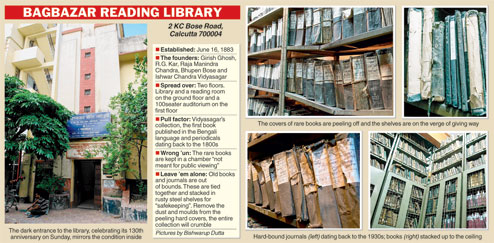
Heaps of books piled up to the ceiling in rusty steel cabinets and a lung-aching dampness in the air symbolise the decadence at Bagbazar Reading Library, which turns 130 on Sunday and probably a bit more withered.
Literary luminaries Girish Ghosh, R.G. Kar, Raja Manindra Chandra, Bhupen Bose, Ishwar Chandra Vidyasagar and their friends helped set up this “seat of learning” on June 16, 1883. In this private library, they masticated every written word in hushed silence and ideated the shape of a nation’s future.
The government took over the reins in 1977 and accorded the institution town library status in 1986. By then the rot had set in.
A fresh coat of paint reflected the enthusiasm of celebrating its 125th anniversary in 2008, but the rust on the steel racks and the dust on the worn-out books remained. The downtrend has accelerated in the five years since Metro last visited the institution, which ranks second only to the State Central Library and the Calcutta Metropolitan Library.
Plastic bottles and garbage litter the entrance, where two platforms for planting flowers have turned into spittoons.
In the dim and musty library with dead incandescent light bulbs hanging from loose wires, prized books have been tied together to keep them from falling apart and stuffed into racks surrounding the 10-seater reading room. Hardbound journals with their jackets peeling from the seams are being stacked from floor to ceiling at the dark end of the room.
The library’s collection ranges from the first book published in the Bengali alphabet in London in 1811 to several first editions of Tagore’s work. It flaunts an assortment of books on literature, science and travel.
The broken cabinets placed against damp walls hold a collection of 49,500 books and 10,000 rare publications and periodicals that are more than 100 years old. Only 1,100 have been digitised while the rest of the collection is waiting to become a feast for moths and book bugs.
The topmost of Calcutta’s three town libraries does not have a fumigation chamber to keep the worms in check or any preservation equipment for the old and rare books. Most importantly, it is going through acute manpower crisis following downsizing of its workforce in recent years.
Town library rules specify that Bagbazar Reading Library must have a librarian, a daftari-cum-bookbinder, a library assistant and a night watchman — the last two posts have been vacant for a long time.
The library secretary, Dipak Bhattacharya, says the institution “has been without a night guard since 2005 and the daftari-cum-bookbinder will be retiring soon”.
“We’ve written to and met the bosses of library services to give us a daftari-cum-bookbinder. Our request has been turned down. The government doesn’t want to fill up any vacant post. In such a situation, what do you do? We hired three hands and pay them nominal salaries from subscriptions and donations that the library gets,” he adds.
“The library is living on the edge… don’t know how it will survive. These books (pointing to a dusty stack on a bent steel shelf) need a dedicated workforce to take care of them. We have prepared a proposal to laminate the books and make space on the terrace to accommodate fresh books. Hopefully our pleas will be heard,” Bhattacharya says.
If manpower crunch is common to most government-aided institutions, poor financial assistance is another all-too-familiar lament. Bagbazar Reading Library has been getting an annual grant of Rs 57,500 instead of the Rs 25,500 it used to get five years ago. The grant has doubled, so has the cost of commodities and services.
“We pay electricity bills in the range of Rs 48,000 per year. Then there are phone bills and maintenance expenses. How can we make ends meet with such little financial assistance?” says librarian Anamika Pal Chowdhury.
The state has provided three computers, which are used to maintain a record of the books and members. There is no Internet connectivity, though. “We’ve requested the Raja Rammohun Roy Library Foundation to send us some of their employees to help us feed data on our books into the computers. We are hard-pressed because of the staff shortage,” Pal Chowdhury says.
With membership dwindling from 1,100 to 700, the lending rate too has taken a hit from more than 100 books a day to less than 40 at present. In fact, not more than 450 members use the library to borrow books on a regular basis.
That shows why many popular books were last stamped in 1996, 1998 or 2003.
Have you visited the library recently? Tell us your experience at ttmetro@abpmail.com