 |
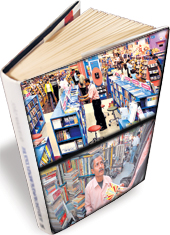
| The book section at Spencer’s, South City; (bottom) Sunil Kar at his stall. Pictures by Pabitra Das and Sanat Kumar Sinha |
Last weekend, the crowd surging into South City mall, the city’s newest and swankiest shopping destination, had yet another section to explore that had just raised shutters. If one entered the shop and took a left turn, through cosmetics, toiletry and myriad other products, one would reach the vegetable and grocery section. If one turned right, one would encounter books. But then Spencer’s Hyper is hardly the first shop to sell books alongside a wide range of products.
“When we opened in 1999, Oxford Bookstore was selling books alongside stationery,” recalls Gautam Jatia, the CEO of Starmark. The Lord Sinha Road address, then called Landmark, added more to the list — music, toys and other gift items. “A bookshop draws only book lovers. We wanted to create a family store where a child who might not want to go to a bookstore would love to come because of the toys. And we succeeded.”
But if Spencer’s Hyper has raised eyebrows it is because it has taken what might be the final step of the book’s journey towards commodification by appearing on the same shop floor as cabbage and cauliflower. It has to fight it out in the market on equal terms.
“Our thumb rule is that a product segment has to contribute at least as much percentage to the coffer as the percentage of the floor area it occupies. In our Gurgaon store, we have increased the area allotted to books when they started yielding much more than the space they occupied,” says Subrata Chowdhury, the president (music and books) of Spencer’s Retail. By the same logic, books might lose ground if they sell below par.
Old hubs
At the other end of town, in College Street, Aurobinda Dasgupta of the 122-year-old Dasgupta & Co has his arsenal full of charges against such multi-product markets. “I have been to such shops. They are air-conditioned, squeaky clean and play music. But scan the racks and all you find are dictionaries, new novels and some running titles that they call bestsellers. I wonder how they conclude which book is a bestseller, given that they stock books only from the big houses. The criterion of promotion should be a book’s quality. So many small publishers have come out with such brilliant books. It is our duty to promote them.”
The biggest differentiator that works in favour of traditional bookshops, in Dasgupta’s view, is the knowledge level of those who man the counters. “You ask for a book on Mughal history, they will show you 10, with suggestions on what to go for. In malls, all that a shop assistant will do is check on the computer and tell you whether it is in stock.”
Is the standalone bookstore under threat? Many traditional booksellers have succumbed, around the country and abroad. Santanu Das, a teacher at Queen Mary, University of London, points out how many bookshops in Cambridge have given way to clothes stores. In Delhi’s publishing hub Daryaganj, booksellers are known to clear their unsold stock at heavily discounted prices and turn to a different trade overnight. Dasgupta himself talks of a Bangalore bookstore that has started selling jewellery on the side.
How long can Calcutta stores keep their exclusivity? The margins, Dasgupta admits, are better for both clothes and jewellery. “But why should we change our tastes? We should try to buck the trend by giving more personalised service to customers.”
Foucault corner
The biggest battle to the big-book-at-the-mall is perhaps being given by pavement shacks like the one near the Ultadanga crossing. Illuminated by light from a Sony World showroom and sandwiched between handkerchiefs and statuettes, Sunil Kar sells Michel Foucault and Manik Bandyopadhyay, imported science journals and humble little magazines.
“Sometimes people ask me if these are second-hand — as if one can’t sell new books from the street,” says the soft-spoken but fiercely proud man who started his own enterprise after the bookshop he worked in closed down. He thrives on personal relations and personalised service.
Office-goers on their way back from Salt Lake and Baguiati stop to check out a stock chosen after scanning the review columns (his brother runs a newspaper stall). He also offers a 20 per cent discount. This means the margins are minimal. Yet Kar is surviving as he manages to sell Rs 4,000 to Rs 5,000 worth of books daily.
And the customer loyalty he enjoys is fierce. Some stop over at fixed times to chat with him and even keep an eye on the shop when he is away. “We have started this vigil after Sunil lost a book on Bikash Bhattacharya costing Rs 2,000,” says Tarun Pyne, a government employee working in Salt Lake. Yes, Kar has stocked and sold D.D. Kosambi’s Combined Methodology and Orhan Pamuk’s works even before he won the Nobel.
Many of his customers will never walk into a mall. “I feel awkward in air-conditioned bookshops,” admits Sudipta Dey, getting the Manik Bandyopadhyay edition of little magazine Korak packed. Some can but would not. “I choose the titles at Starmark and place the orders with Sunil. Just because the malls have sprung up have the local bazaars disappeared?” asks Dr Subir Roy of RG Kar Hospital.
‘I read, we learn’
But some people will not bother for discounts if allowed the comfort of malls. “I prefer to buy books unhindered by the press of people in a clean surrounding,” says IT professional Pinaki Majumdar. Many of these customers would not visit a bookstore otherwise. “Perhaps we have lost a generation of readers,” says Kalyani Ghosh, former teacher of English at Basanti Devi College who runs Thema, a small publishing house.
The evidence lies in the College Street pavements where the second-hand shops have over a decade started selling only syllabus-driven books. “Even in my student days at Presidency College about 15 years back, I have seen Proust’s Remembrance of Things Past in French being sold there. Not any more,” says Santanu Das.
“Today a product has to be seen to be consumed. That is why these shops have turned themselves into sites for various performances in the hope that some books get sold as a byproduct,” feels Supriya Chaudhuri, professor of English at Jadavpur University.
The new-age shops, points out Spencer’s Chowdhury, are drawing new customers to books. “We are starting a Reluctant Reader’s Programme, geared towards students,” he says.
Some companies have done the same for their jet-setting employees. “The executives have no time to read and rarely buy books. So companies hold workshops where someone shares the “gut” of a book with them. The concept originates in a US corporate practice called gutting,” says Pradip Dutta, a former MD of Lipton and Bata India, who has held such workshops here, christened “I read, we learn”.
Tough little magazines
Where does that leave the small publishers? “Perhaps nowhere,” wonders Samik Bandyopadhyay, editor and critic who is involved with Thema. “The economics of the big shops are such that their low-priced titles will never gain entry in air-conditioned environs. We cannot afford to give the huge discounts they demand, that too on sell-or-return clause. Also since books are treated as a commodity, utility guides the choice of the inventory.” He rues the botching of the Book Fair that robbed the small publishers of the biggest space for creative literature.
Author Kunal Basu, who would not pit malls against speciality book shops, feels little magazines will always find a way to reach their clientele, “like we did, by selling them on Pochishe Baisakh at Rabindra Sadan”. Author Nabarun Bhattacharya, who unlike Basu would be “shocked and ashamed” if his books are displayed in supermarkets, shares that optimism and calls for small publishers to pool resources. Pyne admits a lack of effort, remembering only one marketing initiative when Bandyopadhyay went to Bally public library to speak on theatre while related books were sold.
But even here Bandyopadhyay has a story of lost opportunity to share. “The chief minister had offered the Publishers and Booksellers Guild space in a building at the Park Street-Theatre Road crossing. This was to be used by a common distributor for small publishers. The offer was not taken up seriously.”
Word mart
One initiative many are looking forward to is the book mall coming up in College Street called Barna Parichay. “If they really sell books and nothing else, it would be just what the doctor ordered for all of us,” says Dasgupta. With 5.5 lakh sq ft on offer, the book mall’s developer Samar Nag is also full of optimism. “We will think of other products only if there are not enough takers among booksellers,” he says. The mall has both airconditioned and non-airconditioned space, keeping booksellers of all profiles in mind. There will even be a corridor for little magazines. The mall is scheduled for an end-2009 start.
Calcutta 2050?
 |
| The Latin American writers. Picture by Bishwarup Dutta |
They are all writers but almost without exception they have all turned to publishing on the side. A fortnight ago, a group of Latin American writers had gathered at the Palladian Lounge. The Book Fair, which had brought them to Calcutta, was not happening, but books were on their mind.
“We started publishing as desperate readers who find the racks full of non-books,” said Miguel Mena, poet, essayist and publisher from Dominican Republic. The story that emerged from the one-hour conversation was of how the corporate sector had shifted the focus of the Latin American publishing world to best-sellers. “Eighty per cent of it is dominated by Spain, where many of the companies are multi-nationals headquartered in Germany,” said Vivian Abenshushan, Mexican writer, essayist and editor, who started publishing to challenge the mainstream.
The dominance of the bestseller has led to books becoming perishable objects. “In a society like ours, where books are not pushed by the media, you need at least six months on the rack to make a book’s presence felt. The present scenario is only helping instant books, which is low-quality writing on some recent happening, and self-help guides,” Mena said.
Paco Ignacio Taibo, the oldest and most famous of them, grew up at a time when writings of all Latin American countries would be easily available across south America. Not so any more. “There was a big boom of reading in Mexico in the 60s. That is when the supermarkets started keeping books. They don’t believe in books but they sell books.”
As a result many independent bookstores downed shutters in the 70s and 80s. “I do not complain but as a small publisher I need access to the reader,” said Mena.
Mena has started giving talks on books in schools. He has even organised book meetings in cemeteries where he hires a musician to draw the crowd and the titles are laid out.“The library is too static for today’s readers. Books have to take on a new persona to reach out to them.”