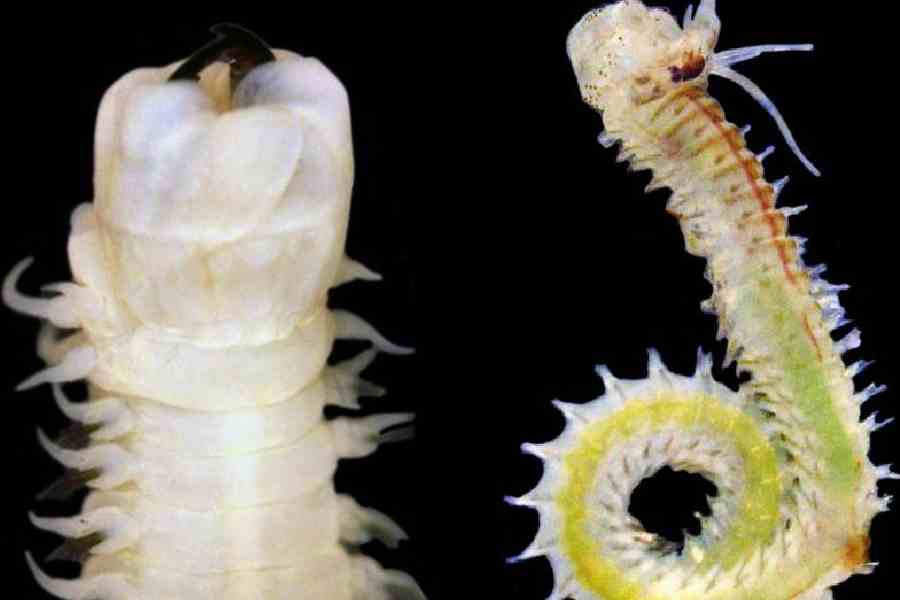
A research team from the city-headquartered Zoological Survey of India (ZSI), in collaboration with international experts, has announced the discovery of two new species of Nereididae worms (polychaetes) from the coastal waters of Bengal.
Nereididae are a family of marine polychaete worms, commonly known as ragworms or clam worms.
These segmented worms are recognised by their long, slender bodies, distinct head with eyes and tentacles, and parapodia — fleshy, paired appendages used for crawling, swimming, and respiration.
The findings, centred in the Digha and Bankiput regions of East Midnapore, highlight the rich yet vulnerable marine biodiversity of the northern Bay of Bengal, a ZSI official said.
The study, titled “Description of two new species of Nereididae (Annelida: Nereididae) from Bengal, India, Bay of Bengal,” was recently published in the peer-reviewed journal Zootaxa. The study detailsthe unique characteristics and habitats of these newly identified marine annelids.
The discovery includes two distinct species, one named for its unique biological traits
and the other in honour of scientific leadership.
The first, Namalycastis solenotognatha, derives its name from the Greek words solenotos (channelled) and gnatha (jaw).
This species features specialised jaws with numerous canals emerging from the pulp cavity. It thrives in extreme environments, including sulfide-rich, malodorous (unpleasant-smelling), and organically enriched mudflats, often found among decomposing mangrove wood and hardened clay.
The second, Nereis dhritiae, is named after Dhriti Banerjee, the first woman director of the ZSI, the country’s oldest taxonomic research organisation. This species was discovered dwelling within wooden dock piles on sandy beaches that are submerged during high tide.
Nereidids are vital to coastal health, playing a critical role in nutrient cycling and sediment aeration. It is a process that infuses air or oxygen directly into the bottom sediments of the water to break down accumulated organic matter and contaminants.
The researchers — including Jyoshna Pradhan, Anil Mohapatra (ZSI), and Tulio F. Villalobos-Guerrero (CICESE, Mexico) — noted that these species were found in areas significantly impacted by human activity and pollution.
“The presence of these species in specialised, highly exposed, and even polluted habitats underscores the resilience of polychaetes,” the team said.
“These worms may serve as vital bio-indicators for monitoring coastal health, though further studies are required to understand their potential for conservation fully,” it said.
“This finding adds a significant chapter to India’s marine inventory and emphasises the urgent need for systematic exploration of the country’s vast coastline. As these habitats face increasing pressure from anthropogenic activities, the discovery of N. solenotognatha and N. dhritiae serves as a reminder of the hidden biodiversity that remains to be protected,” said a ZSI spokesperson.