A young man working for a biriyani chain lost a day’s pay while his brother had to give up his earnings as a chauffeur to attend SIR hearings on Thursday. A mother had to step away from her daughter’s Madhyamik exam timetable for the same reason. They said chief minister Mamata Banerjee’s appearance at the Supreme Court on Wednesday to argue against the way the SIR is being conducted was justified.
They said the Election Commission could have avoided calling people to hearings for a mismatch in the spelling of a name or surname, causing harassment.
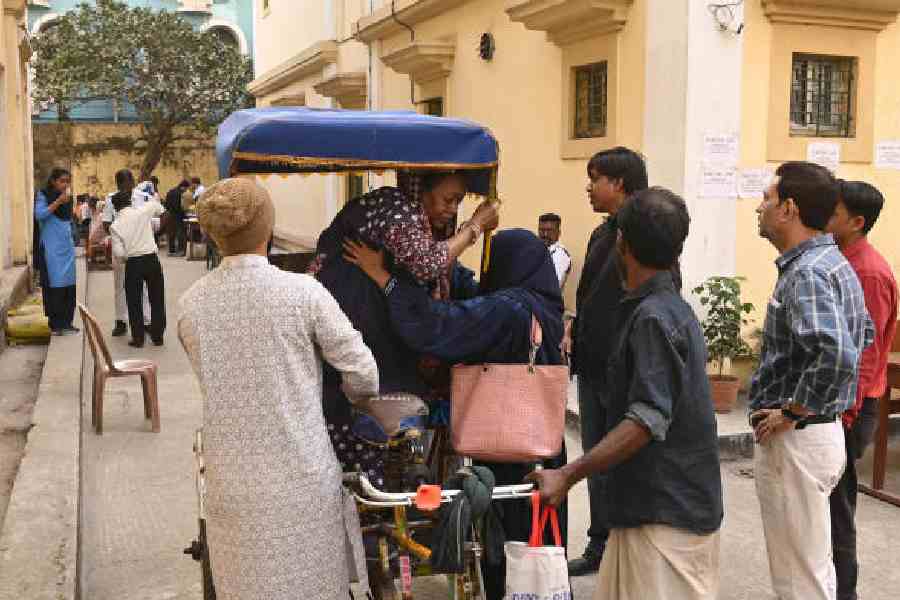
Ruksana Khatun, 55, was hospitalised thrice last year owing to complications arising from her diabetes. On Thursday, she had to come to a SIR hearing centre on Rafi Ahmed Kidwai Road. She struggled to get into the rickshaw that brought her to the centre. Her son, Sheikh Arman Akhtar, 32, bodily lifted her and helped her sit in the rickshaw.
Akhtar felt Mamata’s arguments reflected the reality. “See how my mother struggled to come here. I do not even know why she was called. There are so many like her who had to take the trouble. Mamata Banerjee is the first one to speak up against this harassment,” he said.
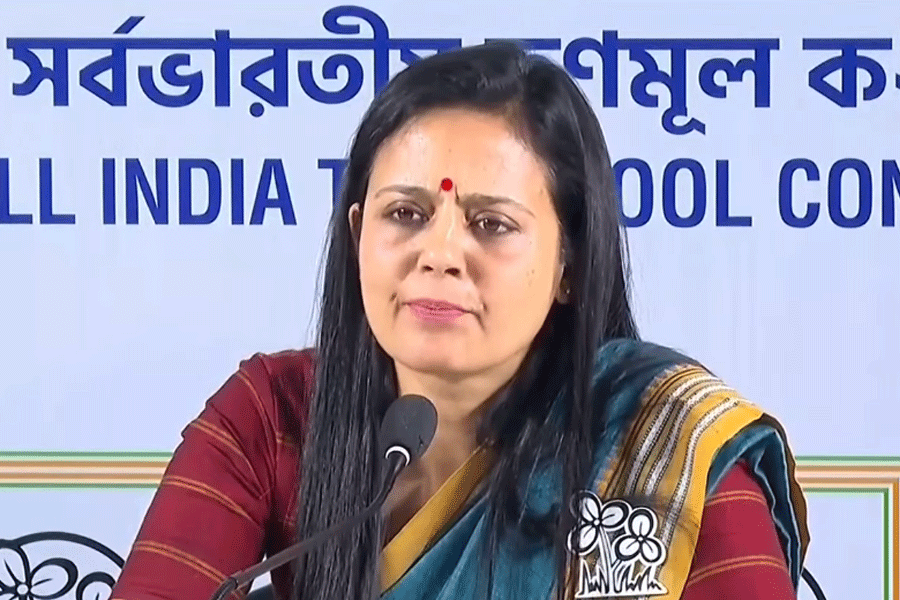
Appearing as petitioner-in-person to argue the “Mamata Banerjee vs ECI” case at the Supreme Court on Wednesday, the chief minister said names of around 58 lakh Bengal voters had been deleted, and over 1.3 crore electors had been put on the “logical discrepancies” list during the ongoing special intensive revision (SIR) exercise.
On Thursday, Mahinder Kanojia, 32, who works for a biriyani chain in Park Circus, was at the Collins Institute on Lenin Sarani to attend a SIR hearing along with his brother Virender, 39, who works as a driver. Both earn only for the days when they work. On Thursday, both of them had to skip work, which meant foregoing a day’s income. “We had to take off from work,” said Virender.
They were asked to attend the hearing because of a mismatch in the spelling of their father’s name between the 2002 electoral roll and the spelling they had written while filling out the enumeration form.
“I think the chief minister was right when she raised the issue of such small spelling changes. Everyone knows we are the same people. People should not have been called to a hearing for such small changes,” said Mahinder.
At the Supreme Court on Wednesday, Mamata flagged the mismatch in names and surnames, and different spellings of the same surname.
“They (EC) point out a mismatch in title and surnames of persons. Suppose a daughter gets married and goes to her in-laws’ house, they are asking why she is using her husband’s name… that is also a mismatch, they say,” Mamata told the bench of Chief Justice of India Surya Kant, Justice Joymalya Bagchi and Justice Vipul M. Pancholi.
The bench agreed with Mamata and senior advocate Shyam Divan, appearing for her, that Bengali surnames such as Tagore, Dutta and Roy could be written differently, and it was no basis for deleting names on the ground of “mismatch”.
At Aliah University’s campus on Rafi Ahmed Kidwai Road, hundreds turned up to attend the hearing. Among them was 37-year-old Sufia Begum, a homemaker. Her daughter is appearing for the Madhyamik examinations.
“Those who work in an office can ask for a day off or at least half a day’s leave. For homemakers like me, there is no leave. My daughter is also writing her Madhyamik this year. It is difficult for me to stay away from home for a few hours at this time,” she said.
“Our chief minister was right when she raised the issue of logical discrepancies,” she said.
In Sufia’s case, too, there is a mismatch in her father’s name between the 2002 list and what she wrote in the enumeration form for the ongoing
SIR.
At many hearing centres, there were only Election Commission officials doing their own work. Hearings had ended, the officials said in multiple centres in north and central Calcutta.
The Commission has told officials to complete hearings by February 6.
The final electoral roll will be published on February 14.