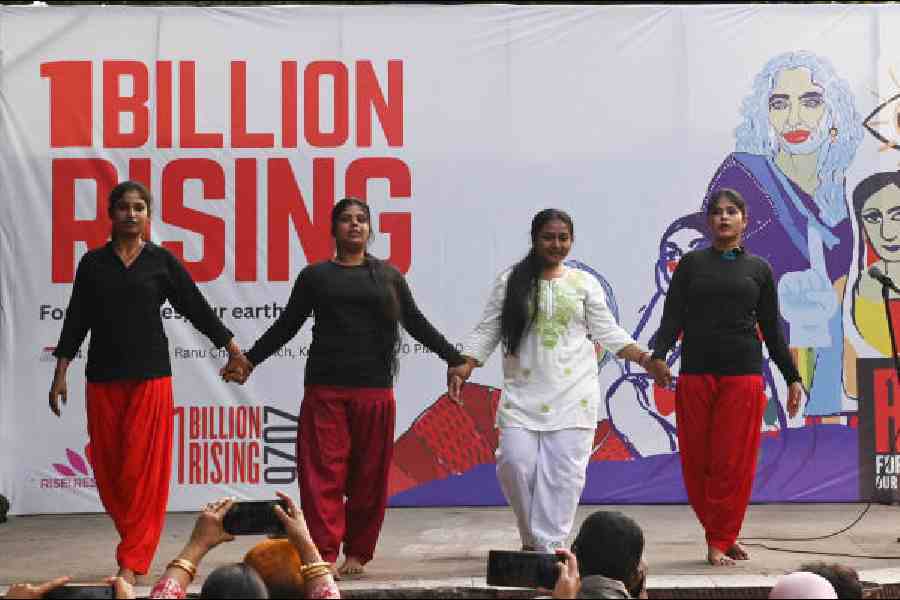
Women rose in solidarity — against injustice, against violence, and for one another.
Through poetry, dance, theatre and other art forms, they asserted their resistance to gender-based violence, rising for their bodies, their dignity and their souls.
The city observed One Billion Rising (OBR) at a programme outside the Academy of Fine Arts on Tuesday, with 15 organisations and hundreds of participants coming together to amplify their voices and demand an end to gender-based violence.
While violence against women has not been eliminated, those behind the movement said it has helped create visibility and awareness around women’s issues and their right to assert themselves.
A 40-year-old survivor of domestic violence shared her story. After enduring abuse in her marital home, she returned to her natal family’s house. Despite paying rent to stay in her own home, she faced further violence from her aunts.
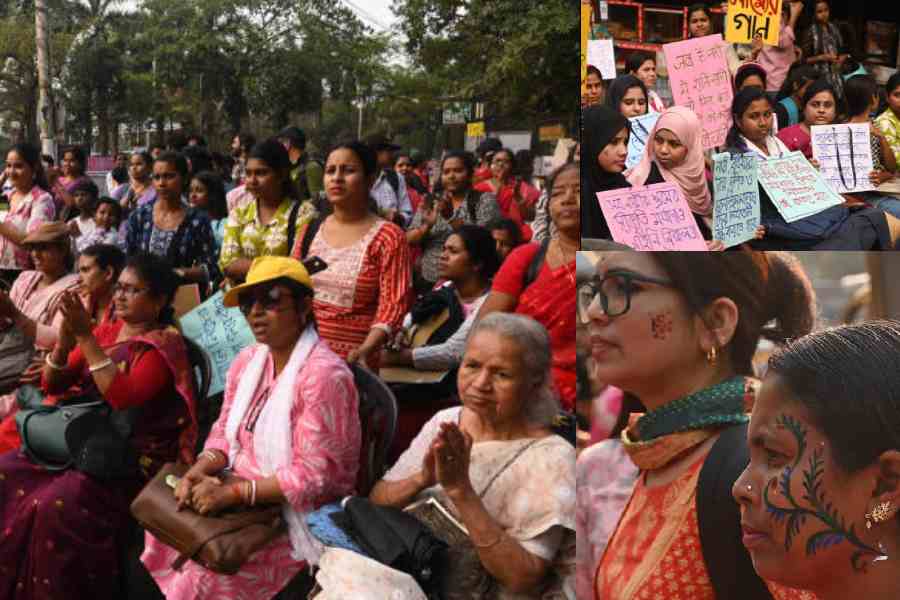
1 Billion Rising programme at Ranu Chaya mancha Bishwarup Dutta
“My father had passed away, and my mother did not have a say. My paternal aunts would torture me,” she said. “I joined a feminist organisation, and today I live in that same house without paying any rent because that house is as much mine as it is theirs.”
Organisations working for women’s rights have witnessed a significant shift, with more women speaking out against abuse.
“Women are increasingly recognising signs of violence that were once normalised. They are talking about it and seeking help much earlier than before,” said Amrita Dasgupta, director of Swayam, a feminist organisation.
“One Billion Rising is about the strength of women. If one billion women are experiencing violence, then one billion of them rise, strike and dance,” she said.
The global movement, initiated in 2012 by feminist activist Eve Ensler, calls for collective action to end violence against women. This year’s theme — “Rise for our bodies, our earth, our future” — underscored the interconnected nature of violence, through caste, class, disability and socio-economic marginalisation. The message was clear: Resistance must be collective because oppression is layered.
Art became both expression and protest at the event.
A group of survivors performed a play asserting a woman’s equal right to space in her natal family after marriage. Their message: if a married man can continue to live in his family home, a woman too has an equal right to live there with dignity.
Another group depicted the realities of online abuse, showing how women are routinely “trolled” for their appearance and behaviour. Violence, they emphasised, is no longer only physical; the virtual world has created new and insidious forms of harm.
“We protested against violence, but the language of our protest is non-violent,” said Sarbari Nag, a coordinator with Lake Gardens Women and Child Development Centre, one of the participating organisations. “Through the arts, we show that women have power, can achieve, and are not lesser than anyone.”
The struggle against patriarchy and its web of injustice remains long. While awareness of physical assault has grown and is more readily recognised, subtler forms of abuse continue quietly.
“There is greater recognition of physical violence,” said Dasgupta. “But psychological, emotional and financial control are still not acknowledged enough.”