Case 1: In a part of Ward 62 of the Kolkata Municipal Corporation that covers Alimuddin Street, nearly 25% of the voters are under adjudication. In a portion of Ward 65, covering parts of Palm Avenue, 29% of voters are under adjudication. Both areas are among the Muslim majority neighbourhoods of Calcutta.
Case 2: Poll panel sources said 78,000 voters were “under adjudication” in south Calcutta. Of them, 56,000 (71%) are from two constituencies — Calcutta Port and Ballygunge — that have a large number of Muslim voters.
Case 3: The Calcutta Port Assembly constituency has 1,79,239 voters in the final SIR rolls. Of them, 32,378 (18%) are “under adjudication”. In contrast, the Rashbehari Assembly constituency with 1,58,955 voters has only 8,157 (5%) “under adjudication”.
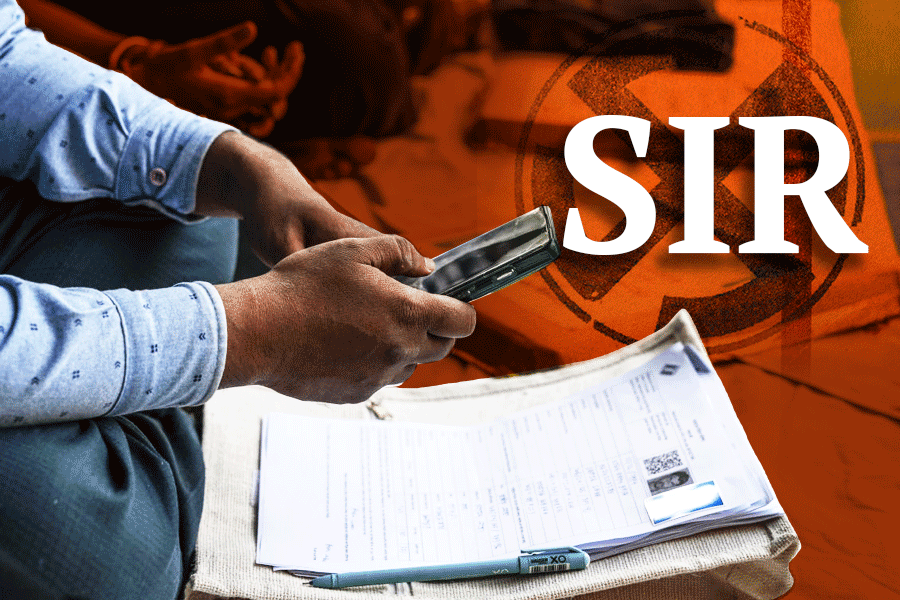
Calcutta: Since the final electoral rolls of SIR 2026 were published on Saturday, BLOs as well as party workers have been busy finding out how many voters in their jurisdiction have been tagged as “under adjudication”.
Once the numbers were added, many alleged that a pattern emerged — a disproportionately higher number of voters in Muslim-majority areas are “under adjudication”.
The state’s chief electoral officer, Manoj Agarwal, said over 60.06 lakh voters
across Bengal were “under adjudication”.
“It is true that wards with a Muslim majority population have an extremely large number of voters under adjudication. The numbers do raise suspicion,” said Debashis Kumar, Trinamool’s south Calcutta district president and MLA from Rashbehari.
Sarfaraz Ali, 40, a resident of Palm Avenue, is “under adjudication”. On Sunday, he visited the polling station to consult the BLO (booth-level officer).
Ali was served a hearing notice, which he attended. “I submitted my school pass certificate, my Aadhaar and voter cards during the hearing. Yet my name has been kept under adjudication,” Ali, baffled at what happened, told
Metro.
The enumeration forms handed to voters at the start of the special intensive revision (SIR) of electoral rolls
listed “matriculation/educational certificate issued by recognised boards/universities” as one of the documents
that voters could submit if they were served hearing
notices.
The fears of those under adjudication are many. “There is no clarity on when my case will be decided. If, during adjudication, my name is removed, to whom will I appeal against the decision? Will there be enough time to appeal and include my name in the voters’ list before the elections?” asked a voter whose name is “under adjudication”.
And if removed, the process of re-entering the electoral rolls might be a long, harassing and humiliating exercise, many fear.
“We have to stand in queues for hours to prove that we were not bogus voters,” said an elector. Those who cannot satisfy the demand for documents may be in for much larger uncertainty.
Firhad Hakim, the MLA from Calcutta Port, the constituency where over 32,000 voters are “under adjudication”, said Muslims often do not use their parents’ surname.
“You will often see that Muslim men do not use their parents’ surname. Muslims do not have surnames, as such. Muslim women also use Begum or Bibi as a surname,” Hakim, also Calcutta’s mayor, said.
“Since the surnames have not matched, they have kept so many Muslims under adjudication. These are cultural issues that those doing the roll revision should have known,” Hakim said.
Calcutta Port is one of the four Assembly constituencies whose SIR processes fell under the district election officer, South Calcutta. The other three constituencies are Ballygunge, Rashbehari and Bhabanipur.
Every district has a district election officer, usually the district magistrate. There is no district magistrate
for Calcutta, but there are two district election officers, one each for north and south
Calcutta.
In Calcutta Port, a constituency with a significant Muslim population, 18% voters are under adjudication. In Ballygunge, also a constituency with a relatively higher Muslim population, over
12% voters are under adjudication.
Over 8% of voters in Bhabanipur are “under adjudication”, while over 5% of voters in Rashbehari are “under adjudication”.
A BLO in Ballygunge, covering a Muslim-majority
area, said 189 of the 650 voters in that part were under adjudication. Another BLO, in neighbouring Chowringhee constituency, covering a Muslim majority neighbourhood, said 161 of 654 voters were “under adjudication” there.
BJP leader Sajal Ghosh said that he suspected pro-Trinamool state government employees were responsible for the skewed balance.
“Trinamool has realised that Muslims will not vote en masse for them. Some will vote for the BJP, some for the CPM-Congress, some for the ISF and some for Humayun Kabir. It should be investigated whether they did this deliberately to keep Muslims out of the voting process,” Ghosh, also a councillor of Ward 50 of the Kolkata Municipal Corporation, said.
“The Supreme Court is now monitoring the matter. Let us wait,” he added.
A source in the poll panel said the cases “under adjudication” were mostly the ones not allowed on the final rolls by micro-observers and roll observers.
“It is not that these cases could not be decided because of a lack of time. The electoral registration officers (EROs) and assistant EROs deemed that these voters should be on the list, but the micro-observers and roll observers returned these cases,” said the source.
The Election Commission approved engaging central government employees — working in banks and PSUs — as electoral roll micro-observers in Bengal. Micro-observers verified the documents submitted by voters called for hearings.
Roll observers are senior government officers, like IAS officers.
EROs and assistant EROs are primarily state government employees.
Mamata Banerjee had earlier alleged that micro observers were being used to manipulate the revision exercise.