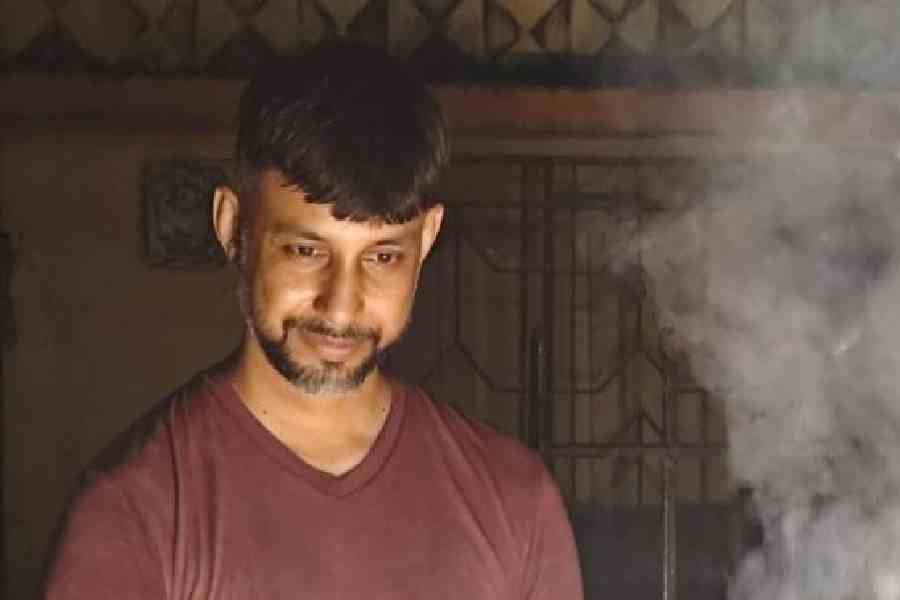
Actor and theatre activist Joyraj Bhattacharjee, 46, was among many injured during a police lathi-charge before the eviction drive at Jadavpur railway station.
He suffered a deep cut on his right forehead after a police stick struck him. A video he uploaded on social media showed him bleeding profusely.
Bhattacharjee has directed Rabindranath Tagore’s Raktakarabi (Red Oleanders), one of the most powerful critiques of systemic oppression. He has acted in William Shakespeare’s A Midsummer Night’s Dream, directed by award-winning British theatre director Tim Supple for the Royal Shakespeare Company. Theatre has taken him to
the UK, the US, Australia and elsewhere.
Bhattacharjee also plays the Creature in an adaptation of Mary Shelley’s Frankenstein. On Sunday evening, hours before the eviction drive, he was at a south Calcutta
auditorium where Frankenstein was staged. Bhattacharjee recounts the night for Metro.
Soon after the play ended, I learned about the impending eviction drive. From the auditorium, I rushed to Jadavpur along with some colleagues and friends. By 10.30pm, we were near Platform No. 4.
A huge police contingent was already there. Many of them were armed with automatic guns. Others had fibre sticks and shields. They were in riot gear. I could see two payloaders.
A group of protesters stood in front of the force. Led by (CPM leaders) Sujan Chakraborty and Srijan Bhattacharya, the protesters formed a human chain to block the payloaders’ path. For a long time, they urged the officers to defer the eviction drive until Monday, when the high court reopens after the summer recess. They sought time to file an appeal against the eviction, citing the loss of livelihood for many.
But the police weren’t having any of it. They started pushing the protesters back.
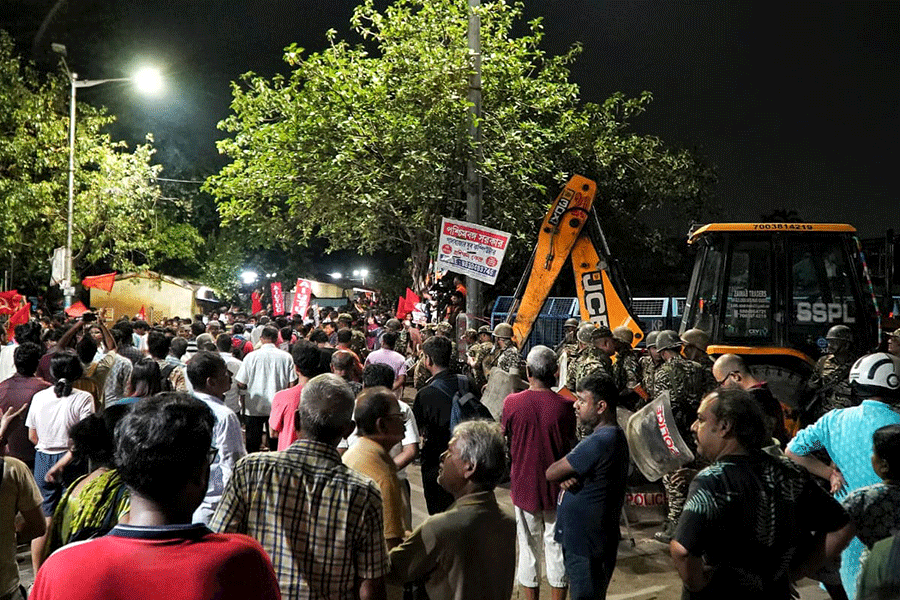
The crowd resisted, and the batons came out. The police started beating the protesters. Even women were not spared. I saw a policeman charging at Sujan-da. I leapt forward and tried to shield him. The stick landed on my forehead. I felt blood oozing from the wound. It soaked my shirt.
As I looked for cover, I was led to a nearby lane by fellow agitators. There, I saw another protester, much younger, who had also been hit on the head. He had lost much more
blood than I had and was lying listless.
We requested the police for an ambulance to take him to a hospital. A policeman refused. In Hindi, he said: “Kyun aaye ho idhar? Jo hua achha hua (Why did you come here? Whatever happened, suits you).”
I have faced police brutality in the past. I participated in the Kamduni protests and the Singur land agitation. But this time, the police’s attitude was different. During a baton charge, the police usually strike agitators below the waist. Outside Jadavpur station, they were aiming for the head.
We went to KPC Hospital, not far away. The younger protester could barely walk. He had multiple stitches. I underwent a CT scan. The results were not alarming. My wound was dressed, and I was kept under observation for a while. I booked an app cab to go home around 5.30am.