The ICSE council is planning an overhaul of the curriculum from pre-school to Class VIII, bringing in real-life experiences into the classroom. The revamped curriculum is expected to be rolled out in phases from the 2026-27 academic year.
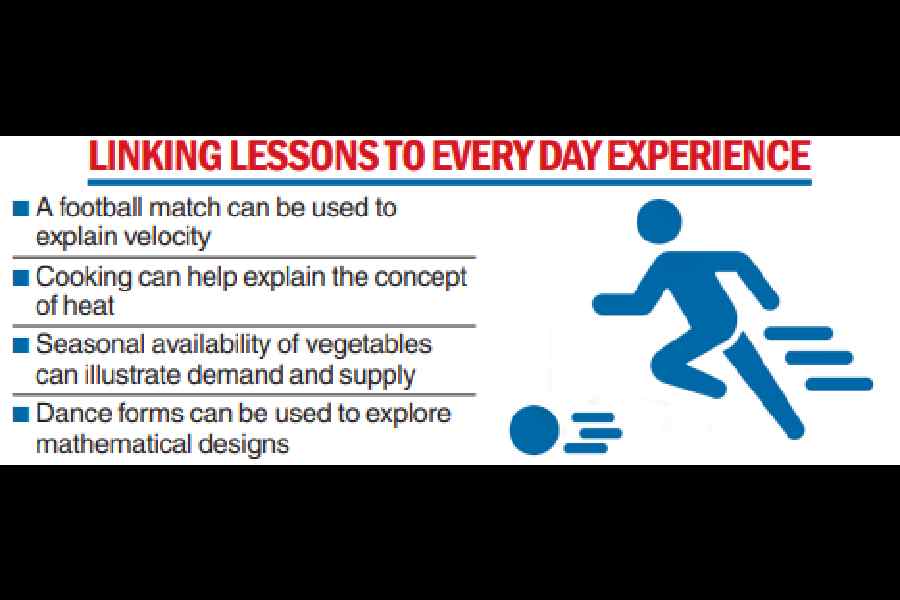
Under the proposed framework, a football lesson could double up as a class on velocity for students in Classes VI or VII, while a kitchen garden might serve as a laboratory for understanding demand and supply, biology concepts or even the properties of heat.
The aim is to move away from rote learning and exam anxiety towards joyful, meaningful education, the Council for the Indian School Certificate Examinations (CISCE) said.
In a circular issued to schools on Wednesday, CISCE chief executive and secretary Joseph Emmanuel described classrooms of the future as “dynamic spaces where curiosity is nurtured,” teachers as facilitators rather than instructors, and learners as individuals who grow “academically, socially, and emotionally in age-appropriate ways”.
“The difference between modern-day education and what we practice lies in methodology,” Emmanuel told Metro. “In science and mathematics, the content will almost remain the same, but the way we teach has to change. Learning needs to be more experiential, joyful, and application-oriented.”
A feature of the new approach will be the use of locally available resources for teaching and learning. Emmanuel cited the example of a kitchen garden, which could be used to teach biology, mathematics and economics. “The prices of vegetables and their seasonal availability can help students understand the concept of demand and supply,” he said.
He also described the kitchen as “a laboratory available at every home”, where children can learn through observation and participation — from procurement and budgeting to understanding heat through cooking.
For younger students, learning will be driven by storytelling and integrated with art, music and dance. “There are mathematical designs in dance forms,” Emmanuel said.
The revised curriculum will place greater emphasis on project work and participation in a range of activities to make learning more relevant and engaging.
“There should be no exam fear,” Emmanuel said. “At the same time, children should learn meaningfully, develop understanding, and acquire application-oriented skills instead of relying on rote learning.”
Earlier this month, Metro reported the council’s intent to link classroom learning with everyday life, when Emmanuel addressed around 150 principals of Anglo-Indian schools at a national heads’ meet. At the time, he had stressed the need to change teaching approaches, connect learning with real-worldcontexts and prioritise skill development.
According to the circular, “CISCE is developing a new competency-based curriculum transactional plan for the foundational, preparatoryand middle-school stages, in alignment with the National Curriculum Framework (NCF) 2023... National Education Policy (NEP) 2020, and global best practices.”
“The curriculum transaction plan is rooted in the belief that learning at all stages must be joyful, engaging, and activity-based, enabling children to construct understanding through experience, inquiry, and reflection,” Emmanuel said in the circular.
To prepare for the transition, CISCE has asked principals and teachers to complete a needs analysis form, assessing areas that require strengthening and evaluating how prepared schools and learners are for the change. The deadline for submissions is January 31.
The curriculum transactional plan will cover pre-school through Class VIII. Schools chosen for the first phase will reflect a balanced representation of “India’s socio-cultural and demographic variations”, the council said. “The success of this initiative rests significantly on your leadership and active engagement,” it told principals. “We seek your support in preparing your school communities... encouraging professional dialogue, and fostering a culture that embraces innovation while remaining grounded in sound pedagogicalprinciples.”