Passengers of IndiGo’s Bagdogra-Calcutta flight 6E 6135 on Sunday evening were left confused when their plane was delayed due to “bad weather”, despite no fog at
either Calcutta or Bagdogra.
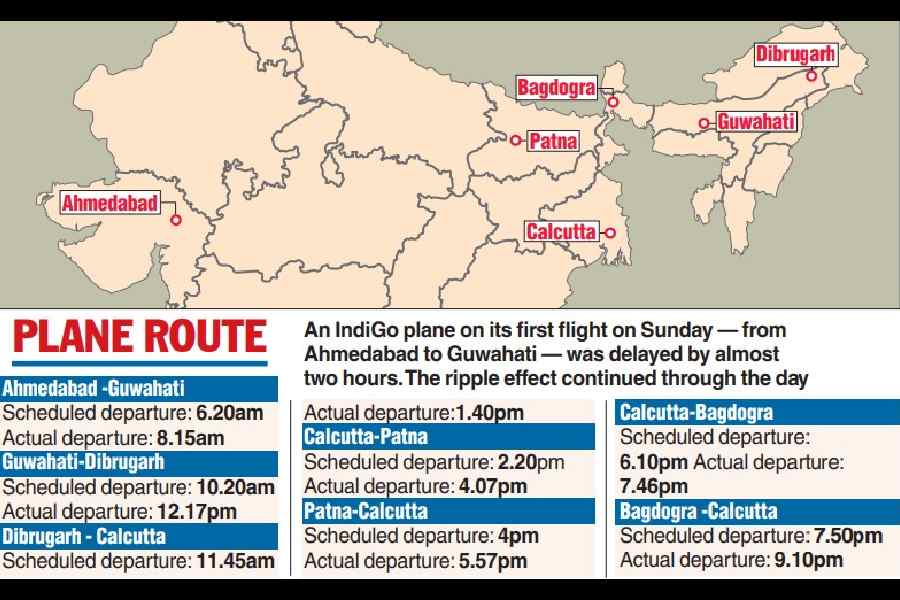
The flight, scheduled to depart Bagdogra at 7.50pm, finally took off at 9.10pm. The delay at night was allegedly caused by fog in Guwahati in the morning.
Sequential delays
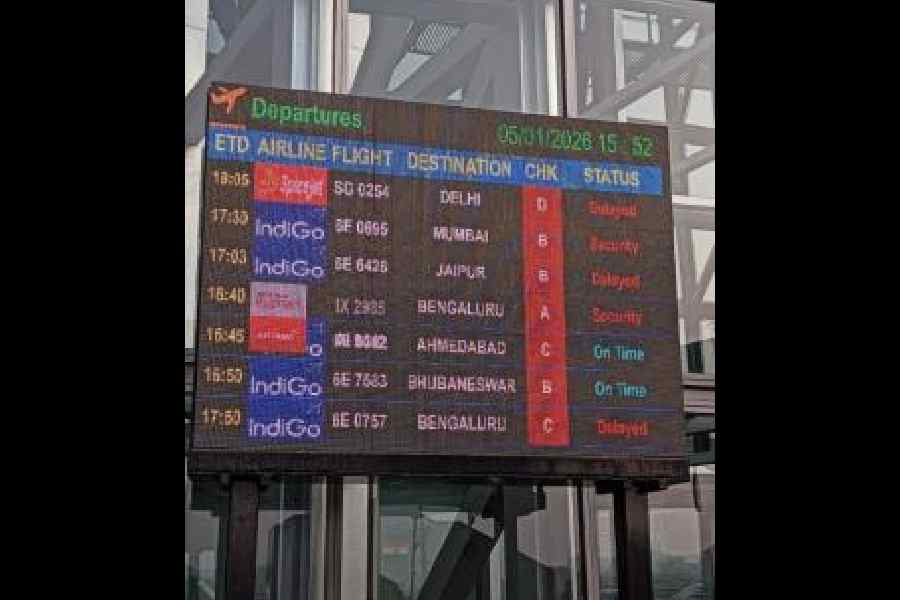
Calcutta airport has yet to experience fog-related poor visibility this season. Yet, several flights in and out of the city have been disrupted due to “sequential delays”.
A sequential delay occurs when the delay of an aircraft’s first flight of the day carries over to all subsequent flights operated by the same plane.
Airline and airport sources said such delays are common during the fog season, affecting passengers even if they are not flying to or from fog-affected airports.
In this case, the IndiGo plane flying to Calcutta was delayed by almost two hours while operating its first flight of the day from Ahmedabad to Guwahati. The delay then continued across multiple sectors, including Dibrugarh, Calcutta, Patna, and finally Bagdogra, sources said.
“This is happening across the networks of all airlines. However, since IndiGo has the largest network, the impact is bigger,” said a Calcutta airport official.
Several flights in and out of Calcutta were delayed on Monday due to this chain reaction.
How it happens
“When an aircraft hops to multiple destinations and gets delayed on the first flight, a chain reaction of delays starts,” the official said.
The typical turnaround time for an IndiGo aircraft at domestic airports is 30-40 minutes, and about an hour for international flights. “The delay at each domestic stop can be reduced by 5-10 minutes, but that is often not enough to make up for the initial delay,” said a source.
“Pilots can speed up cockpit procedures, but only to a point, as exceeding that could compromise safety,” the official said.
Another aircraft could be deployed to replace the delayed one, but the tight schedules often make this impossible.
Operational teams usually calculate which rotation will cause the least average delay, though factors such as airport restrictions, sunset landing limits can complicate redeployment. “There’s also the flight duty time limitations,” the airline official said.
International flights, with longer turnaround windows, allow more flexibility to reduce sequential delays.
Airline response
“The adverse weather conditions during winter, like fog and smog, especially in the north Indian cities, lead to poor visibility, making it difficult for pilots to land or take off safely, impacting overall flight schedules,” IndiGo said.
“Strong wind bands, infrastructure limitations, airport congestion, and navigational challenges add to operational disruptions. With the India Meteorological Department (IMD) forecasting harsher winters this year, the operational challenges are expected to be tougher this time,” it said.
“Given the extensive presence across India, the impact is relatively bigger on IndiGo’s operations. Furthermore, it becomes more complex to manage resources to match the infrastructure capabilities and fog conditions across a variety of airports. Any significant disruption has the potential to have a cascading effect across the nationwide network,” the airline added.
Air India said most of its aircraft and pilots are compliant with CAT III Instrument Landing Systems (ILS), yet delays still occur.
At the start of the fog season, Air India activates its annual Fog Care initiative to minimise passenger inconvenience.
Under the initiative, flights likely to be affected are identified in advance based on forecasts, and passengers are alerted about possible disruptions.
“The northern parts of India, including Air India’s primary hub Delhi, experience low visibility due to dense fog with a potential to have a cascading impact on flight schedule across the network,” Air India said.