Calcutta University is struggling to implement the National Education Policy (NEP) at the postgraduate level due to the shortage of teachers and lack of funds, the vice-chancellor of the university said.
CU vice-chancellor Ashutosh Ghosh raised the issue during his address at the annual convocation on Monday.
“Since the policy mandates the implementation of an exhaustive programme, the shortage of faculty and funds is having an adverse effect,” the VC later told Metro.
“The university is gradually addressing the broader mandate of the NEP, which is multidisciplinary learning, digital education, internationalisation, research promotion and institutional autonomy,” he said in his address at the centenary auditorium of the university’s College Street campus.
“We must acknowledge that the university is facing practical challenges, including the need to fill vacant faculty positions, strengthen funding, and forge effective coordination across the university campuses,” said the VC.
“These are challenges we are facing with determination in close cooperation with the state and central governments,” he added.
The VC flagged the issue of inadequate faculty positions days after the Calcutta University Teachers’ Association staged a protest, alleging that over 57% of the university’s faculty positions remain vacant.
The increasing vacancies have hindered class instruction, teachers said during the protest.
IIT Kharagpur director Suman Chakraborty, who delivered the convocation address, said in his speech that even in this era of AI, there is no alternative to fundamental learning, which equips a student with the skills to ask questions.
“The spirit of asking questions lies at the heart of any great discovery,” Chakraborty said.
Sanatan Chattopadhyay, the president of the Calcutta University Teachers’ Association, who led the protest assembly on March 19, said that out of the 883 teaching positions, the university has only 383 teachers.
“With only about 43% of positions filled, it is not possible to run a postgraduate programme that has become more exhaustive, with
a more research-intensive component and a module-based curriculum coming into force under the National Education Policy,” said Chattopadhyay.
He said some departments, such as applied mathematics, physics, and chemistry, have nine, 14, and 19 teachers against sanctioned posts of 25, 25, and 47, respectively.
The poor faculty strength is also affecting the four-year BTech programme run by the university at the undergraduate level.
Some of the departments, like computer science, engineering and radio physics and engineering, have 6 and 22 teachers against the sanctioned post of 16 and 42, respectively.
The VC said they are aware of the challenges which he referred to in his address.
“Apart from teachers, we need funds because the curriculum has become research-intensive. Research requires constant updating. So, we are trying to source funds from wherever possible. We are reaching out to funding agencies and former students,” VC Ghosh said.
When Ghosh was appointed as the full-term VC in late October last year, he said that the filling of the vacant teaching positions would be one of his priority areas.
Resource strain
“There are some reservation issues for which we are in touch with the backward class welfare department. We hope to advertise the posts after the elections are over in May,” said VC Ghosh.
IIT Kharagpur director said in his address that AI is reshaping science, medicine, economics, governance, and even creativity itself.
“Machines today can analyse billions of data points in seconds. And yet, there is something they cannot do. AI can generate answers — but it cannot generate the deepest questions. Those still arise from the restless urge to understand what is not yet known,” director Chakraborty said.
“The future belongs to human minds courageous enough to ask the questions that machines cannot even imagine,” he added.
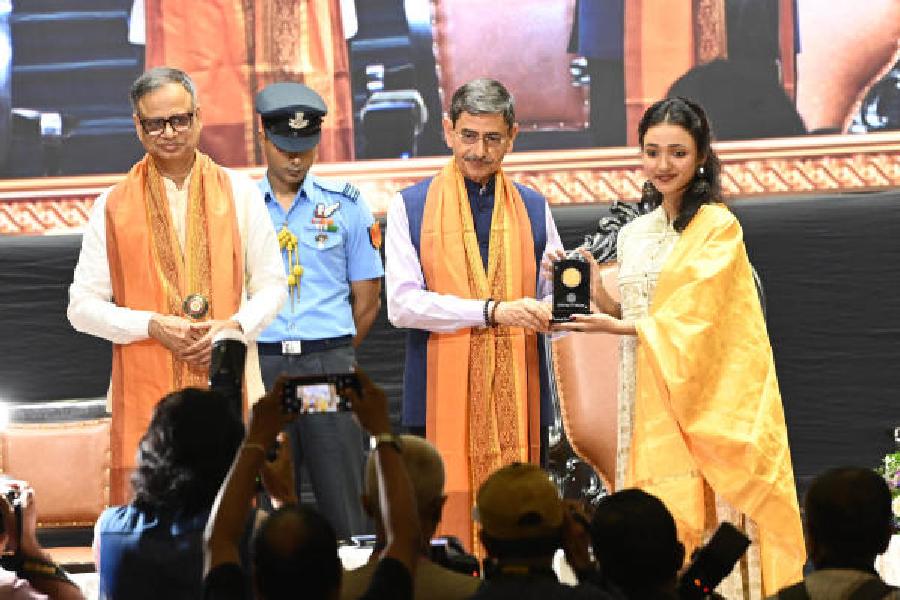
R.N. Ravi, the governor, awarded degree certificates to 1,007 PhD students at the convocation.