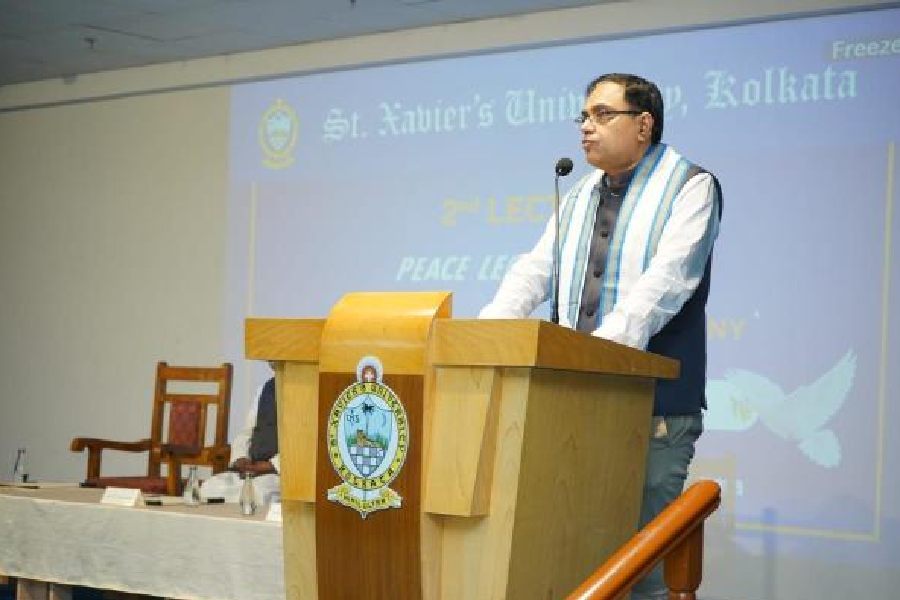
The IIT Kharagpur director said at a lecture at St Xavier’s University that although artificial intelligence enables policymakers to make decisions instantly, such decisions must be vetted by “ethical judgment that requires deliberation”.
Suman Chakraborty was addressing a medal-awarding ceremony for graduating students at the university in New Town on Monday. He delivered the lecture on the topic — Ethical leadership in public governance.
Chakraborty said AI was already influencing elections, shaping access to welfare and determining patterns of policing. “If governance becomes algorithmic, then ethics must become intrinsic to the design of those systems. Otherwise, we risk automating injustice at a scale never seen before,” Chakraborty told his young audience.
The IIT director said technology was concentrating power in “unprecedented” ways, as governments can monitor, predict, and intervene at scale.
“But who monitors the monitors? Ethical leadership begins precisely where unchecked power ends,” Chakraborty said.
According to him, radical accountability, transparency by design, the courage to dissent and human intelligence are not optional virtues anymore.
He said they were “structural necessities” because they constitute principles that must guide ethical leadership in the emerging world.
The university invited the IIT director to hand over medals to students who registered outstanding performances.
Chakraborty told Metro: “At a time when AI is so dominant, we need to deliberate on how we can change our approach. We need to exercise
caution. AI enables us to make decisions almost instantaneously, but ethical judgement requires deliberation.
“Otherwise, we will just become slaves to AI tools.”
The IIT director told students that at a time
when data is abundant, there is a need “to interrogate data”.
“Do not worship it. Behind every dataset lies a bias, a blind spot, or a boundary you must understand,” Chakraborty told students.
The IIT director sounded a note of caution on data at a time when institutions are being accused of manipulating data and publishing fudged numbers in an attempt to build a narrative that is more palatable.
During the recent special intensive revision drive in Bengal, there were allegations of unchecked and biased application of AI in drawing up the electoral rolls ahead of the Assembly polls.
The IIT director said there was also a need to “institutionalise dissent”.
“Build systems where questioning is not punished but encouraged, because silence is often the first symptom of ethical failure. Also, align innovation with inclusion,” Chakraborty told the students.
“If your technology excludes, discriminates, or marginalises, it is not progressive — it is regression in disguise,” he reminded students.
Father Felix Raj, the vice-chancellor of the university, said there must be checks and balances in the use of AI.
“AI can only be an instrument to help you. AI cannot take over. It can be used to make things more accurate, sharper, and faster,” he said.